
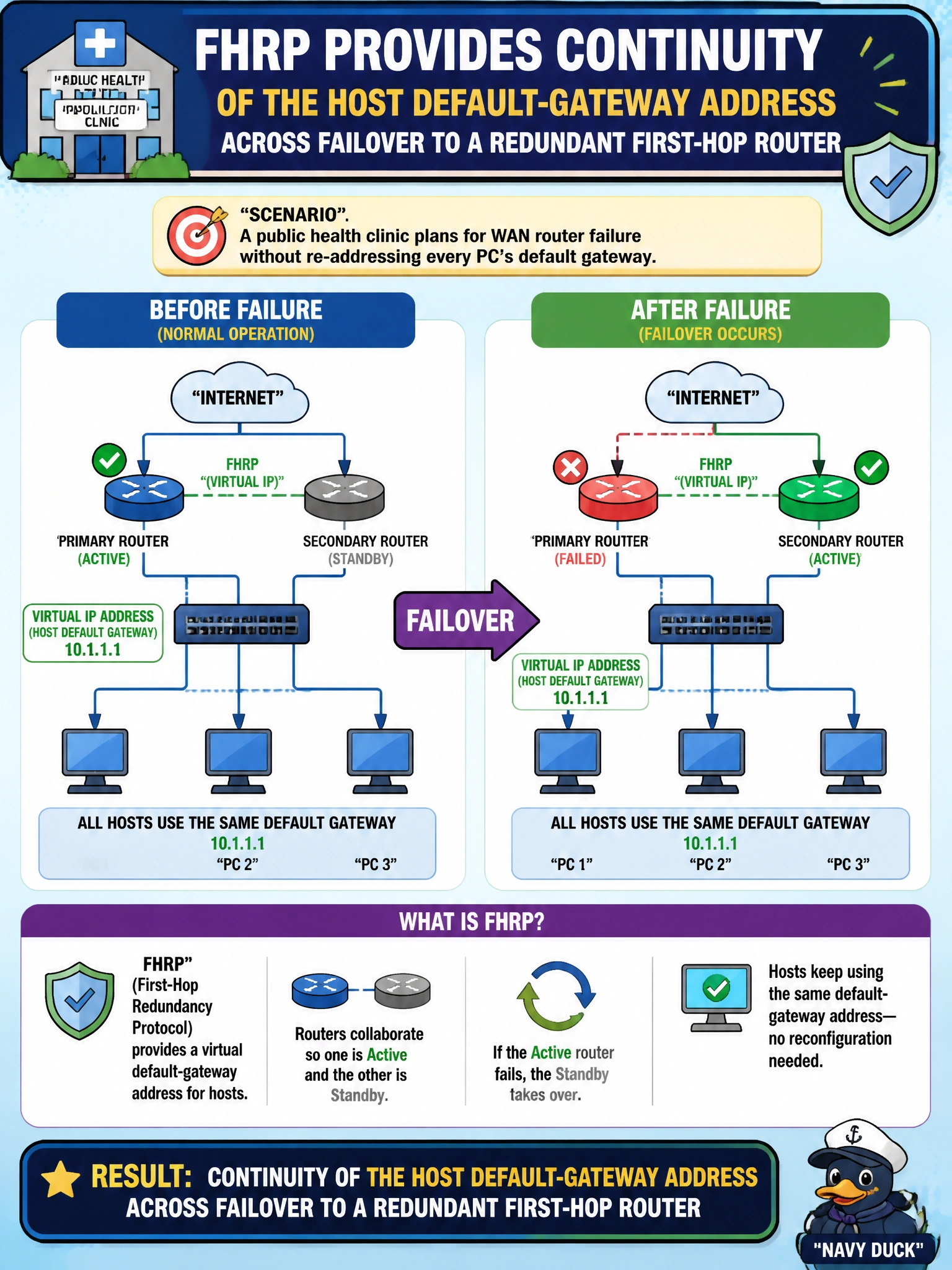
A public health clinic plans for WAN router failure without re-addressing every PC’s default gateway. What does FHRP provide in that situation?
Select an answer to reveal the explanation.
Short Explanation
When the primary WAN router takes a nap, clinic PCs should not need a desk-by-desk gateway rewrite. FHRP keeps the same default-gateway address alive on the standby. That is host continuity, not a VLAN demolition project.
Full Explanation
A public-health clinic planning for WAN router failure without re-addressing every PC’s default gateway needs continuity of that gateway address. FHRP provides a virtual first-hop IP that remains the hosts’ configured gateway while forwarding moves to a redundant router. Endpoints keep their DHCP or static gateway setting; only the router owning the VIP changes. That host-facing continuity is the operational value during WAN first-hop failure.
Automatic conversion of all host routes into BGP path attributes fails by concept: FHRP does not rewrite host routes into BGP. Elimination of VLANs so every clinic PC shares one collision domain fails by concept: FHRP runs on a subnet/VLAN; it does not require flattening Layer-2 design. Replacement of DHCP with manual addressing whenever the primary WAN router reloads fails by concept: FHRP exists precisely so mass re-addressing is unnecessary across failover.
Exam caveat: FHRP failover continuity assumes hosts already point at the VIP—not at unique physical router IPs. Operational check: ensure clinic PCs use the FHRP virtual gateway, simulate primary WAN-router failure, and confirm sessions recover (or new flows succeed) without changing host gateway configuration.