
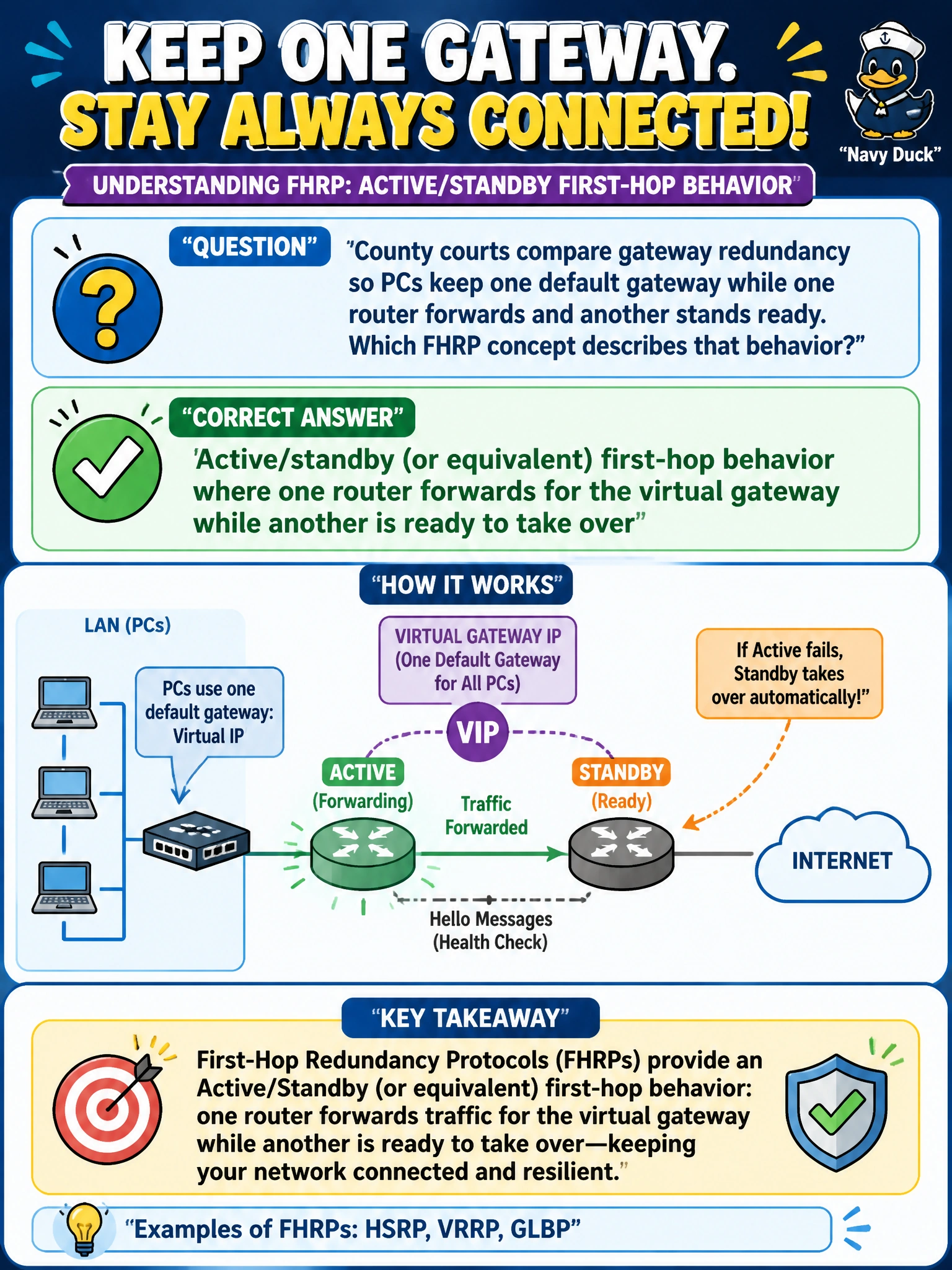
County courts compare gateway redundancy so PCs keep one default gateway while one router forwards and another stands ready. Which FHRP concept describes that behavior?
Select an answer to reveal the explanation.
Short Explanation
Picture one judge’s gavel (the active gateway) and a backup judge waiting—if the first steps out, the standby picks up the same virtual gateway role. Hosts still dial one address. That active/standby idea is the FHRP story courts need, not BGP confederations.
Full Explanation
County courts comparing gateway redundancy so PCs keep one default gateway while one router forwards and another stands ready are describing active/standby (or equivalent) first-hop behavior. In that FHRP model, one router is active (or master) for the virtual gateway and forwards host traffic, while the standby monitors and takes over the virtual IP role if the active fails. Hosts retain a single gateway address through the transition.
Equal-cost OSPF load sharing of every host ARP entry across all VLANs without a VIP fails by concept: OSPF ECMP is router-to-router path selection, not a host first-hop VIP service, and ARP entries are not “load-shared” as a substitute for FHRP. Mandatory GLBP on every access port before any VLAN can have a default gateway fails by concept: FHRP is configured on Layer-3 gateway interfaces for a subnet, not mandated per access port, and other FHRPs can satisfy active/standby needs. Using BGP confederations as the only supported campus first-hop method fails by concept: confederations are BGP scaling tools, not LAN gateway redundancy.
Exam caveat: know the active/standby idea conceptually even when vendor feature names (HSRP/VRRP/GLBP) differ on the exam. Operational check: verify which courts router is active for the VIP, force failover, and confirm the standby becomes active while PCs still use the same default-gateway address.