
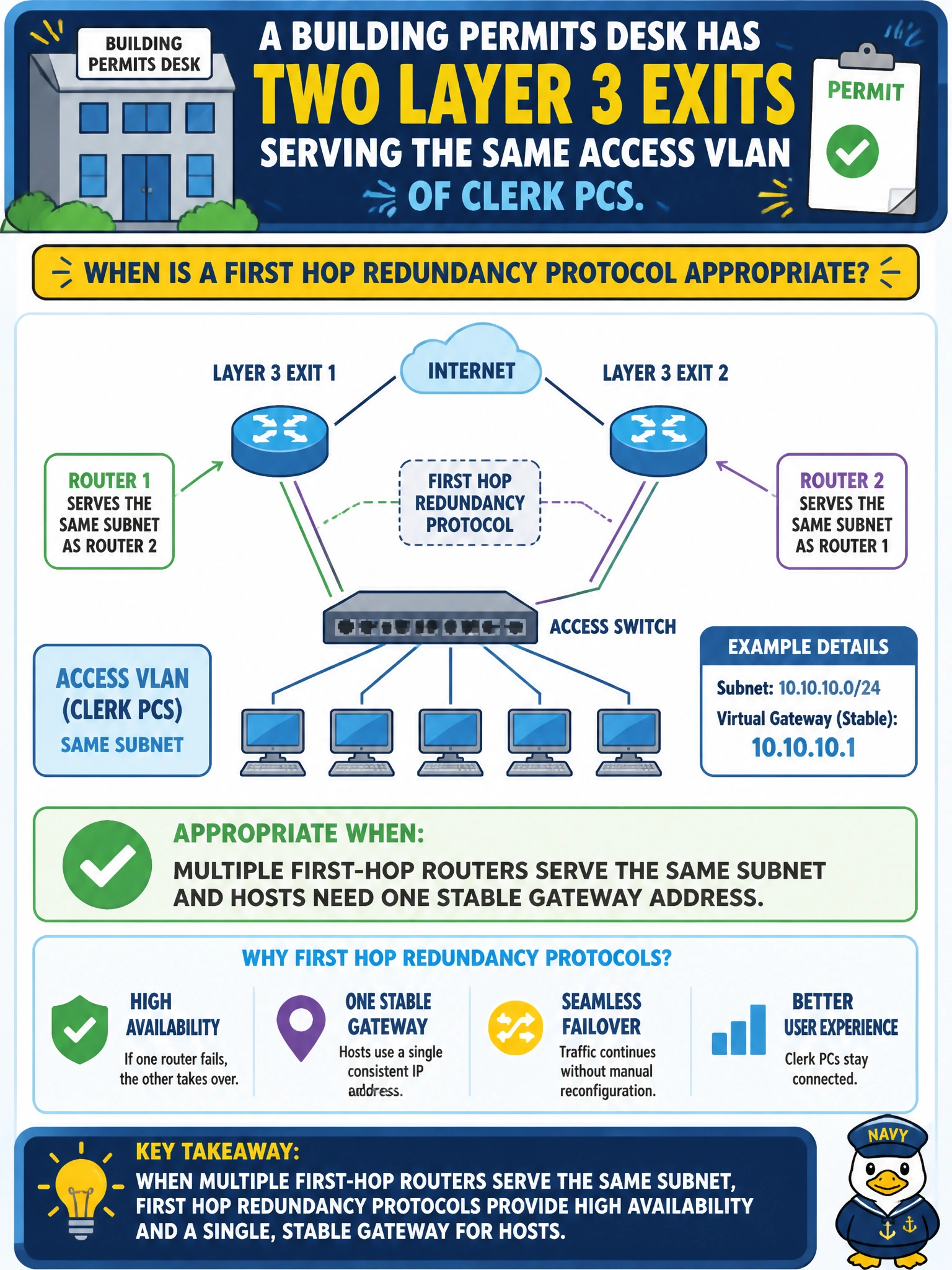
A building permits desk has two Layer 3 exits serving the same access VLAN of clerk PCs. When is a first hop redundancy protocol appropriate?
Select an answer to reveal the explanation.
Short Explanation
With two Layer 3 exits on your permits VLAN, you have the classic FHRP setup: multiple first-hop routers, one stable gateway address for your PCs. A single router has no backup to fail over to, and FHRP can coexist with OSPF. Match the tool to multiple first hops on the same subnet.
Full Explanation
A building-permits desk with two Layer 3 exits on the same access VLAN of clerk PCs is a classic FHRP use case: multiple first-hop routers serve one subnet, and hosts need one stable gateway address. FHRP coordinates a virtual IP for gateway redundancy, so operators need not split hosts across separate gateway addresses. The claim that FHRP is appropriate only when a VLAN has a single router and no redundant path exists fails because a lone first hop has nothing to fail over to; FHRP needs multiple gateways. The claim that OSPF must be removed and every route made static fails because FHRP can coexist with OSPF: gateway redundancy and dynamic routing solve different problems. The claim that FHRP is only for wireless controllers without Ethernet uplinks fails because it is also common on wired access VLANs with dual Layer 3 exits. Exam caveat: multiple routers serving hosts on one subnet suggests FHRP, while routing between sites calls for an IGP or EGP. Practical check: confirm both permits-desk gateways share the VLAN subnet, configure an FHRP virtual IP as the DHCP default gateway, and test failover without changing clerk PC settings.