
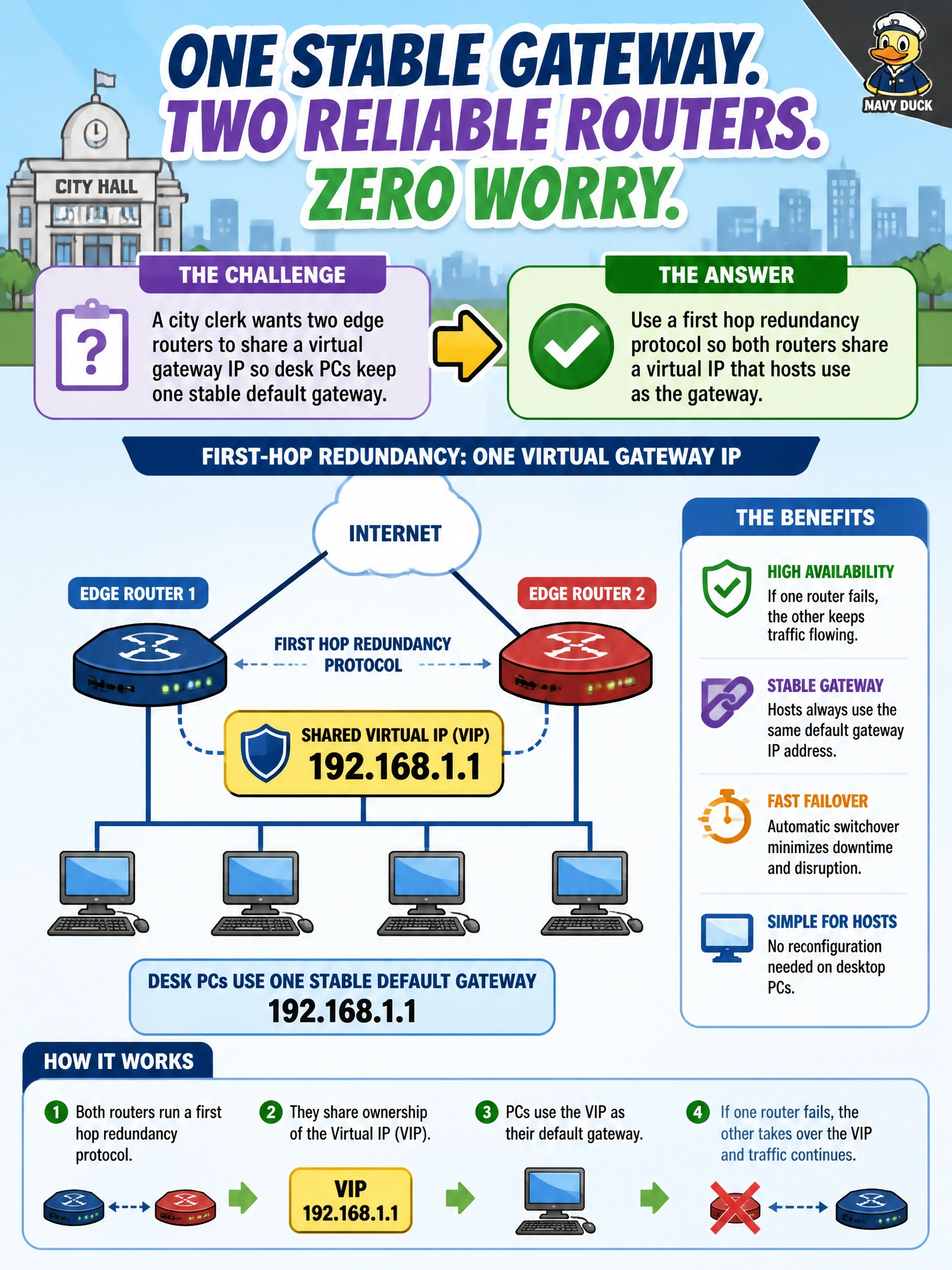
A city clerk wants two edge routers to share a virtual gateway IP so desk PCs keep one stable default gateway. Which approach matches that first-hop redundancy purpose?
Select an answer to reveal the explanation.
Short Explanation
Give every clerk PC one VIP gateway and let FHRP make two routers share that address—like two firefighters sharing one duty phone number. Splitting PCs across different gateways without a VIP leaves you with messy failover. That is exactly what first-hop redundancy is for.
Full Explanation
A city clerk wanting two edge routers to share a virtual gateway IP so desk PCs keep one stable default gateway is describing first-hop redundancy. An FHRP (such as HSRP, VRRP, or GLBP at concept level) lets both routers share a virtual IP that hosts configure as their gateway while one router forwards and another stands ready. Hosts keep a single gateway address across router failure or maintenance—the core purpose of FHRP on municipal access VLANs.
Assigning half the PCs to router A and half to router B with no shared virtual address fails by concept: that static split creates two failure domains and forces gateway re-addressing or outages for half the desks when one router dies. Replacing default gateways with proxy ARP only on the core switch management VRF fails by concept: proxy ARP is not a structured first-hop redundancy protocol for user VLANs and does not provide coordinated VIP failover. Disabling IP on both edge routers and bridging all VLANs into one flat Layer-2 domain fails by concept: it removes Layer-3 gateways entirely and enlarges the failure/broadcast domain.
Exam caveat: FHRP protects the host default gateway on a subnet; it does not replace dynamic routing between networks. Operational check: configure an FHRP VIP on both clerk-edge routers for the access VLAN, point PCs at that VIP, fail one router in a test window, and confirm hosts keep the same gateway IP with continued forwarding.