
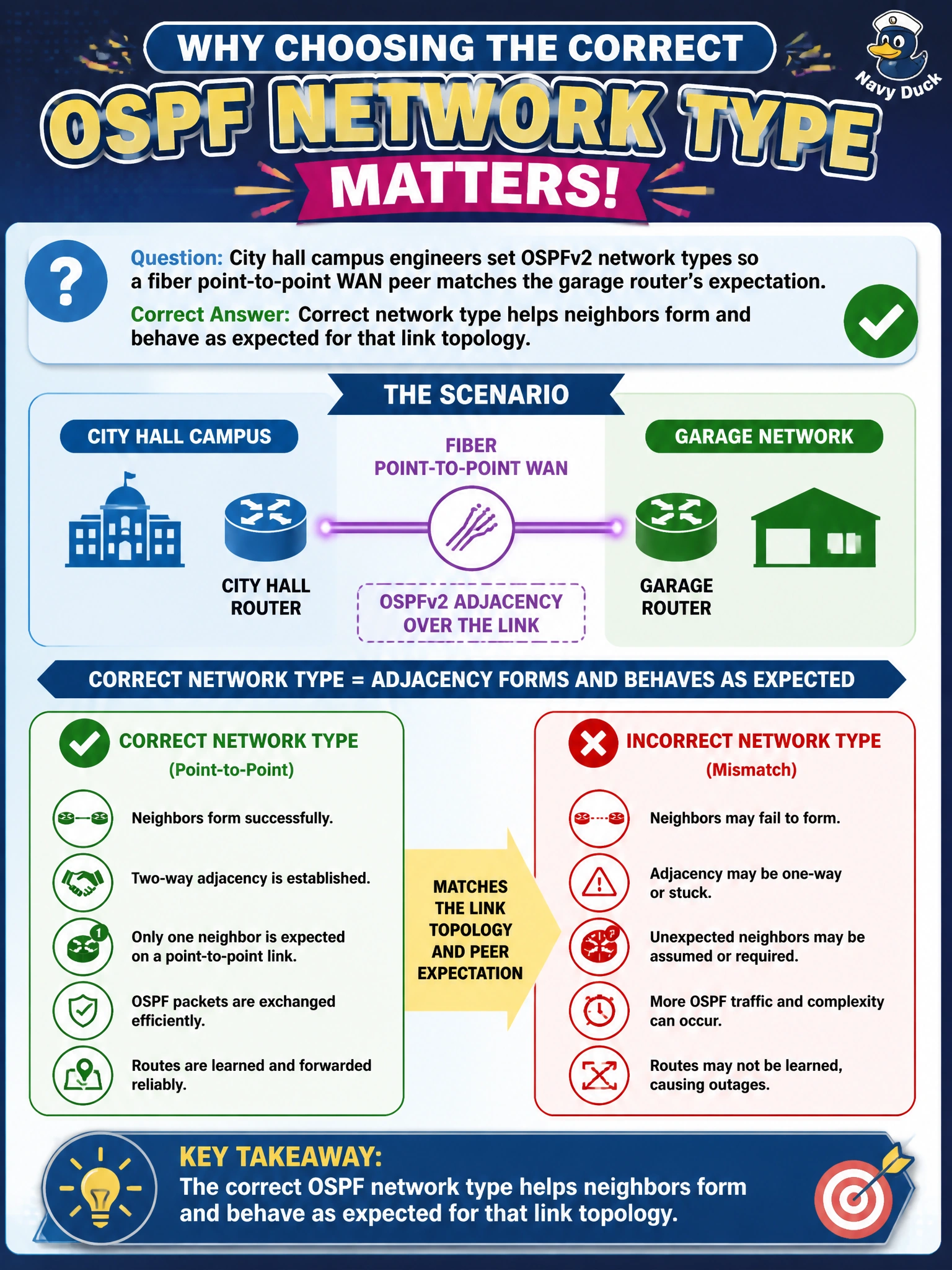
City hall campus engineers set OSPFv2 network types so a fiber point-to-point WAN peer matches the garage router’s expectation. Why does choosing the correct OSPF network type matter?
Select an answer to reveal the explanation.
Short Explanation
If one side thinks the link is a party-line Ethernet and the other thinks it is a quiet two-router hop, OSPF gets confused. Matching network type to the real topology helps city hall and the garage form neighbors the way you expect. Area IDs still have to match too—network type is not a free pass.
Full Explanation
City-hall campus engineers must set OSPFv2 network types so a fiber point-to-point WAN peer matches the garage router’s expectation because network type shapes Hello timing assumptions, whether DR/BDR election occurs, and how adjacency is formed. Aligning type with the real topology (point-to-point on a dedicated two-router fiber, broadcast on multi-access Ethernet) helps neighbors form and behave as designed. Mismatched types are a frequent reason municipal WAN peers stall or elect unexpected roles.
Claiming network type only changes the banner message shown on console login fails by concept: banners are cosmetic; network type is control-plane behavior. Saying network type replaces the need for matching area IDs between neighbors fails by concept: area ID must still match regardless of network type. Asserting network type forces every LAN switch to become an OSPF ASBR automatically fails by concept: ASBR status comes from redistributing external routes, not from OSPF network-type knobs, and Layer-2 switches are not OSPF ASBRs by default.
Exam caveat: correct network type is necessary but not sufficient—area, timers, authentication, and subnet must still agree. Operational check: on both city-hall and garage ends of the fiber, verify matching OSPF network types and area IDs with show ip ospf interface, then confirm adjacency state and expected DR presence or absence for that topology.