
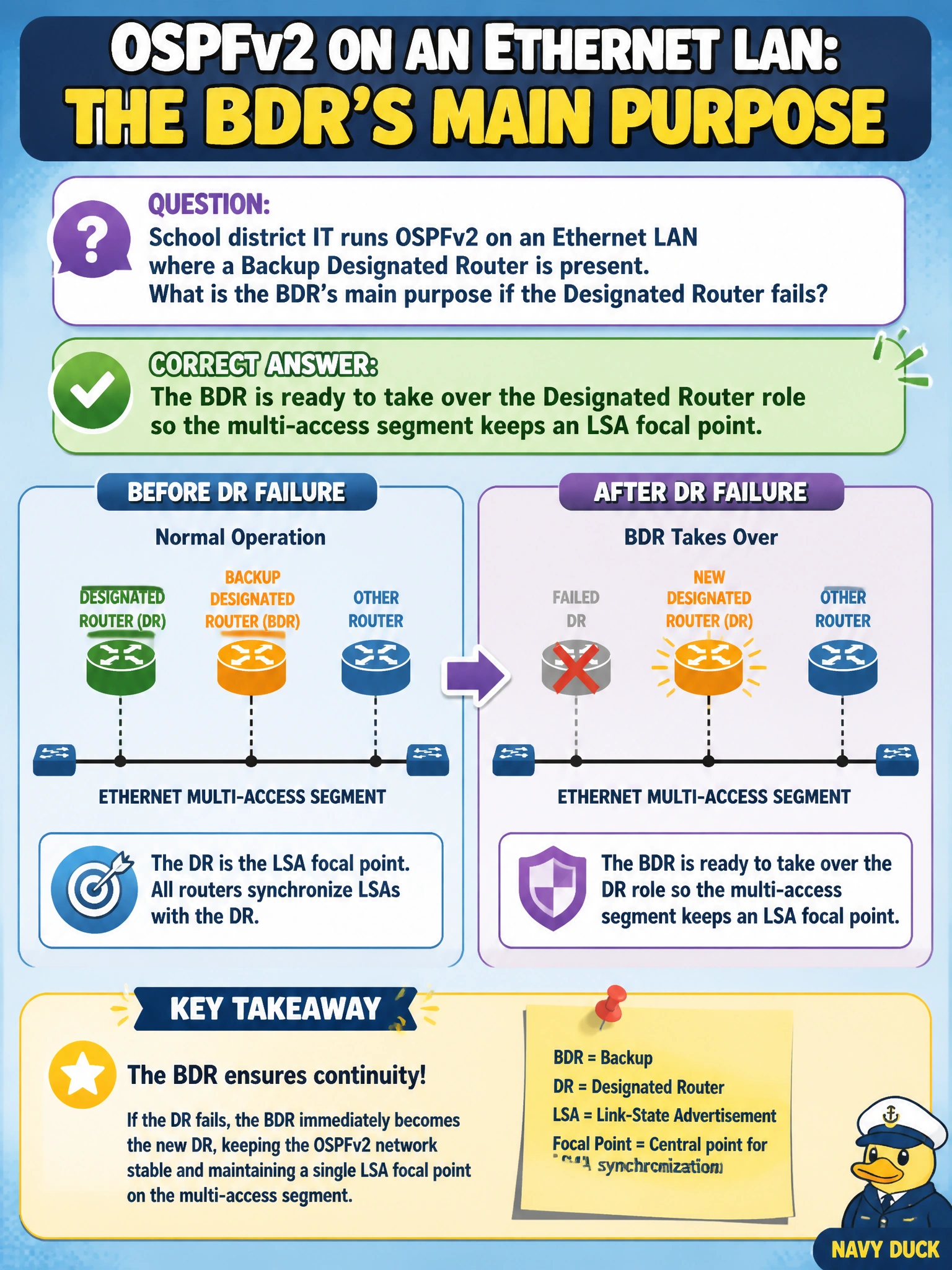
School district IT runs OSPFv2 on an Ethernet LAN where a Backup Designated Router is present. What is the BDR’s main purpose if the Designated Router fails?
Select an answer to reveal the explanation.
Short Explanation
The BDR is the understudy waiting in the wings. If the DR on the school LAN drops, the BDR steps up so OSPF still has a designated focal point on that Ethernet segment. It is not STP root magic or a NAT failover box.
Full Explanation
On a school-district Ethernet LAN running OSPFv2, the Backup Designated Router’s main purpose is readiness to assume the Designated Router role if the current DR fails. While the DR is healthy, the BDR maintains adjacency relationships that let it take over as the LSA focal point on the multi-access segment with minimal disruption. Continuity of that focal-point role preserves efficient flooding and adjacency structure after DR loss—exactly why OSPF elects a BDR alongside the DR.
Saying the BDR immediately becomes the Spanning Tree root for all access VLANs fails by concept: STP root election is independent of OSPF DR/BDR. Claiming the BDR translates inside source NAT pools when the DR loses Internet reachability confuses OSPF LAN roles with edge address translation and WAN reachability. Stating the BDR disables OSPF Hellos so remaining routers fall back to static defaults only invents destructive behavior; the BDR continues OSPF operation and prepares to become DR, not to shut down Hellos.
Exam caveat: BDR readiness is about the OSPF multi-access segment role, not automatic failover of NAT, STP, or static default injection. Operational check: identify DR and BDR with show ip ospf neighbor on the school LAN, reload or shut the DR in a maintenance window, and confirm the former BDR becomes DR while DROTHER adjacencies and LSA exchange continue for municipal prefixes.