
Animal control changes a manually configured OSPFv2 router ID on a clinic edge router. What operational awareness should the team have?
Select an answer to reveal the explanation.
Short Explanation
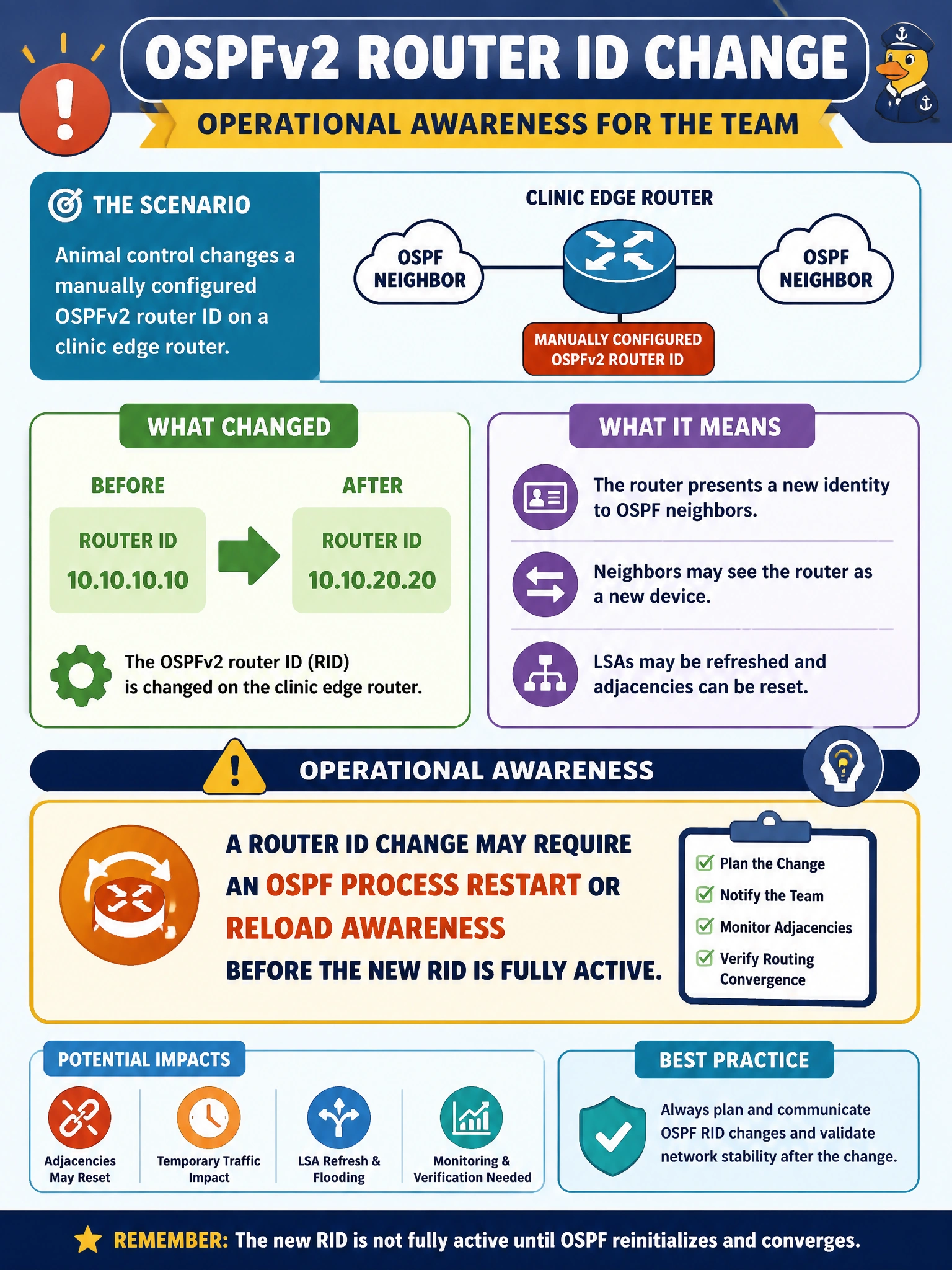
Tweaking the OSPF router ID is not always a hot-swap name-tag change—the process may need a restart before the new ID sticks everywhere. Animal control should plan that blip, not assume the RID flips with zero drama. Hosts keep their gateways; this is OSPF identity housekeeping.
Full Explanation
When animal-control staff change a manually configured OSPFv2 router ID on a clinic edge router, operational awareness matters: many Cisco platforms continue advertising with the previous RID until the OSPF process restarts or the device reloads. Planning for that restart (or documented platform behavior) avoids surprise adjacency resets and stale identity in the LSDB. The new RID becomes fully active only after that operational step is completed as required.
Claiming RID changes always propagate instantly with zero impact on existing adjacencies fails by concept: identity changes can disrupt LSA ownership and neighbor relationships and often need a process restart. Saying changing the RID automatically converts the router into an NTP stratum-1 server invents a time-sync side effect unrelated to OSPF identity. Asserting the RID can only be changed by rewriting every host default gateway on the VLAN fails by concept: host gateways are independent of the OSPF RID; endpoints do not use the RID as their gateway.
Exam caveat: treat RID changes as a controlled maintenance action—schedule the OSPF process restart/reload awareness window and watch neighbor reconvergence. Operational check: set the new manual RID, restart the OSPF process (or follow platform guidance), verify show ip ospf shows the new RID, and confirm clinic neighbors re-form with consistent LSA origination under the new identity.