
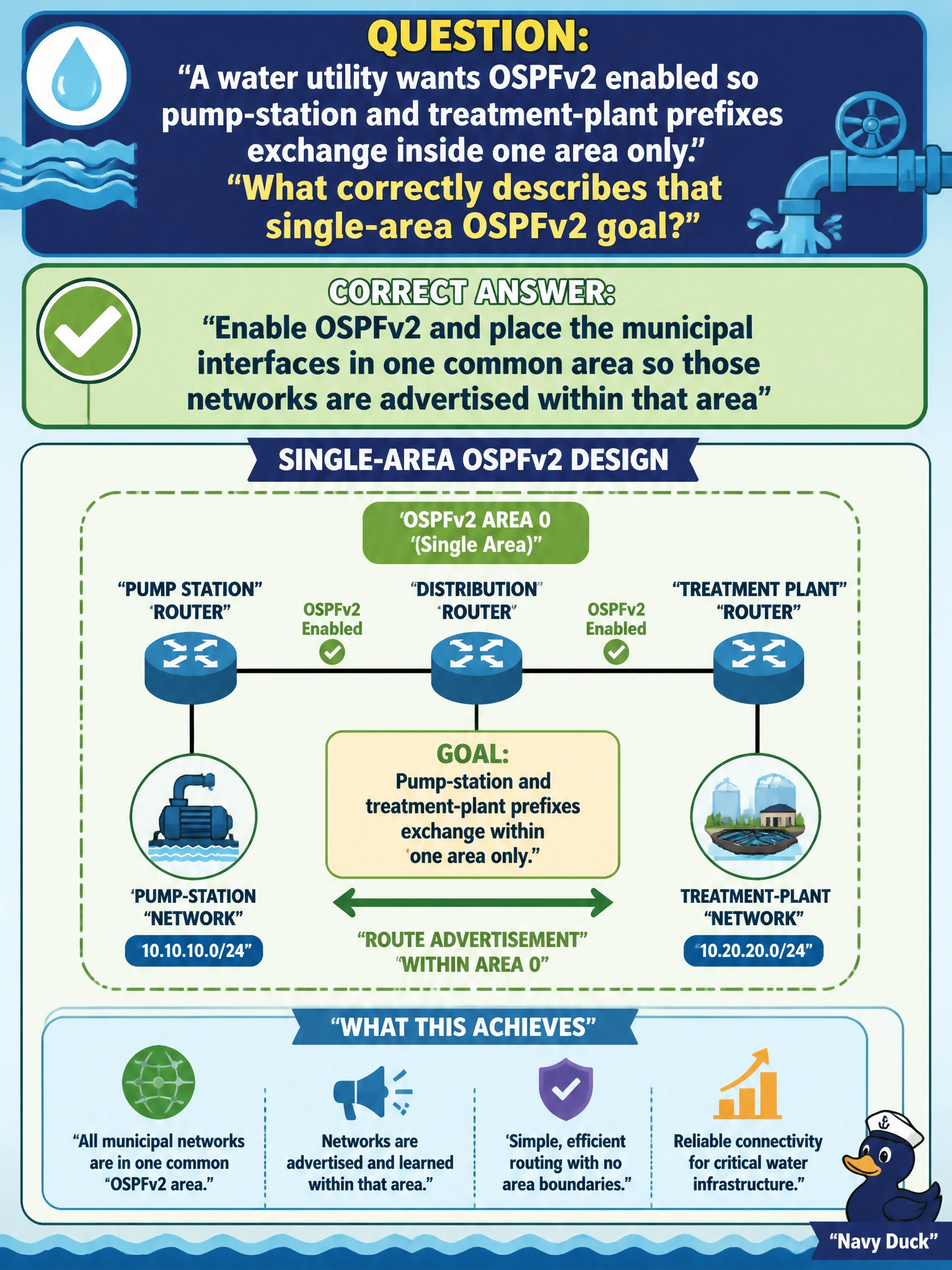
A water utility wants OSPFv2 enabled so pump-station and treatment-plant prefixes exchange inside one area only. What correctly describes that single-area OSPFv2 goal?
Select an answer to reveal the explanation.
Short Explanation
Water utility OSPF in one area is basically: turn on OSPFv2, stick the plant and pump interfaces in the same area, and let them share the map. You are not swapping in HSRP for link-state updates or hand-building a host route for every PC.
Full Explanation
A water-utility goal of exchanging pump-station and treatment-plant prefixes inside one area is achieved by enabling OSPFv2 and placing the relevant municipal interfaces (or network statements) into one common area. Routers in that area then originate and flood LSAs for those networks so other single-area peers install OSPF routes to the plants and pumps. That is the configuration intent: one process participation scope, one area, dynamic advertisement of the included prefixes.
Configuring only static host routes for every PC instead of any dynamic protocol fails by concept: per-host statics do not scale and abandon the OSPFv2 design goal. Replacing OSPF with HSRP so routers share LSAs without Hello packets fails by concept: HSRP provides first-hop gateway redundancy, not link-state advertisement between sites. Using extended ACLs as the only method to inject prefixes into the routing table fails by concept: ACLs filter or match traffic; they are not a substitute for OSPF LSA-based route advertisement.
Exam caveat: single-area OSPF still requires correct network type, timers, and addressing on links—enabling the process alone is not enough if interfaces are not in the area. Operational check: enable OSPFv2, assign pump and treatment interfaces to the shared area, verify neighbors, then confirm those prefixes appear as OSPF routes on peer routers with show ip route ospf.