
An emergency-management office runs OSPFv2 on a multi-access Ethernet segment connecting several municipal routers. Why does OSPF elect a Designated Router on that broadcast segment?
Select an answer to reveal the explanation.
Short Explanation
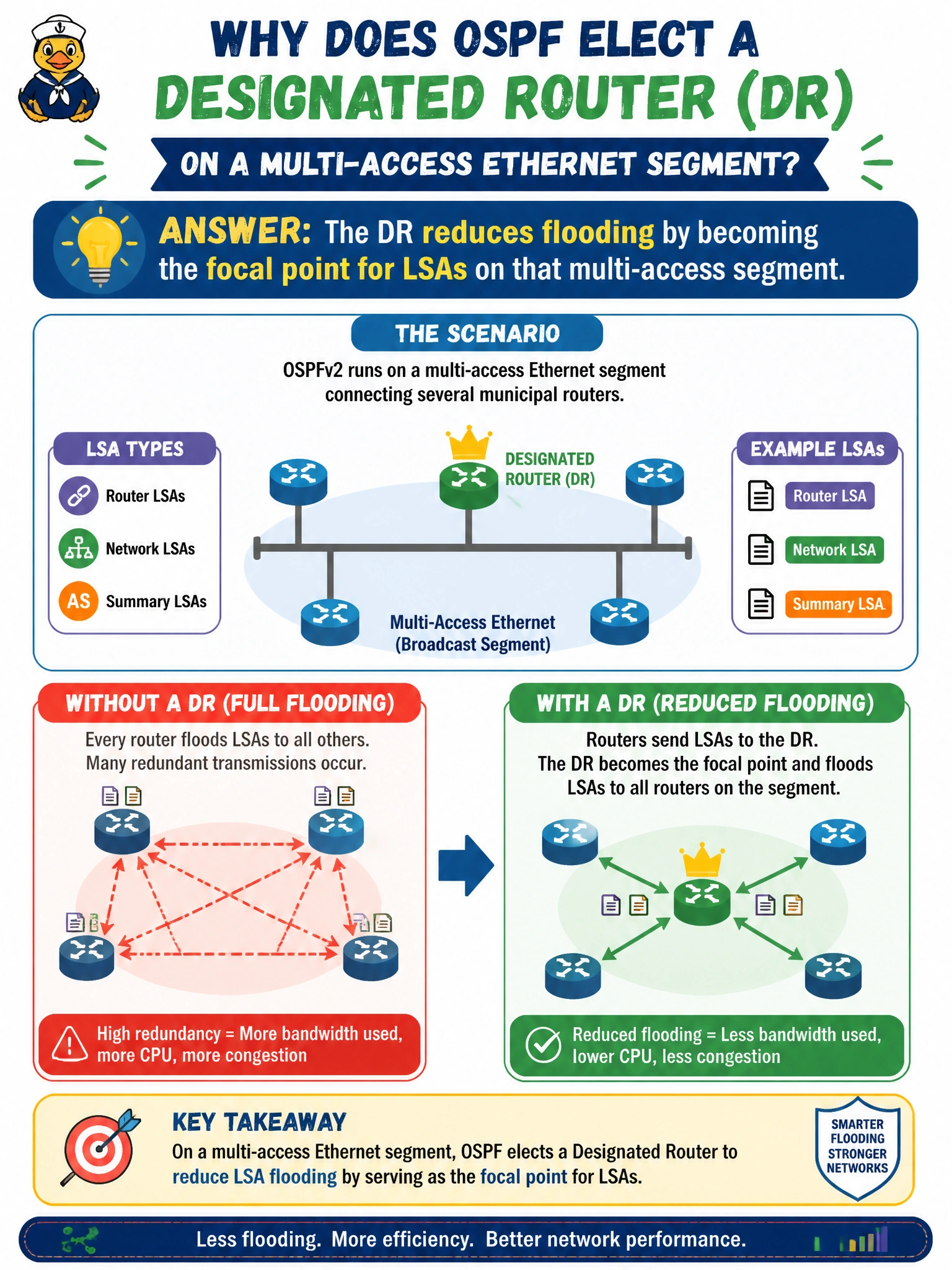
On a busy Ethernet LAN with several OSPF routers, everybody talking to everybody gets noisy. The Designated Router is the meeting chair—neighbors sync LSAs through it so the segment stays orderly. That is why broadcast multi-access segments elect a DR.
Full Explanation
On an emergency-management multi-access Ethernet segment with several municipal OSPFv2 routers, every router peering with every other router would create an adjacency mesh and heavy LSA flooding. Electing a Designated Router (with a Backup DR) makes the DR the focal point for LSAs on that segment: DROTHERs form adjacency primarily with the DR/BDR, and flooding is centralized through that role. The operational purpose is reduced adjacency scale and controlled flooding on broadcast multi-access media—not Layer-2 or NAT functions.
Saying the DR stores all VLAN trunks so Rapid PVST+ does not need a root bridge fails by concept: DR is an OSPF role, while STP root is independent Layer-2 loop prevention. Claiming the DR replaces NAT so private clinic addresses become public without a pool confuses first-hop LSA coordination with address translation. Stating the DR authenticates only wireless PSKs for guest SSIDs mixes wireless security with OSPF; PSK authentication is unrelated to why OSPF elects a DR on Ethernet.
Exam caveat: DR/BDR election applies to OSPF broadcast (and nonbroadcast) multi-access network types, not to point-to-point links where election is skipped. Operational check: on the emergency-management LAN segment, use show ip ospf neighbor and interface OSPF output to identify DR/BDR, confirm DROTHER adjacencies toward them, and validate LSA exchange remains healthy when one municipal router reloads.