
A fleet garage WAN uses a dedicated fiber point-to-point link between two OSPFv2 routers and sets the OSPF network type to point-to-point. What benefit does that choice provide?
Select an answer to reveal the explanation.
Short Explanation
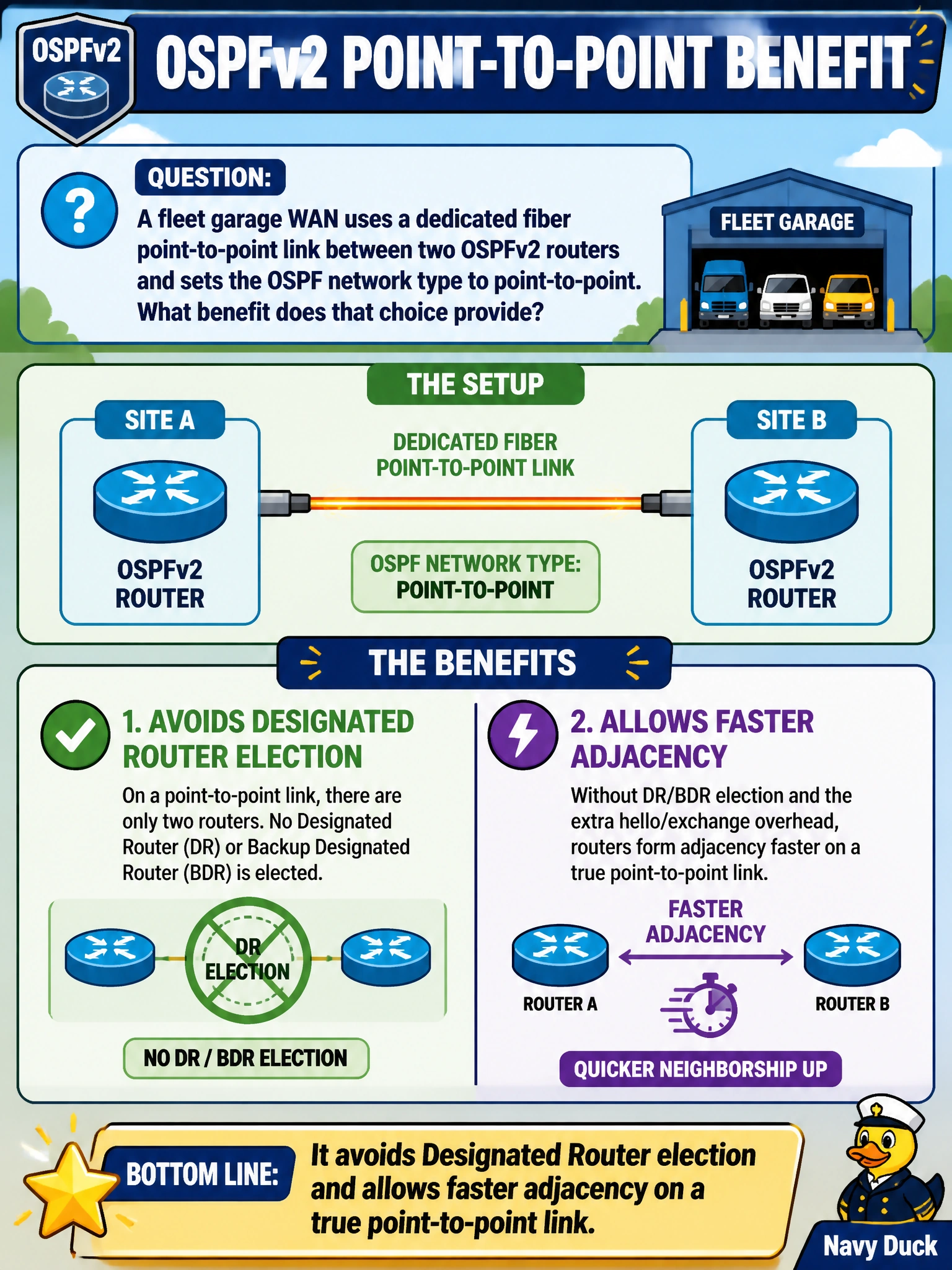
On your dedicated two-router fiber link, there’s no shared network that needs a DR chairperson. Point-to-point OSPF skips the election, so the garage routers can form an adjacency and reach FULL sooner. Keep DR elections for links that actually need them.
Full Explanation
A dedicated fiber link between two OSPFv2 routers is a true point-to-point topology. Setting the OSPF network type to point-to-point tells OSPF that the link does not need a Designated Router or Backup Designated Router. The routers form an adjacency directly, typically reaching FULL faster and with less control-plane overhead than when using behavior that includes a DR election. This is the benefit of matching the network type to the two-router WAN link. Forcing a DR election so three routers can share one serial cable is incorrect: point-to-point skips the election, and the dedicated link described connects only two routers. Converting OSPF into EIGRP and using hop counts is also incorrect: the network type does not change the routing protocol or replace OSPF cost with hop count. Suppressing OSPF Hellos and requiring manual neighbor configuration is incorrect as well: point-to-point OSPF still sends Hellos; it changes adjacency and DR behavior to suit the link. Exam caveat: use point-to-point for dedicated two-router links, and ensure both ends use matching network types, since a mismatch can disrupt adjacency expectations. Practical check: configure ip ospf network point-to-point (or its equivalent) on both WAN interfaces, confirm no DR or BDR is listed for the link, and verify the neighbor reaches FULL after cutover.