
A library consortium documents OSPFv2 router IDs on each clinic WAN router. What primary role does the OSPF router ID play?
Select an answer to reveal the explanation.
Short Explanation
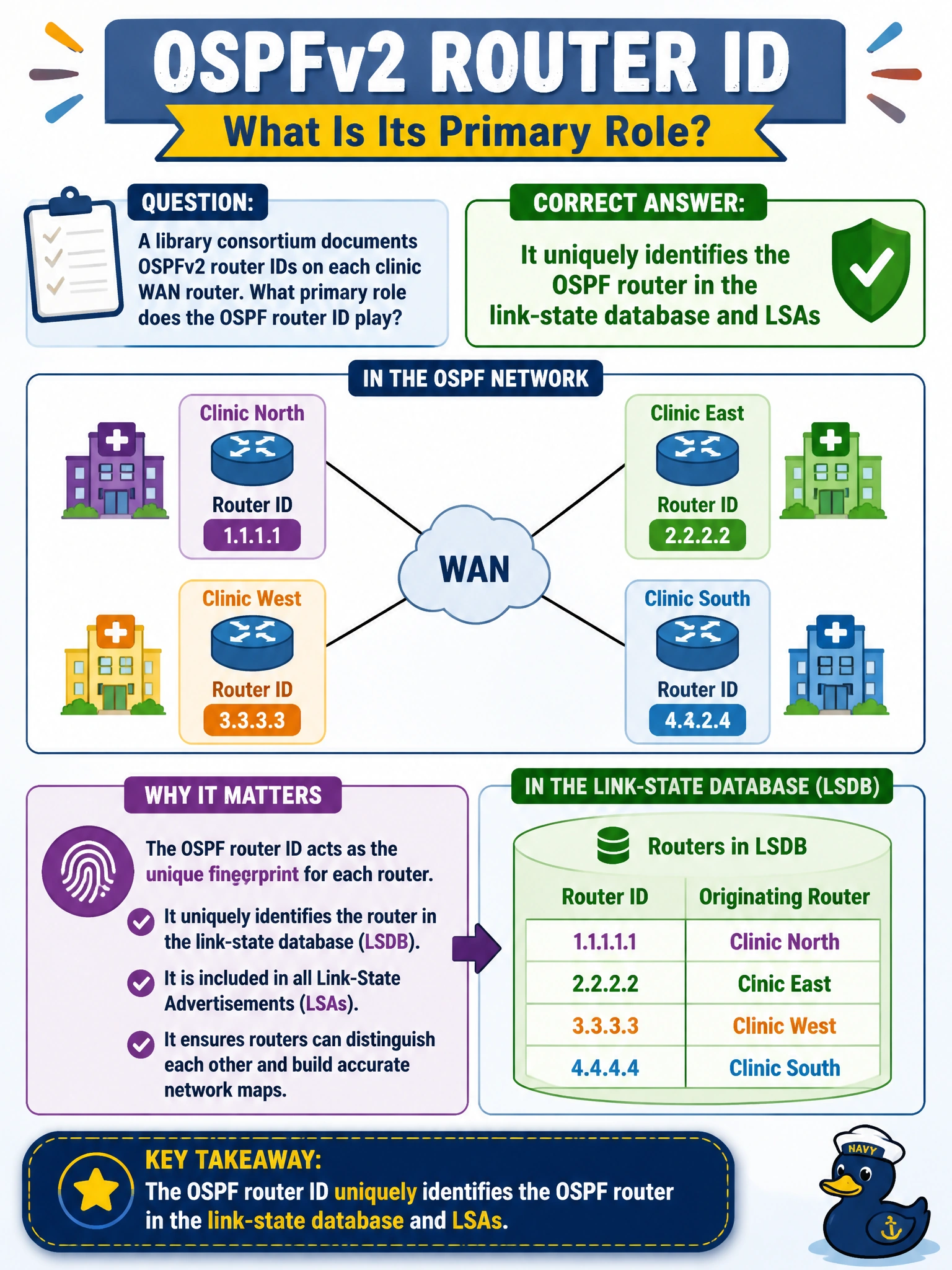
The OSPF router ID is the name tag stuck on every LSA that router originates—so the whole library consortium can tell who said what in the link-state database. It is identity for OSPF, not a client gateway or STP MAC.
Full Explanation
The OSPFv2 router ID uniquely identifies each library-consortium clinic WAN router inside the OSPF domain. That identity appears in LSA headers and the link-state database so every other router can attribute topology advertisements to a specific originator and detect duplicate or changing identities. Operators commonly set the RID manually (often aligned with a loopback) for documentation and stability. At CCNA depth, the RID’s primary role is OSPF identity—not host addressing or Layer-2 roles.
Treating the RID as the only IPv6 address clients may use as their default gateway fails by concept: client gateways are interface addresses or FHRP VIPs, not the OSPF RID. Claiming the RID replaces interface MTU so Ethernet frames automatically exceed 9000 bytes invents a frame-size function the RID does not have. Calling the RID a Layer-2 MAC reserved for the Spanning Tree root on every VLAN confuses OSPF control-plane identity with STP bridge priority/MAC selection.
Exam caveat: the RID is a 32-bit identifier that looks like an IPv4 address but is not required to be a reachable host address for forwarding; uniqueness within the OSPF domain matters most. Operational check: document each clinic router’s RID, prefer manual configuration for stability, verify with show ip ospf, and ensure no two municipal routers share the same RID before troubleshooting mysterious LSA ownership issues.