
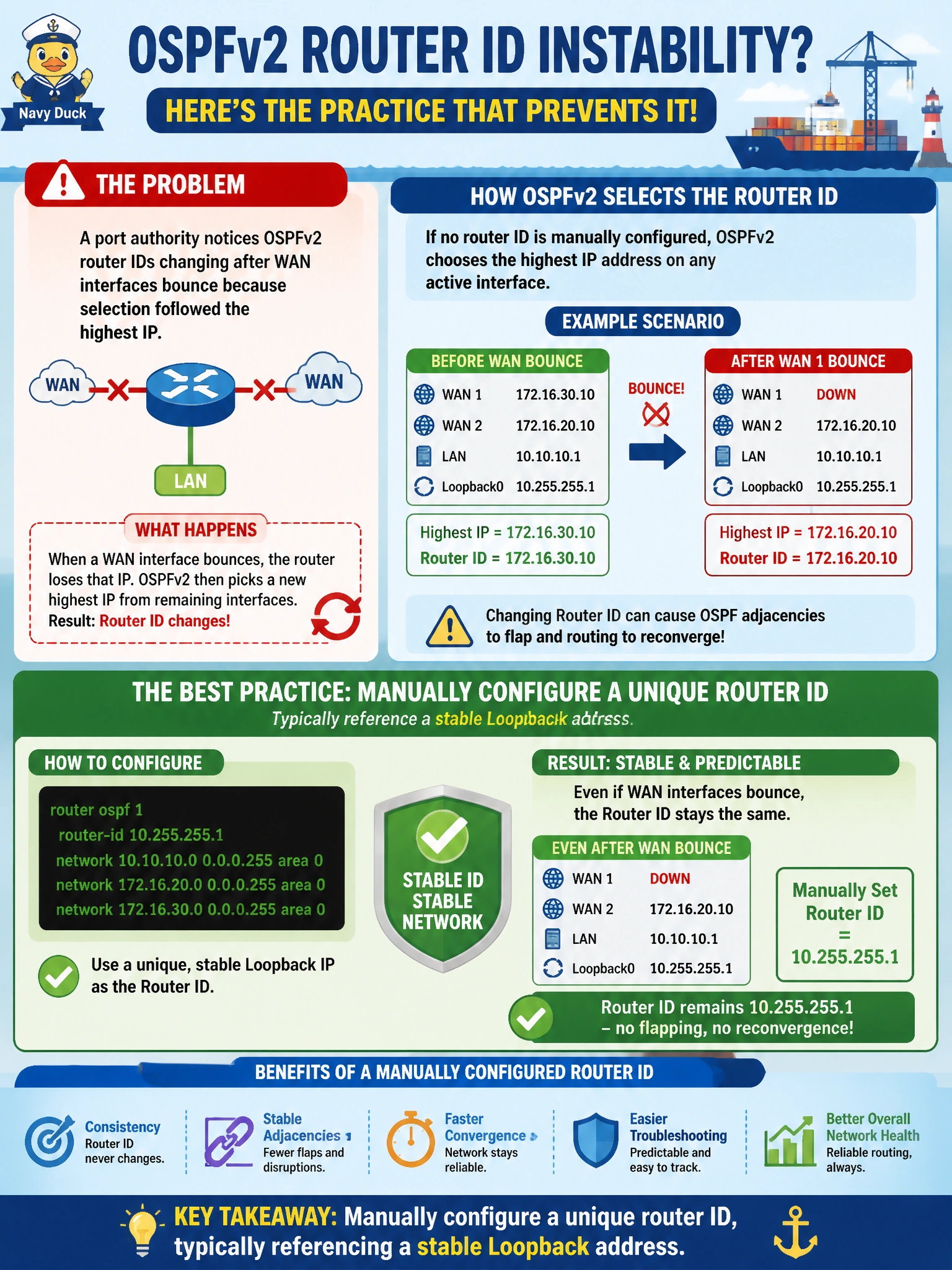
A port authority notices OSPFv2 router IDs changing after WAN interfaces bounce because selection followed the highest IP. What practice prevents that instability?
Select an answer to reveal the explanation.
Short Explanation
Don’t let a bouncing WAN IP rename the router in OSPF’s phone book. Set a manual, unique RID — usually a quiet loopback — and keep that identity steady.
Full Explanation
When a port authority sees OSPFv2 router IDs change after WAN interfaces bounce because selection followed the highest IP, the stabilizing practice is to manually configure a unique router ID, typically referencing a stable loopback address that does not depend on WAN link state. Manual RIDs stop automatic re-selection from transient interface addresses, keep LSA identity consistent, and make neighbor troubleshooting predictable across flaps on customs and terminal WAN edges where interface churn is common.
Disabling OSPF authentication does not stabilize RIDs and weakens security without addressing the selection problem. Forcing every router to share one RID taken from a core switch SVI creates duplicate RID conflicts—the opposite of uniqueness—and corrupts the OSPF identity model across the authority domain. Removing loopbacks so only flapping WAN addresses remain candidates maximizes instability rather than preventing it and leaves RID selection tied to the very interfaces that bounce.
Exam caveat: choose RIDs that are unique across the OSPF domain; using loopback addresses is convention, but the RID is a 32-bit identifier—it need not be reachable, though reachability helps management access. A process reset may be required to apply a new RID after it is configured. Operational check: configure unique manual RIDs on each port-authority router, bounce WAN interfaces, and verify show ip ospf still reports the same RID with stable neighbor sessions rather than a new identity after each flap.