
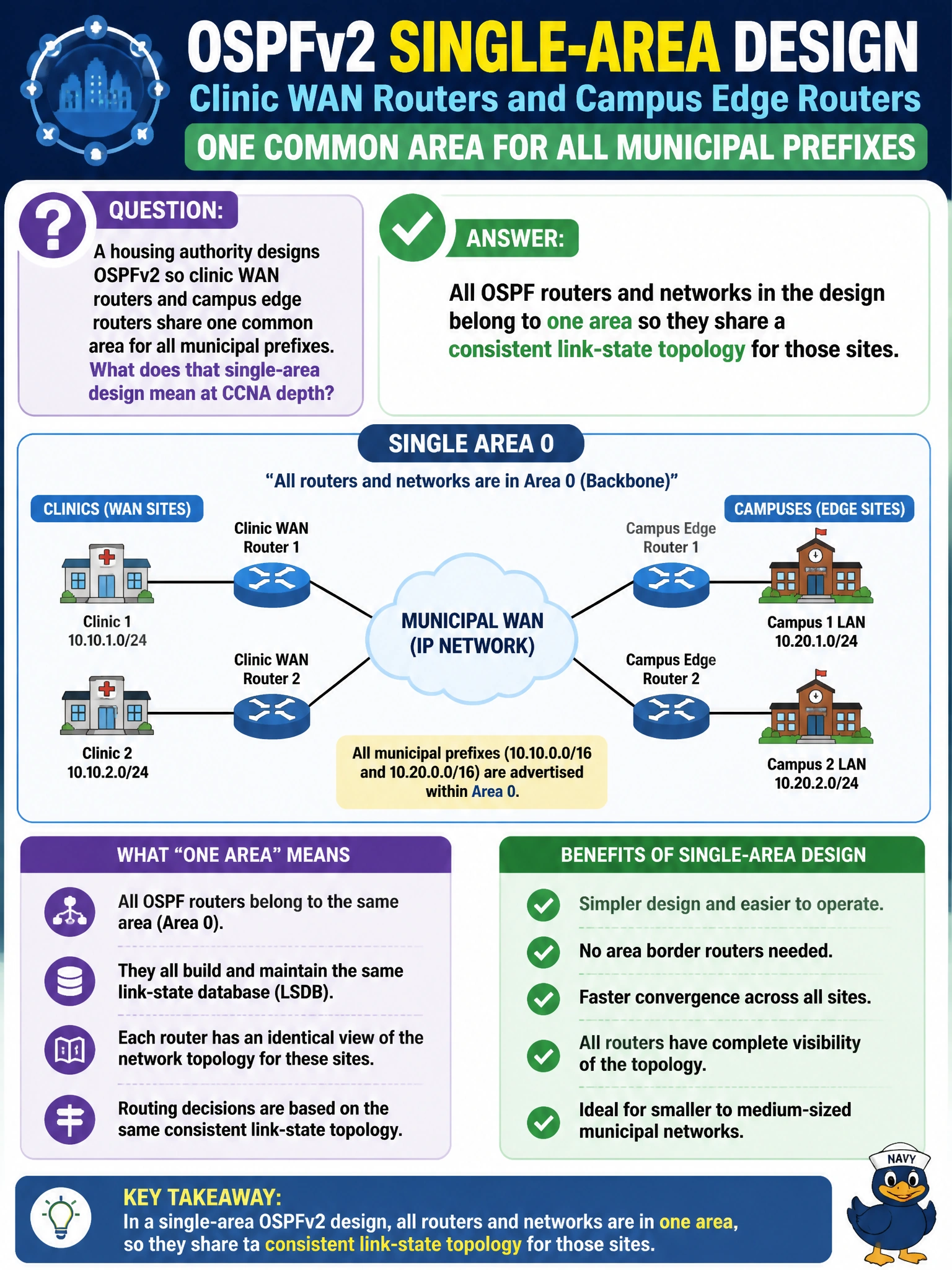
A housing authority designs OSPFv2 so clinic WAN routers and campus edge routers share one common area for all municipal prefixes. What does that single-area design mean at CCNA depth?
Select an answer to reveal the explanation.
Short Explanation
Think of one neighborhood map that every housing-authority router agrees on. Single-area OSPFv2 means those routers share one area—and one link-state view—for the clinics and campus edges in the design. You are not inventing multi-area CCNP sprawl here.
Full Explanation
In a housing-authority single-area OSPFv2 design, clinic WAN routers and campus edge routers place their municipal prefixes in one common area. That means participating routers share the same area identity and exchange Type-1 and Type-2 LSAs so each builds a consistent link-state topology database for those sites. Shortest-path calculations therefore use one coherent view of the clinics and campus edges rather than fragmented multi-area summaries. At CCNA depth, single-area OSPF is the intentional simplification: one area scope, one LSDB scope for the networks in the design.
Requiring a separate OSPF process per VLAN with no shared area ID fails by concept: VLAN segmentation does not force independent OSPF processes, and neighbors still need a shared area on a common link to form an adjacency. Demanding BGP confederations before any LAN prefix can be advertised confuses exterior BGP scaling with interior OSPF advertisement; single-area OSPF does not depend on confederations. Forbidding Area 0 and assigning a unique private area number per host invents rules that do not exist in OSPFv2—hosts are not OSPF area members, and Area 0 is allowed (and often used) even in single-area designs.
Exam caveat: “single-area” means one OSPF area for the routers and networks in scope, not “no Area 0” and not multi-protocol prerequisites. Operational check: confirm every housing-authority interface intended for OSPF is in the same area ID, verify neighbors reach FULL, and compare LSDBs (show ip ospf database) so clinic and campus edges show a consistent topology for the municipal prefixes.