
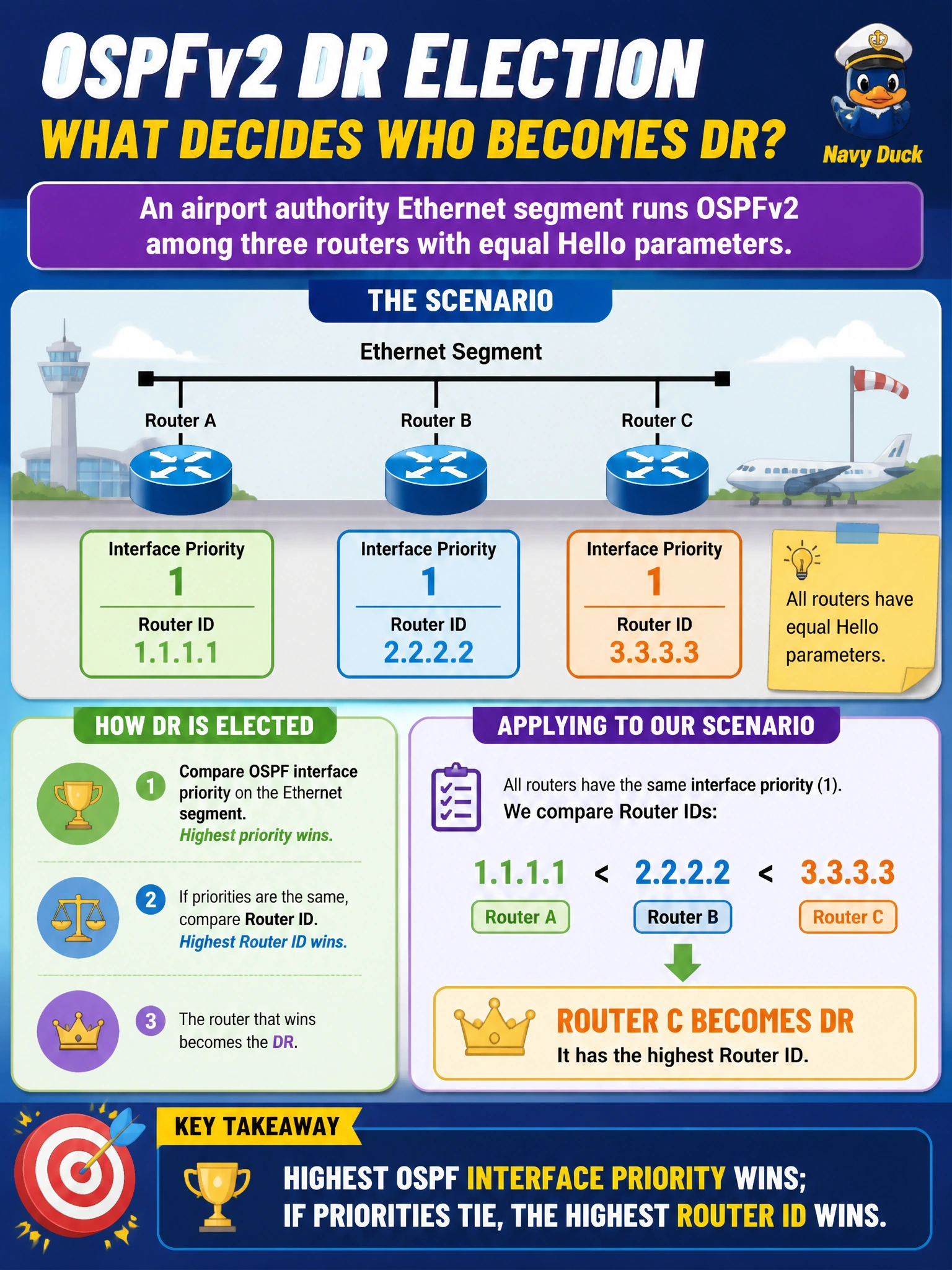
An airport authority Ethernet segment runs OSPFv2 among three routers with equal Hello parameters. Which factor most directly decides who becomes DR?
Select an answer to reveal the explanation.
Short Explanation
DR election is like picking a table captain: highest priority gets the chair; if priorities match, highest router ID breaks the tie. Uptime and Area 0 cost aren’t the DR scorecard.
Full Explanation
On an airport authority Ethernet segment with three OSPFv2 routers and equal Hello parameters, DR election is decided first by highest OSPF interface priority; if priorities are equal, the highest router ID wins. Those rules are deterministic and local to the multi-access segment. Priority 0 makes a router ineligible to become DR/BDR, which is how you keep low-powered edges out of the role. Understanding priority-then-RID is essential for predicting who becomes DR when clinic or authority routers share a LAN.
Longest uptime does not automatically win regardless of priority. Lowest OSPF cost to Area 0 is an SPF/path metric concern, not the DR election scorecard. The router that boots last does not always preempt as DR on Cisco IOS; DR preemption behavior is not “last boot wins,” and stable DR/BDR roles often persist until the DR fails even if a higher-priority router appears later depending on classic OSPF non-preemptive DR behavior.
Exam caveat: remember non-preemption of an existing DR when a better router joins later—priority/RID matter most at election time when the segment has no DR. Operational check: set priorities deliberately on the three routers, clear OSPF on the segment if needed to re-elect, and use show ip ospf interface/neighbor to confirm the highest priority (then highest RID) became DR with the next as BDR.