
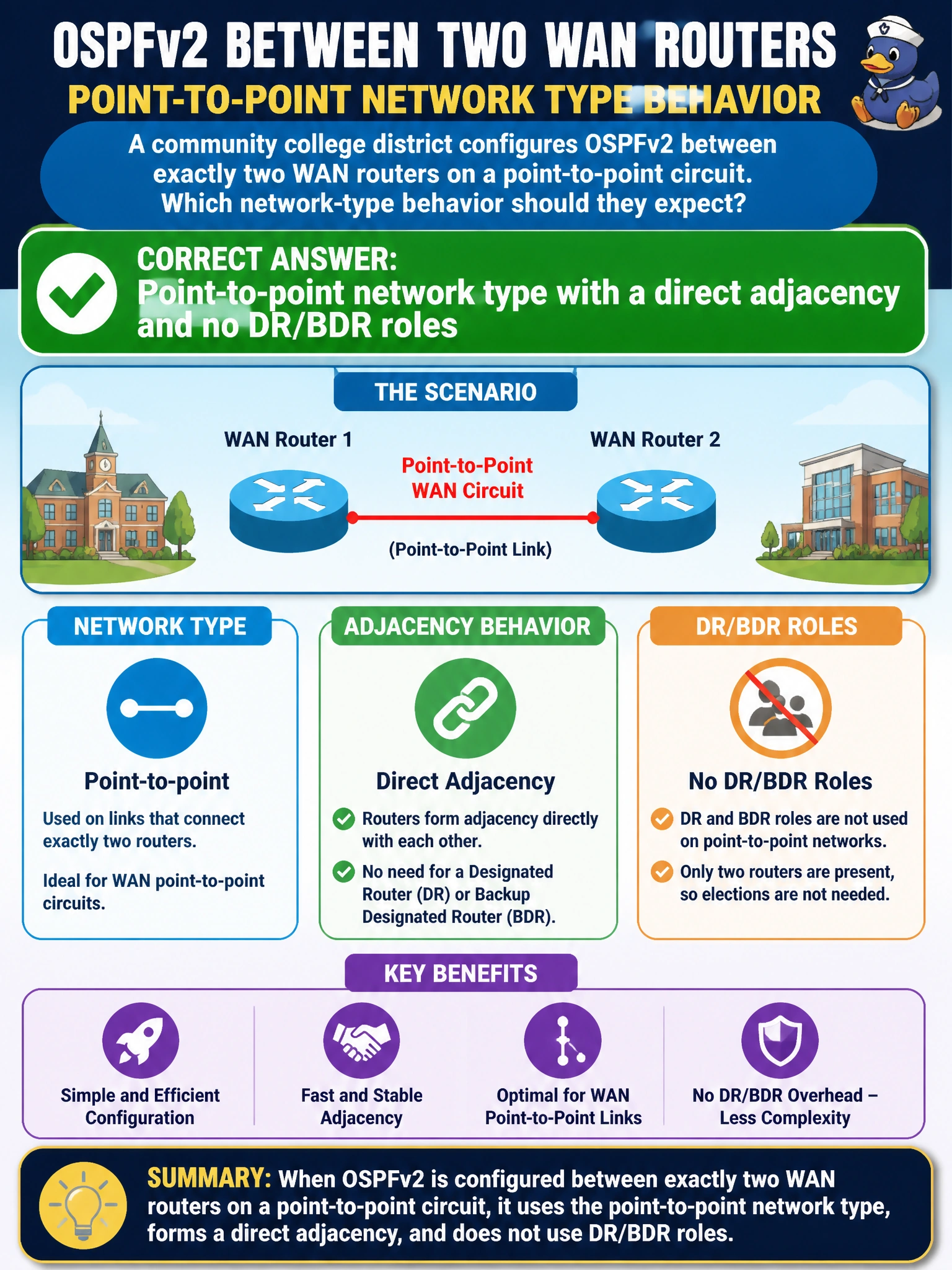
A community college district configures OSPFv2 between exactly two WAN routers on a point-to-point circuit. Which network-type behavior should they expect?
Select an answer to reveal the explanation.
Short Explanation
Two routers, one wire — OSPF treats that as point-to-point: shake hands directly, skip the DR/BDR pageant. No extra LAN switch required for the adjacency model.
Full Explanation
Exactly two community college WAN routers on a point-to-point circuit should use OSPFv2 point-to-point network-type behavior: they form a direct adjacency and do not elect DR/BDR roles. That matches the physical topology—no shared multi-access LAN—and avoids unnecessary designated-router election timers and roles. Hellos are typically multicast, the adjacency goes to FULL, and LSAs are exchanged between the pair without a DR intermediary, which is the expected model for a dedicated district WAN circuit between two sites.
Mandatory DR/BDR election despite only two routers describes broadcast multi-access behavior, not point-to-point, and would add needless election complexity on a simple wire. Broadcast multi-access requiring a LAN switch in the middle misstates both the media and the OSPF network type for a dedicated circuit. Nonbroadcast mode waiting for static neighbor maps is an NBMA model (for example classic Frame Relay-style designs), not the default expectation for a simple point-to-point WAN between two college routers.
Exam caveat: Cisco may default serial interfaces to point-to-point OSPF network type while Ethernet defaults to broadcast—know which you are configuring and verify with show commands rather than assuming media alone. Operational check: show ip ospf interface on the WAN circuit for point-to-point and absence of DR/BDR, confirm a single FULL adjacency between the two district routers, and ensure inter-site routes appear without depending on designated-router roles.