
A tax assessor WAN uses a serial point-to-point link for single-area OSPFv2. What is true about DR/BDR election on that link type?
Select an answer to reveal the explanation.
Short Explanation
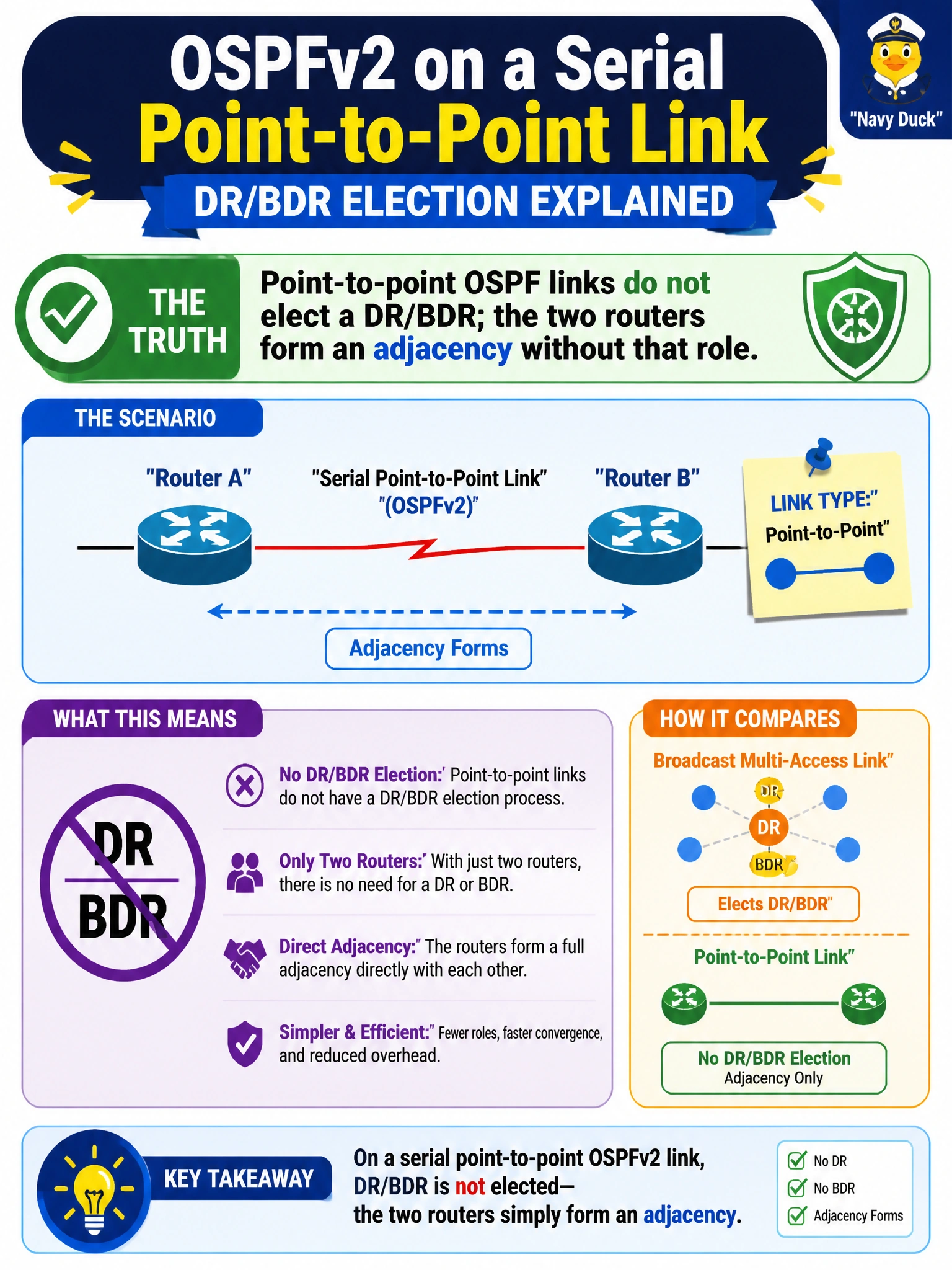
On a pure point-to-point wire there’s no shared LAN party, so OSPF skips the DR/BDR election and the two routers just become neighbors. No mayor needed for a two-person road.
Full Explanation
On a tax assessor serial point-to-point link running single-area OSPFv2, OSPF does not elect a DR or BDR. Point-to-point network types have exactly two routers and no multi-access shared segment that needs a designated router to reduce peering mesh. The two routers form an adjacency directly and exchange LSAs without DR/BDR roles. That is normal and required behavior for this link type—not a failure state—and it keeps Hello processing and adjacency formation simpler on leased municipal serial or PPP-style WAN circuits.
Requiring both routers to become DR or else refusing LSA exchange misapplies broadcast-segment rules to a point-to-point circuit. Claiming the lowest router ID always becomes BDR and blocks SPF invents a failure mode that does not describe point-to-point operation. Broadcast DR election does not still run as if a hub switch were present on a true point-to-point serial network type; there is no shared LAN election domain on that link.
Exam caveat: if someone mis-sets the OSPF network type to broadcast on a serial link, DR election may appear even though the physical topology is still two routers; know the difference between physical media and the configured OSPF network type. Operational check: show ip ospf interface on the serial link, confirm network type point-to-point and no DR/BDR listed, and verify the neighbor reaches FULL without designated-router roles while assessor WAN routes install as expected.