
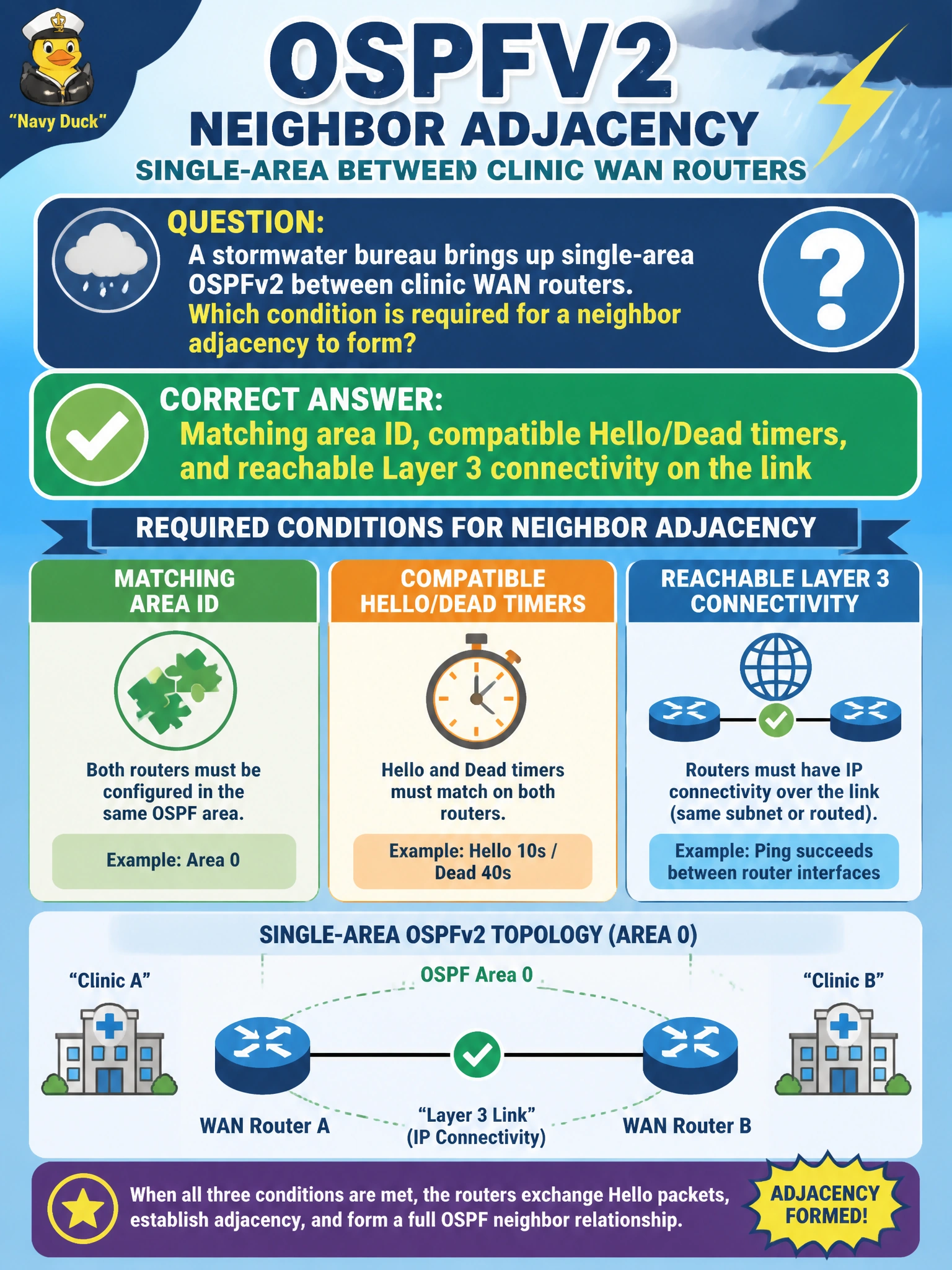
A stormwater bureau brings up single-area OSPFv2 between clinic WAN routers. Which condition is required for a neighbor adjacency to form?
Select an answer to reveal the explanation.
Short Explanation
Neighbors have to agree on the club rules — same area, compatible timers — and actually reach each other at Layer 3. Mismatched areas or twin router IDs wreck the handshake.
Full Explanation
Single-area OSPFv2 adjacency on stormwater clinic WAN routers requires agreement on critical Hello parameters and basic IP reachability. Neighbors must share the same area ID on the link, use compatible Hello and Dead intervals, have matching network masks on the subnet (for broadcast/NBMA style checks), compatible authentication if configured, and be able to exchange Hellos at Layer 3 on that interface. When those conditions hold, the neighbor state machine can progress toward FULL and LSAs can synchronize within the single area.
Different areas on each side of the link prevent a normal adjacency on that interface; that is how area boundaries work, not how you “start ABR behavior” between two routers that should be in one area. Identical router IDs on both neighbors are illegal/conflict conditions that break the OSPF identity model—router IDs must be unique. Disabling IP on the interfaces so Hellos ride only Layer 2 broadcasts removes the IP transport OSPF requires on that link.
Exam caveat: additional mismatches (authentication, stub flags, MTU on DBD exchange) also block FULL even when area and timers match. Operational check: show ip ospf neighbor for the clinic WAN peer progressing to FULL, verify matching area and timers on both sides, and confirm Type-1/Type-2 LSAs as expected in a single area.