
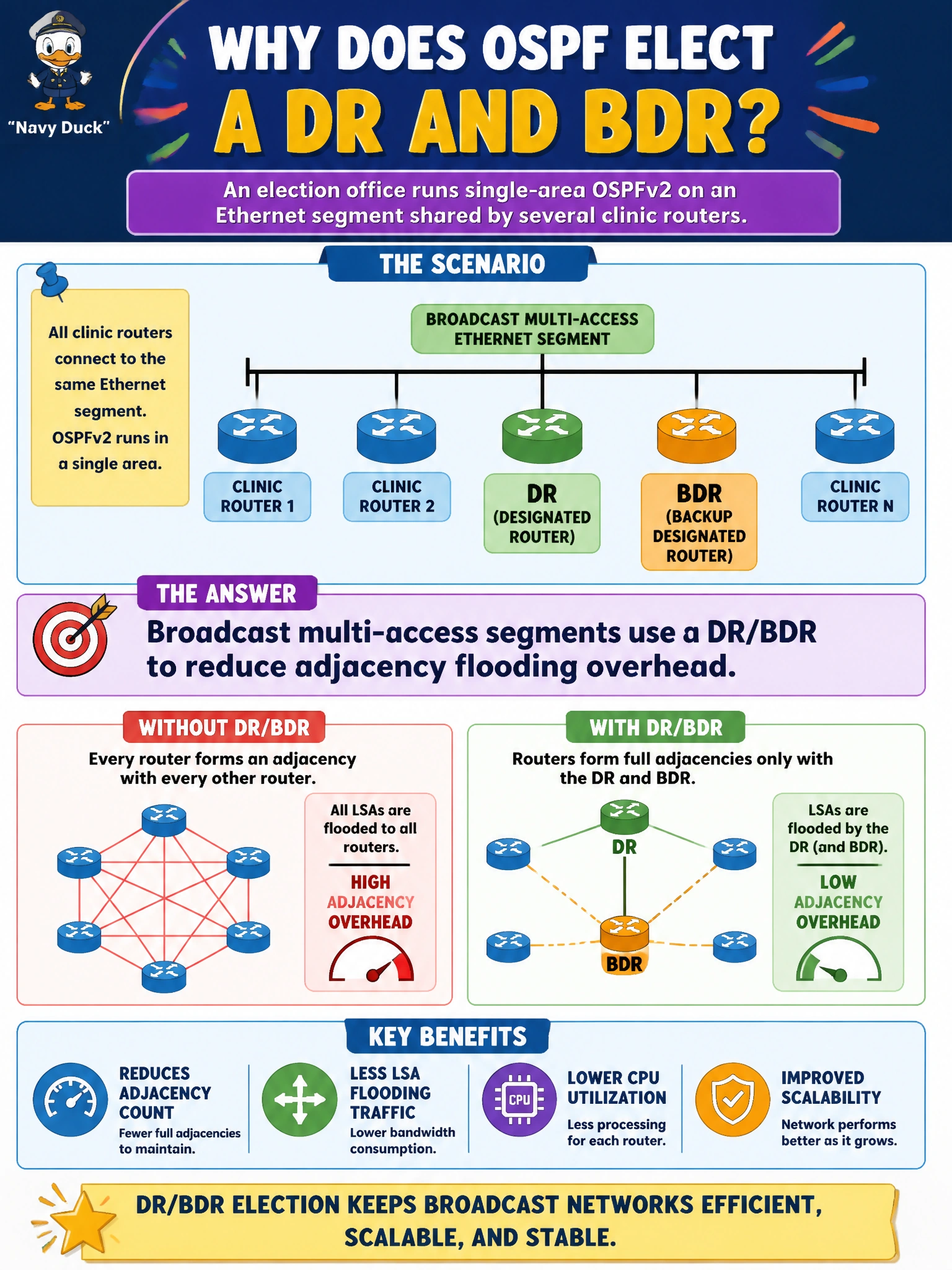
An election office runs single-area OSPFv2 on an Ethernet segment shared by several clinic routers. Why does OSPF elect a DR and BDR there?
Select an answer to reveal the explanation.
Short Explanation
On a busy Ethernet LAN, everybody talking to everybody gets noisy. OSPF picks a DR (and BDR backup) so routers peer mainly with those roles instead of a full mesh of chatter.
Full Explanation
When an election office runs single-area OSPFv2 on Ethernet shared by several clinic routers, the segment is a broadcast multi-access network. Without optimization, every router might attempt a full mesh of adjacencies and flood LSAs to every peer, scaling poorly as neighbor count grows. OSPF elects a Designated Router and Backup Designated Router so other routers form adjacencies primarily with the DR/BDR, and the DR handles much of the LSA flooding responsibility on that segment—reducing adjacency and flooding overhead.
Point-to-point serial links do not always require a DR for clocking; clocking is a Layer 1/2 serial concern, and point-to-point OSPF skips DR election. DR election does not replace the need for matching area IDs—area mismatch still prevents adjacency. The BDR does not alone advertise default routes into every VLAN automatically; default origination is a separate configuration.
Exam caveat: DR/BDR are per-multi-access segment, not a single lab-wide role; priority and router ID decide the election. Operational check: on the shared Ethernet, show ip ospf neighbor and interface to identify DR/BDR, confirm non-DR routers are FULL with DR/BDR, and note 2-WAY between DROTHERs as expected on broadcast segments.