
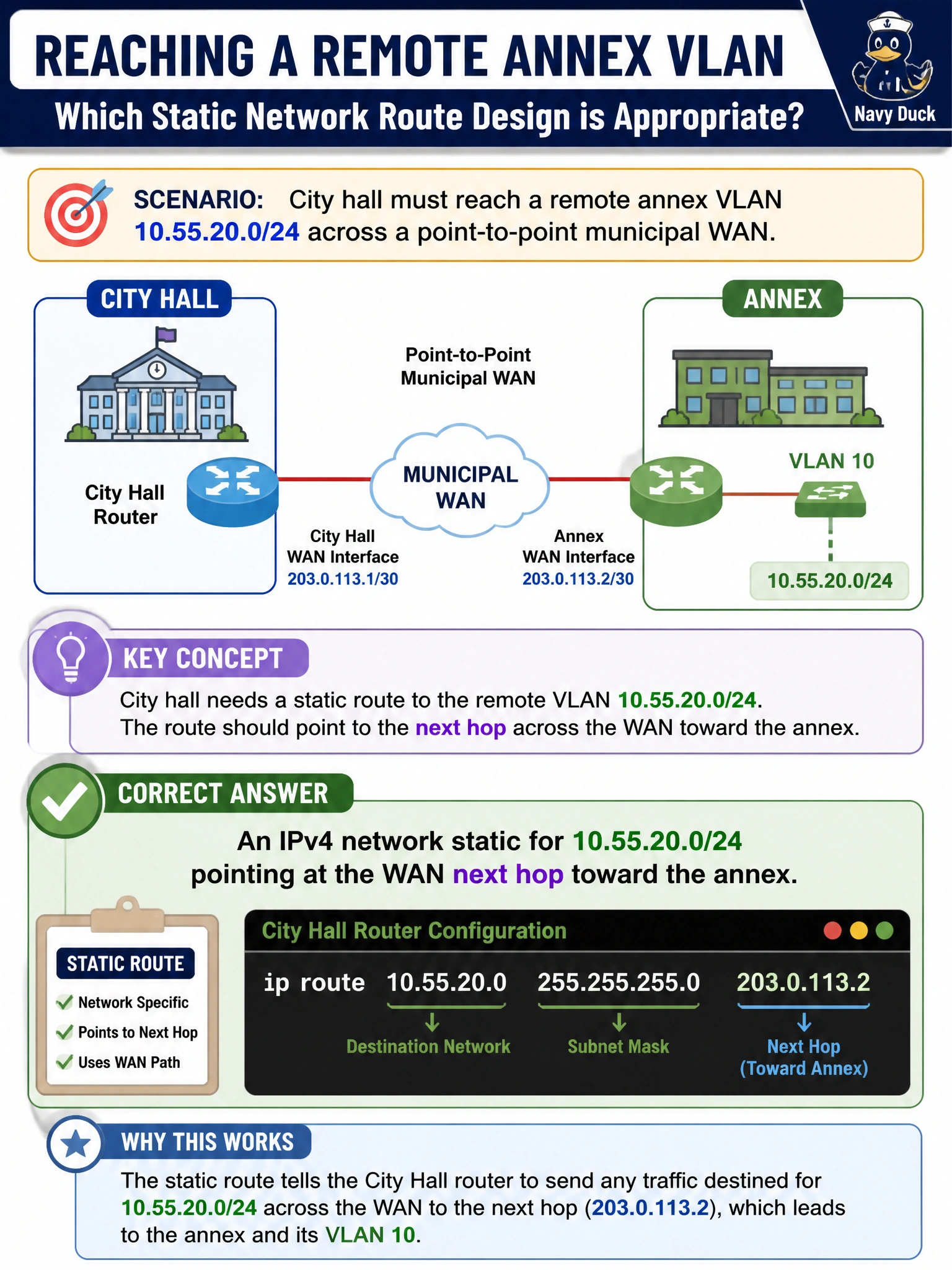
City hall must reach a remote annex VLAN 10.55.20.0/24 across a point-to-point municipal WAN. Which static network route design is appropriate?
Select an answer to reveal the explanation.
Short Explanation
Two sites, one subnet at the annex — give city hall a /24 static aimed down the WAN. VLANs don’t magically stretch across routed links by themselves.
Full Explanation
City hall reaching a remote annex VLAN subnet 10.55.20.0/24 across a point-to-point municipal WAN requires Layer 3 routing, not VLAN extension. The appropriate design is an IPv4 network static for 10.55.20.0/24 pointing at the WAN next hop toward the annex (or the point-to-point exit interface when that is the platform’s accepted form). That installs precise reachability for the annex user subnet so city-hall clients can reach annex servers without declaring a site-wide default into the WAN or pretending Layer 2 identity spans the circuit.
A host route only to the annex switch management IP reaches one device and leaves annex clients and servers uncovered. An IPv6 default does not map or forward IPv4 annex users across address families. Assuming VLANs span routed WAN links automatically is a broadcast-domain misconception; 802.1Q domains stop at Layer 3 boundaries unless you deliberately bridge or use an L2VPN service, which this civic WAN scenario does not imply.
Exam caveat: on point-to-point WAN, either next-hop or exit-interface statics may appear in exam examples; know what your platform installs, and remember Ethernet multipoint still prefers an explicit next-hop IP. Operational check: verify 10.55.20.0/24 appears in the city-hall routing table via the WAN next hop, ping multiple annex hosts in the /24, and confirm forwarding does not rely on an accidental default or a claimed stretched VLAN across the municipal circuit.