
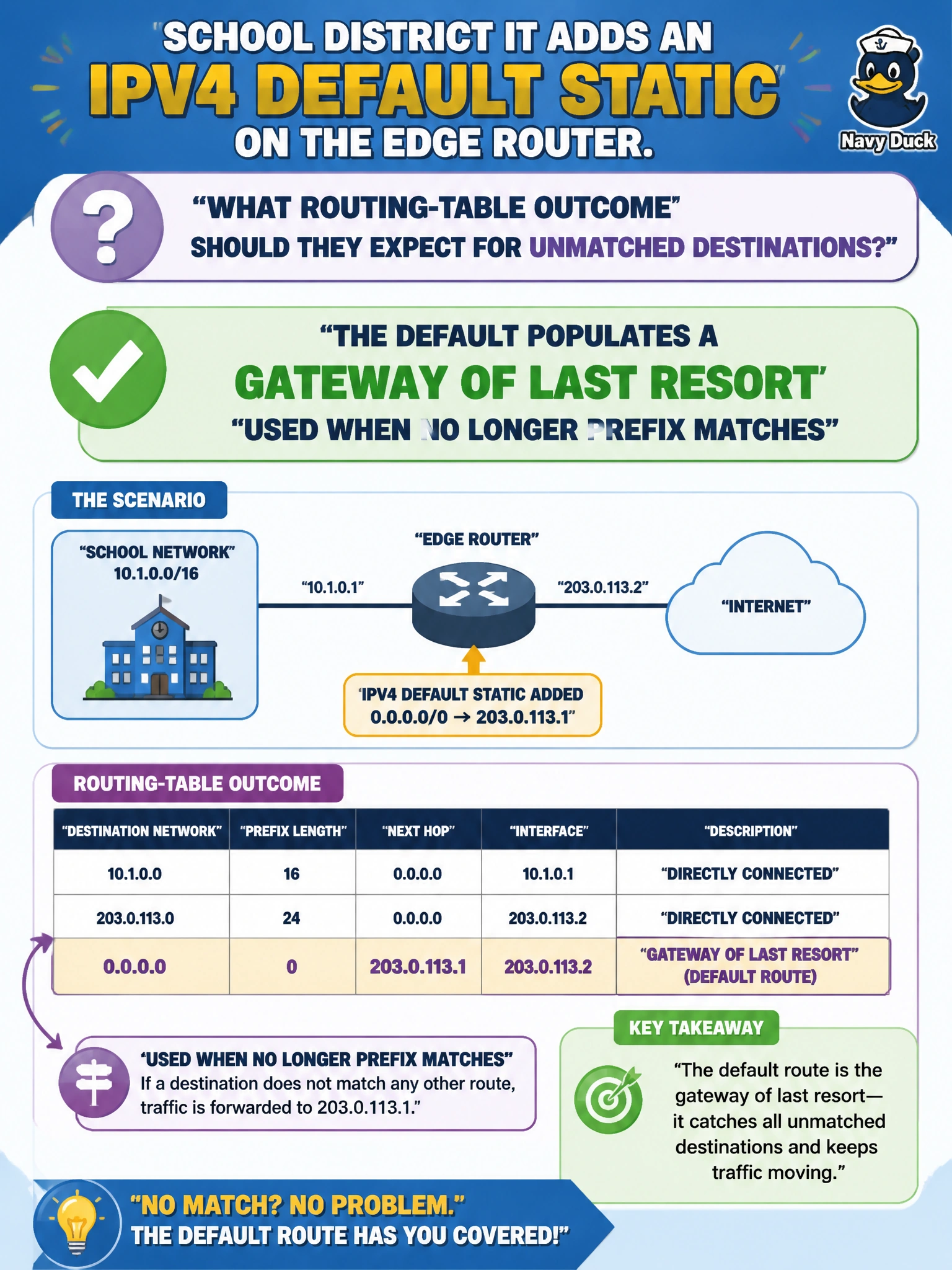
School district IT adds an IPv4 default static on the edge router. What routing-table outcome should they expect for unmatched destinations?
Select an answer to reveal the explanation.
Short Explanation
A default is the “if nothing else fits, go here” exit — gateway of last resort. Specific routes still win; the default only catches leftovers headed off campus.
Full Explanation
When school district IT adds an IPv4 default static on the edge, the expected routing-table outcome is a gateway of last resort (candidate default) used only when no longer prefix matches. Connected routes, more-specific statics, and IGP prefixes remain; the default does not delete them. Unmatched destinations—typically Internet-bound traffic from campuses—follow 0.0.0.0/0 toward the configured next hop.
The default does not delete every more-specific connected route. Packets without a longer match are not discarded if a default exists; discarding is what happens without a default or null route policy. A default does not replace OSPF entirely regardless of administrative distance; OSPF routes for specific prefixes still install based on AD and longest match, and an OSPF default would compete with the static default by AD.
Exam caveat: if both a static default (AD 1) and an OSPF default (AD 110) exist, the static default wins unless you raise the static’s AD. Operational check: confirm gateway of last resort appears, keep a more-specific internal route visible, send traffic to an unmatched public IP, and verify egress uses the default while internal subnets still use their specific routes.