
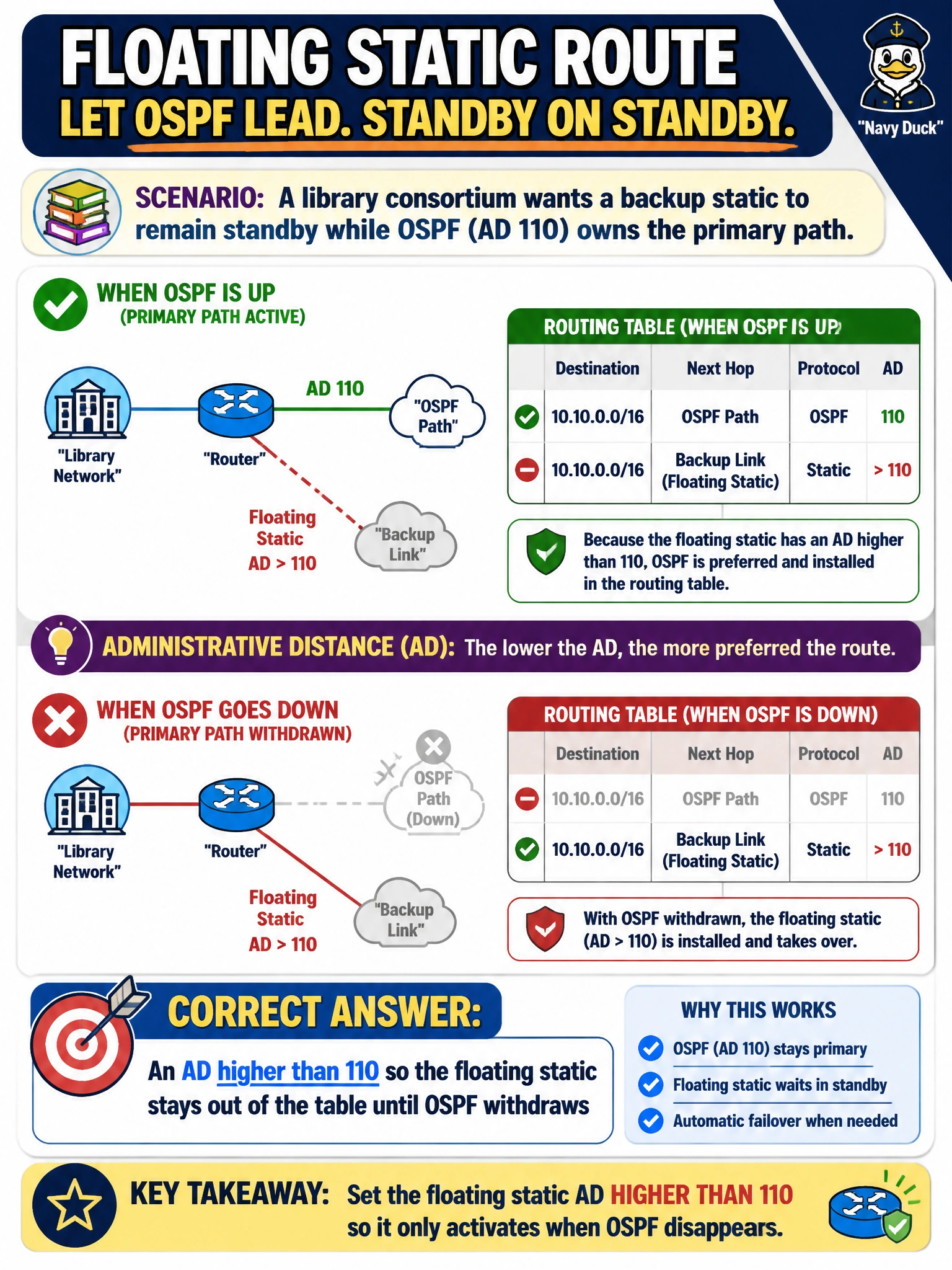
A library consortium wants a backup static to remain standby while OSPF (AD 110) owns the primary path. Which administrative distance choice is correct for the floating static?
Select an answer to reveal the explanation.
Short Explanation
Higher AD means “worse preference,” which is exactly what you want for a spare tire. Keep the static above 110 so OSPF drives until it can’t.
Full Explanation
For a library consortium backup static that must remain standby while OSPF (AD 110) owns the primary path, the floating static needs an administrative distance higher than 110. Higher AD means less preferred. The static is configured toward the backup next hop but does not install in the RIB while any OSPF route for that prefix exists at AD 110. After OSPF withdrawal, the static becomes the best remaining path and installs.
AD 1 is the default static preference and would always install ahead of OSPF, making the “backup” into the permanent primary. AD 110 identical to OSPF does not create a clean standby; depending on metrics and implementation details you risk unexpected selection or sharing rather than true float-on-failure behavior for a static versus OSPF. AD 0 is reserved for connected interfaces; assigning it to a static is inappropriate and would dominate incorrectly.
Exam caveat: memorize common ADs (connected 0, static 1, eBGP 20, EIGRP 90, OSPF 110, IS-IS 115, RIP 120) so you can pick a floating value deliberately (for example 121 or 200). Operational check: verify OSPF owns the prefix at AD 110 while the static is configured with a higher AD but not selected; fail OSPF, confirm the static installs with that higher AD, and restore OSPF to reclaim the route.