
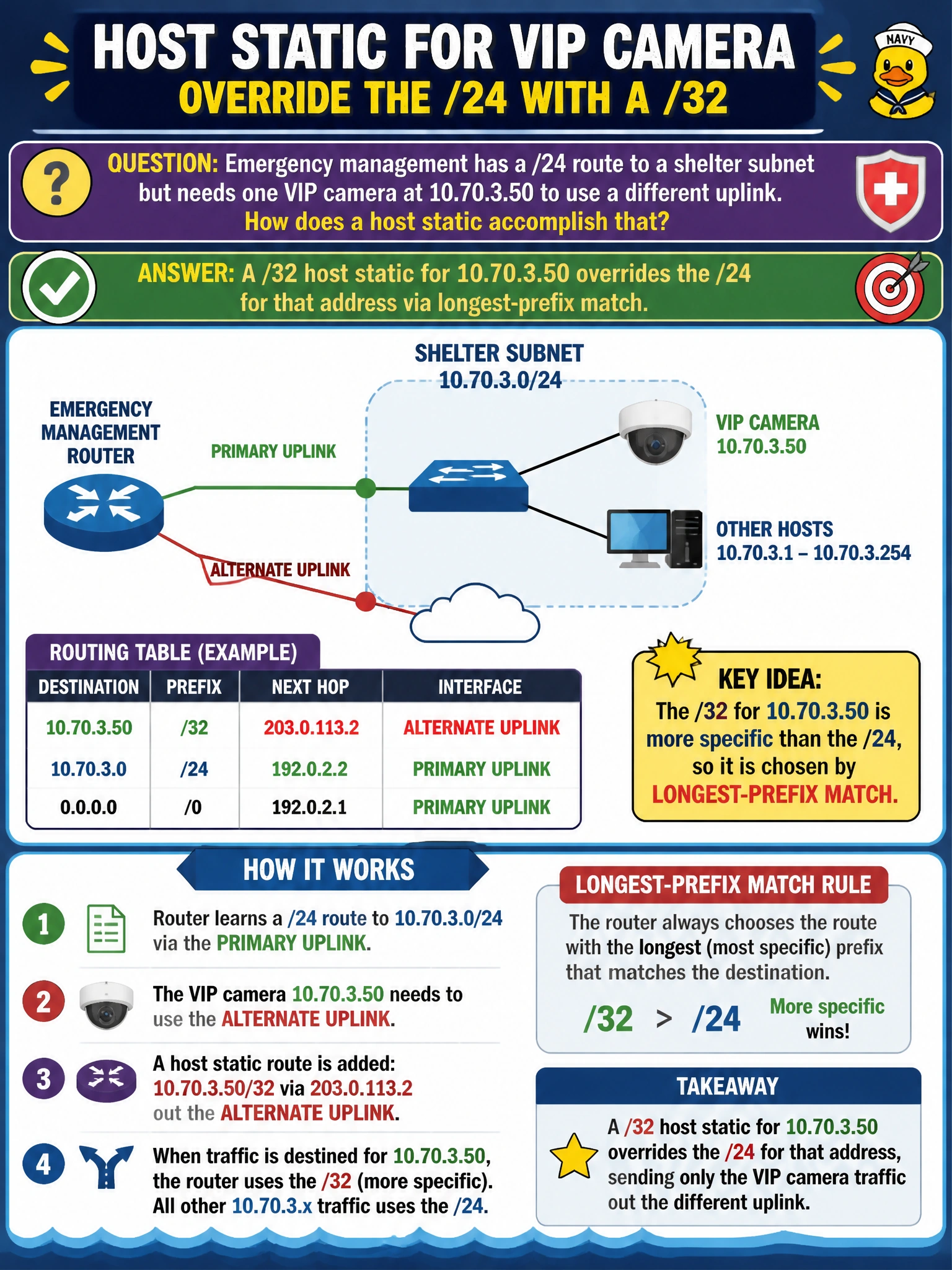
Emergency management has a /24 route to a shelter subnet but needs one VIP camera at 10.70.3.50 to use a different uplink. How does a host static accomplish that?
Select an answer to reveal the explanation.
Short Explanation
You can use longest-prefix match to send only 10.70.3.50 over a different uplink: its /32 host static is more specific than the shelter’s /24. Think of it as a special driveway for one camera while the rest of the neighborhood keeps using its usual route.
Full Explanation
A /32 host static for 10.70.3.50 sends traffic for that camera through the alternate uplink because longest-prefix match selects the most specific matching route. The /32 is more specific than the shelter’s /24, so it changes the path for that one address while other shelter addresses continue to use the /24. The claim that a broader mask outranks a longer prefix reverses the routing rule: among matching routes, the longer prefix wins. Equal administrative distance does not make the router ignore the camera address; administrative distance is not a reason to discard a more-specific matching route. Nor are host-specific routes limited to IPv6: a /32 is a valid IPv4 host route and can redirect this camera from its /24 route. Exam caveat: longest-prefix match is evaluated before administrative distance, so do not remove the /24 just to accommodate the camera; keep both routes. Practical check: confirm the routing table contains the /24 and the /32, then trace to 10.70.3.50 and another shelter address to verify that only the camera uses the alternate uplink.