
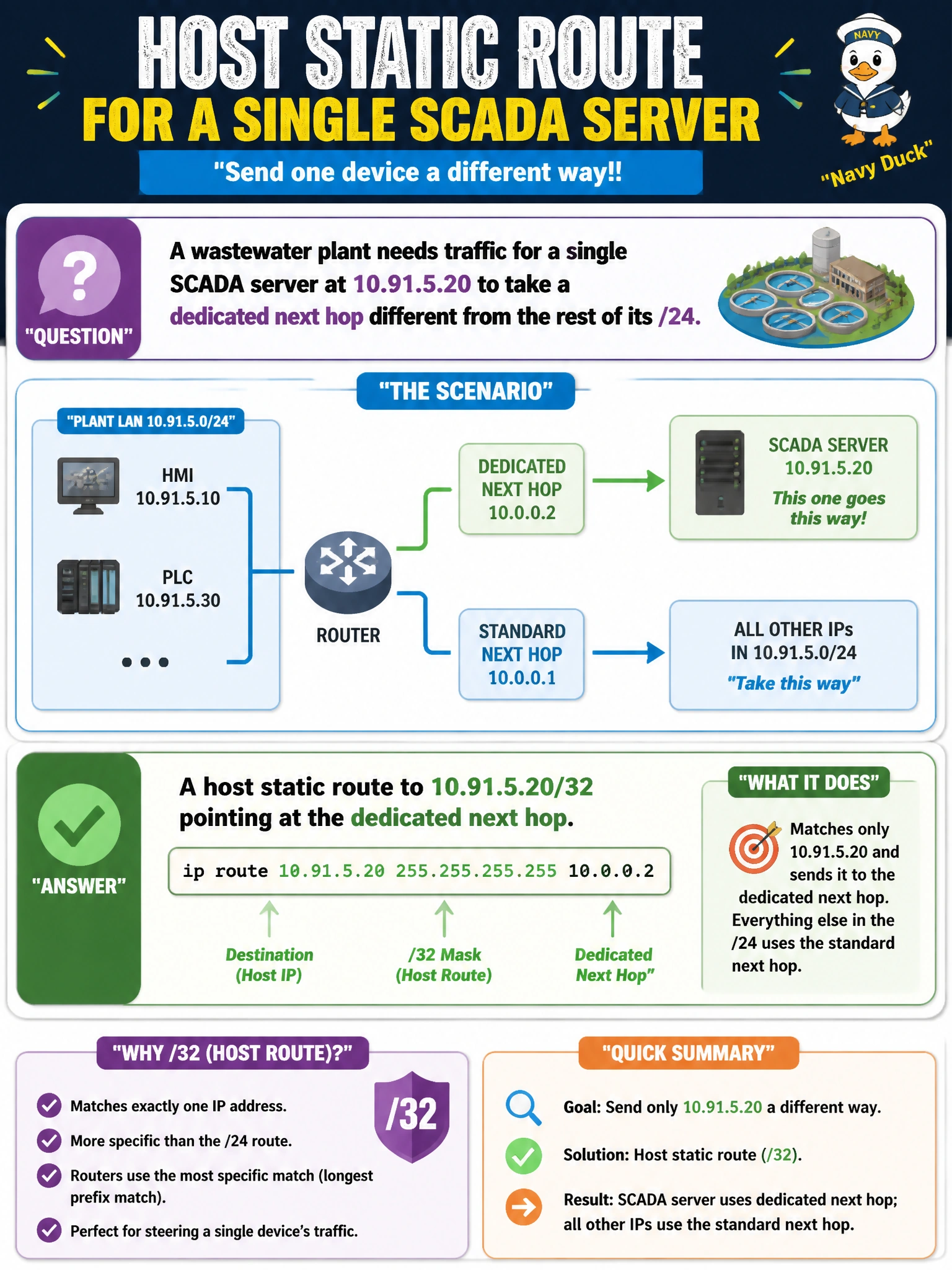
A wastewater plant needs traffic for a single SCADA server at 10.91.5.20 to take a dedicated next hop different from the rest of its /24. Which static route accomplishes that?
Select an answer to reveal the explanation.
Short Explanation
You can steer traffic for just the SCADA server with a host route to 10.91.5.20/32, sending it through the dedicated next hop. A /24 route covers the whole subnet, a default route does not isolate that host, and a native VLAN change does not create a Layer 3 route.
Full Explanation
To send traffic for the SCADA server at 10.91.5.20 through a dedicated next hop while other addresses in its /24 use the usual path, configure a host static route to 10.91.5.20/32 pointing to that next hop. Longest-prefix match selects the /32 for that one address ahead of the covering /24, providing precise Layer 3 traffic steering. A /24 network static cannot distinguish the server from the other hosts in the subnet, so it would direct the whole subnet rather than create a host-specific exception. A default route alone cannot prefer 10.91.5.20 over other destinations that match that default; where a /24 route exists, that more-specific route also takes precedence for the subnet, but does not isolate the server. Changing the native VLAN on the server access port changes Layer 2 classification and does not establish the required Layer 3 route to a dedicated next hop. Exam caveat: if the /32 next hop fails while the /24 route remains, traffic to the server may be black-holed; plan appropriate monitoring or a floating host route, and check return-path symmetry where firewalls require it. Practical check: inspect the route lookup for 10.91.5.20 and a neighboring address such as 10.91.5.21, then traceroute to both and document the SCADA host exception separately from the parent subnet route.