
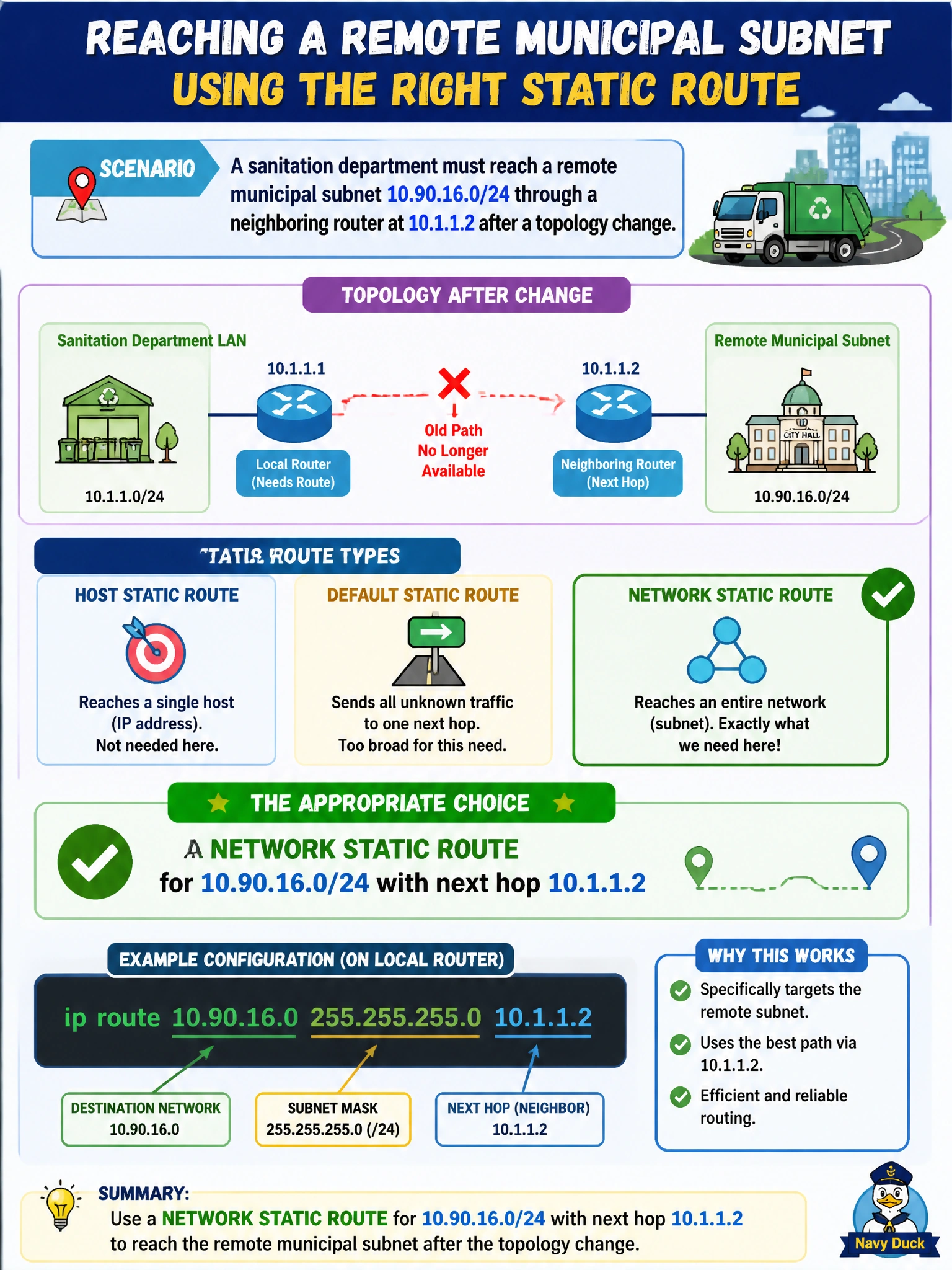
A sanitation department must reach a remote municipal subnet 10.90.16.0/24 through a neighboring router at 10.1.1.2 after a topology change. Which static route type is appropriate?
Select an answer to reveal the explanation.
Short Explanation
You can think of a network static route as one sticker for the whole remote block: 10.90.16.0/24 via 10.1.1.2. A default route is broader than you need, and entering a /32 for every PC is unnecessary when one route covers the subnet.
Full Explanation
To reach remote municipal subnet 10.90.16.0/24 through neighboring router 10.1.1.2, configure a network static route for 10.90.16.0/24 with that next hop. One entry targets the entire remote block, which is appropriate for a specific subnet. A default route only is broader than the requirement and cannot prefer this specific remote subnet over other destinations. A /32 host route for every PC is not appropriate as the only approach: it creates unnecessary per-host configuration when one network static route covers the block. An IPv6-only static is also incorrect; IPv4 network static routes remain standard on CCNA-level routers and are not obsolete. Exam caveat: a recursive static route requires its next hop to resolve through another route, while interface statics have different failure modes; when the neighbor IP is known and stable, prefer next-hop style. Practical check: enter ip route 10.90.16.0 255.255.255.0 10.1.1.2, run show ip route 10.90.16.0, then ping a host in the subnet from the sanitation edge and confirm the next hop remains reachable after the topology change.