
A stormwater bureau keeps a primary OSPF path to the treatment plant and wants a static backup that installs only if that path disappears. How should the floating static be configured?
Select an answer to reveal the explanation.
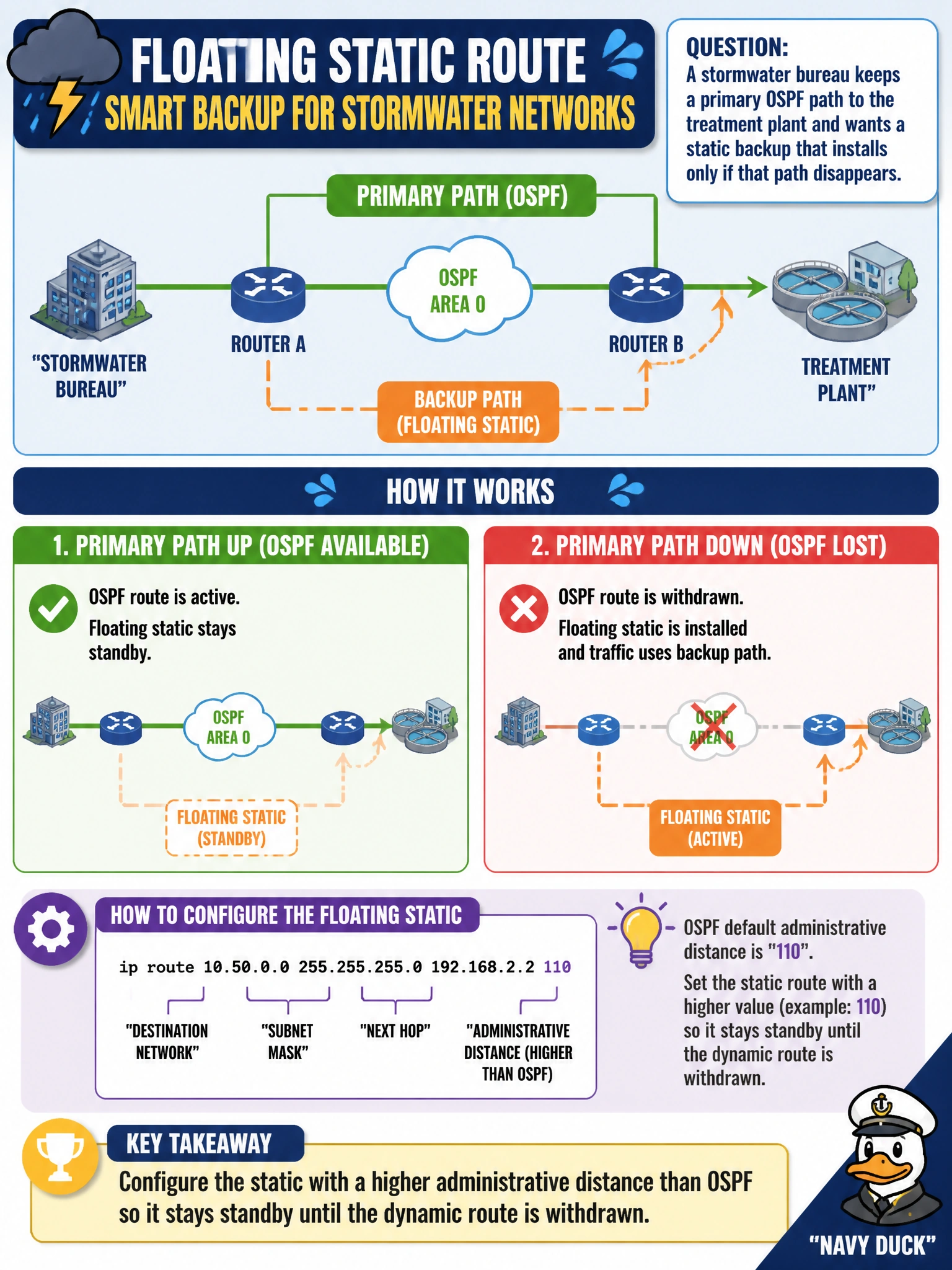
Short Explanation
Think of OSPF as the main road and the floating static as the spare key under the mat. Give that static a worse (higher) administrative distance so it stays out of the table until the main road vanishes — then it quietly takes over.
Full Explanation
A floating static route is the intentional standby path for the stormwater bureau’s treatment-plant reachability: keep the primary OSPF route in the RIB while a carefully worse static waits to install only after that dynamic path is withdrawn. Administrative distance (AD) is the tie-breaker among routing sources. OSPFv2 intra-area and inter-area routes typically use AD 110. A normal static defaults to AD 1, which would permanently override OSPF. For a backup that must stay dormant, raise the static’s AD above OSPF (commonly 121, 200, or another value higher than 110) so the static remains in the configuration but does not populate the routing table while OSPF still advertises the prefix. When the primary WAN or adjacency fails and OSPF withdraws the route, the higher-AD static installs and restores forwarding toward the treatment plant without waiting for a full redesign.
Setting the static AD lower than OSPF is the opposite of floating-static design: the static would always win and OSPF’s learned path would never be preferred. Advertising the static into OSPF Area 0 does not make it a floating backup; redistribution changes what neighbors learn and can create loops or primary preference issues unrelated to local standby behavior. Using an identical next hop and metric to force permanent load-balancing conflates equal-cost multipath with failover and does not implement “install only if the primary disappears.”
Exam caveat: AD comparison is local to the router installing the route; neighbors do not inherit your floating-static AD unless you redistribute. Also confirm you are floating against the correct OSPF AD (external OSPF may use 110 or 220 depending on type and platform defaults). Operational check: with OSPF up, verify the treatment-plant prefix shows as OSPF in the routing table and the static is absent or listed only as a candidate depending on platform display; shut the primary path or clear the OSPF neighbor, then confirm the static appears with the configured higher AD and that traffic to the plant follows the backup next hop.