
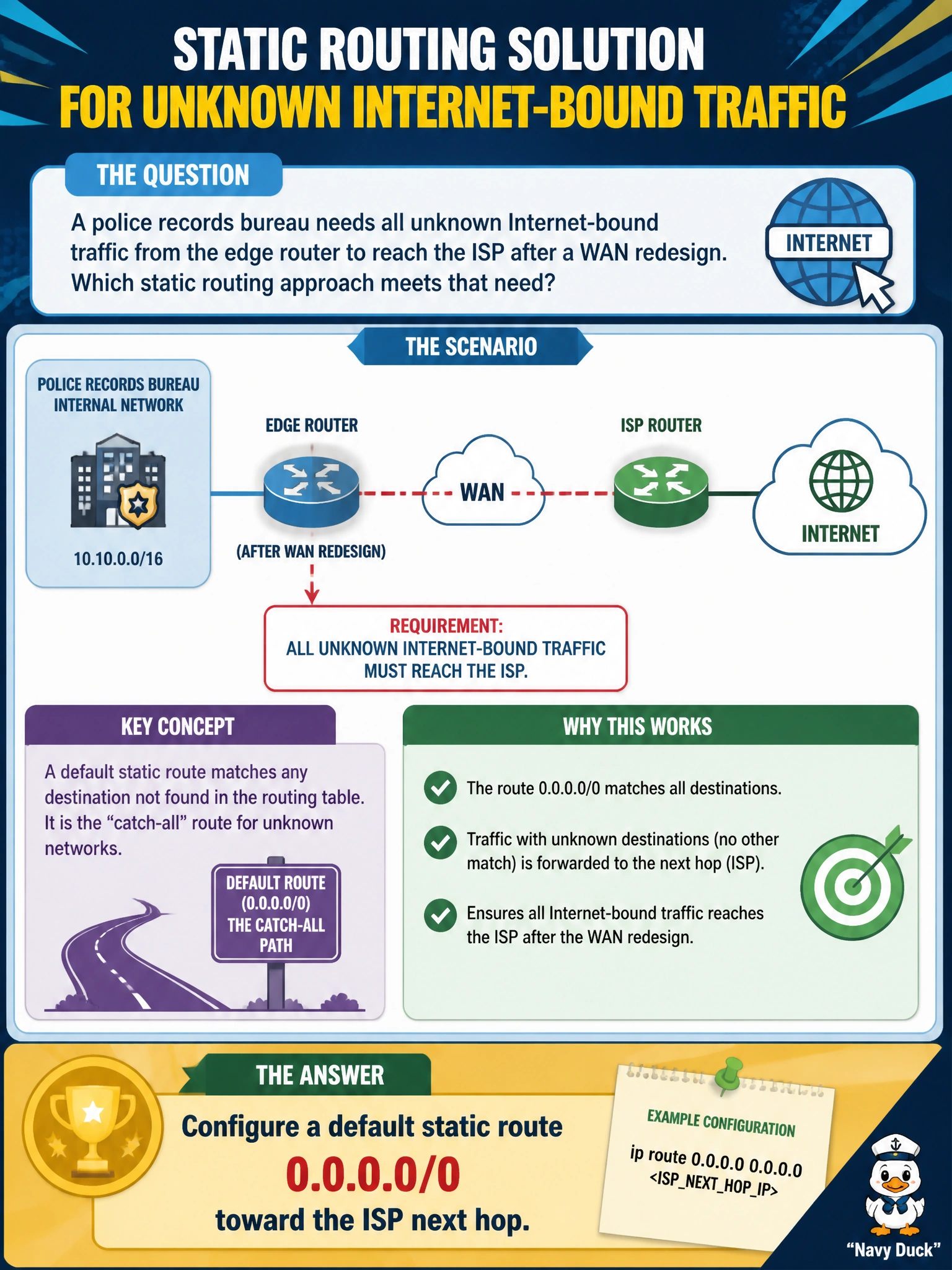
A police records bureau needs all unknown Internet-bound traffic from the edge router to reach the ISP after a WAN redesign. Which static routing approach meets that need?
Select an answer to reveal the explanation.
Short Explanation
You need a default route to send unknown Internet-bound traffic toward the ISP. A /32 route to the DNS server covers only that destination, and PortFast does not provide Internet routing.
Full Explanation
The bureau should configure a default static route, 0.0.0.0/0, toward the ISP next hop. It provides a gateway of last resort for IPv4 destinations that do not match a more specific route, making it the standard solution for general Internet egress from an edge router. A /32 host route to the ISP DNS server covers only that single destination; DNS reachability does not provide routes to general web or cloud destinations. Disabling the routing table and flooding IP packets like a hub is not how routers operate: routers forward packets using longest-prefix matching rather than hub-style flooding. Enabling PortFast on the ISP-facing switch port changes that port’s spanning-tree behavior; it does not create Layer 3 reachability to the Internet. Exam caveat: a default route can also be learned dynamically, and a static default requires a reachable next hop. Dual defaults may need tracking or different administrative distances for primary and backup ISP designs. Practical check: configure 0.0.0.0/0 via the ISP next hop, verify that the gateway of last resort appears, and, if policy permits, ping an external address; document the bureau’s Internet exit after the WAN redesign.