
An airport authority router has two candidate paths to the same clinic prefix from the same protocol with equal administrative distance. What breaks the tie for which path is preferred for forwarding?
Select an answer to reveal the explanation.
Short Explanation
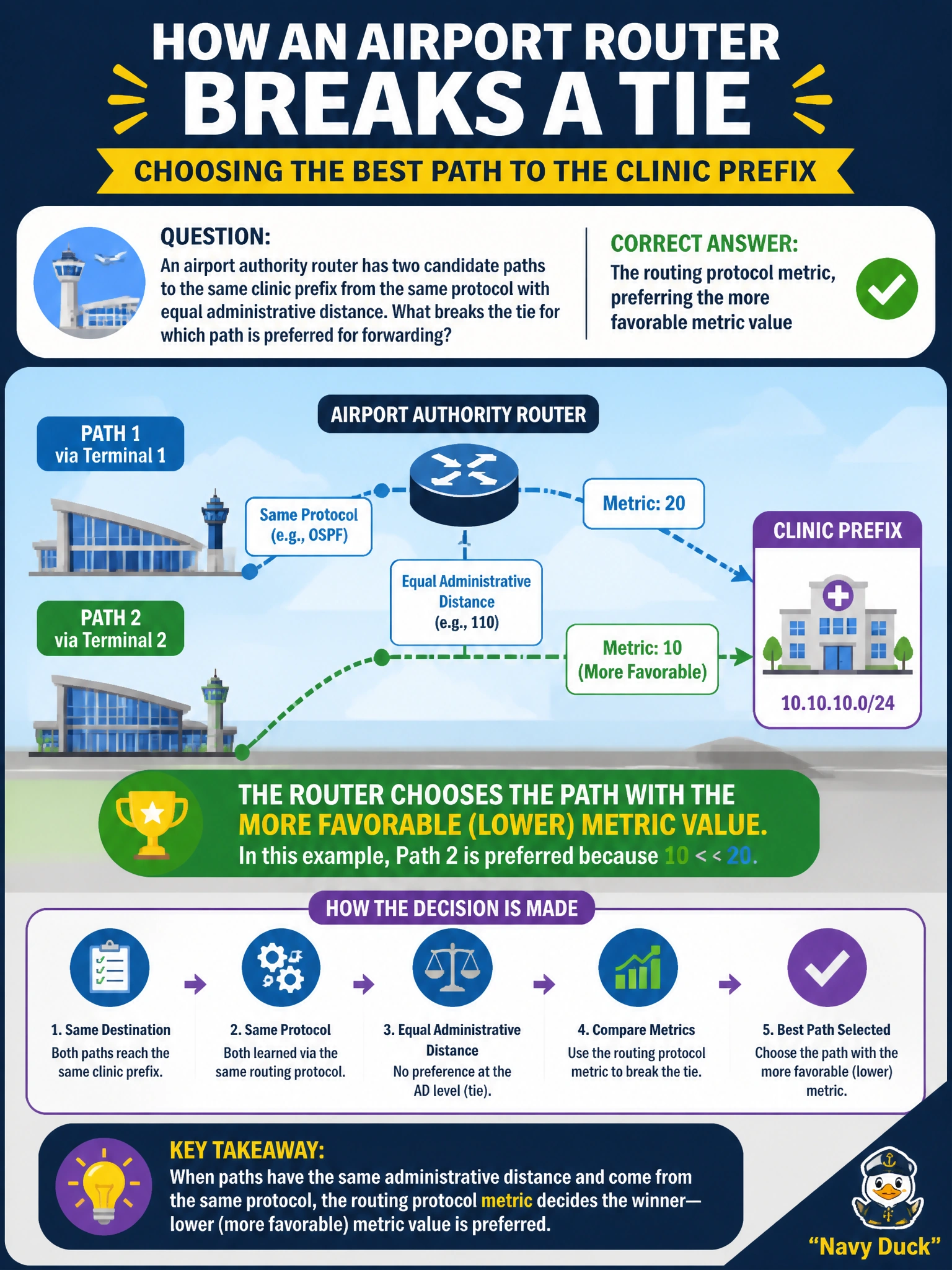
With the prefix and administrative distance tied, you use the routing protocol’s metric to choose the preferred path. Recent learning time, NTP stratum, and VLAN count do not decide this forwarding tie.
Full Explanation
When two candidate paths to the same clinic prefix come from the same protocol and have equal administrative distance, the router compares that protocol’s metric and prefers the path with the more favorable metric value. For OSPF, that means lower cost; other protocols follow their own metric rules. The metric is the protocol’s way to rank its candidate paths, so it determines which next hop the airport authority router installs for forwarding. Choosing the path learned most recently fails because recency does not override the protocol’s metric comparison. The NTP stratum of the edge clock fails because time-source quality does not select routes. The number of VLANs configured on the switch fails because VLAN count is unrelated to comparing routing metrics for the clinic prefix. Exam caveat: “more favorable” is protocol-specific, and equal metrics may allow multiple next hops for load sharing, depending on platform features. Practical check: inspect both candidates’ metrics for the clinic prefix with show ip route or the protocol-specific show command, confirm the selected next hop is installed, and use traceroute to verify the forwarding path. Recheck after changing link bandwidth or tuning metrics on the airport edge interfaces.