
A community college district router learns the same /24 clinic prefix from EIGRP (AD 90) and OSPF (AD 110). Which route enters the routing table?
Select an answer to reveal the explanation.
Short Explanation
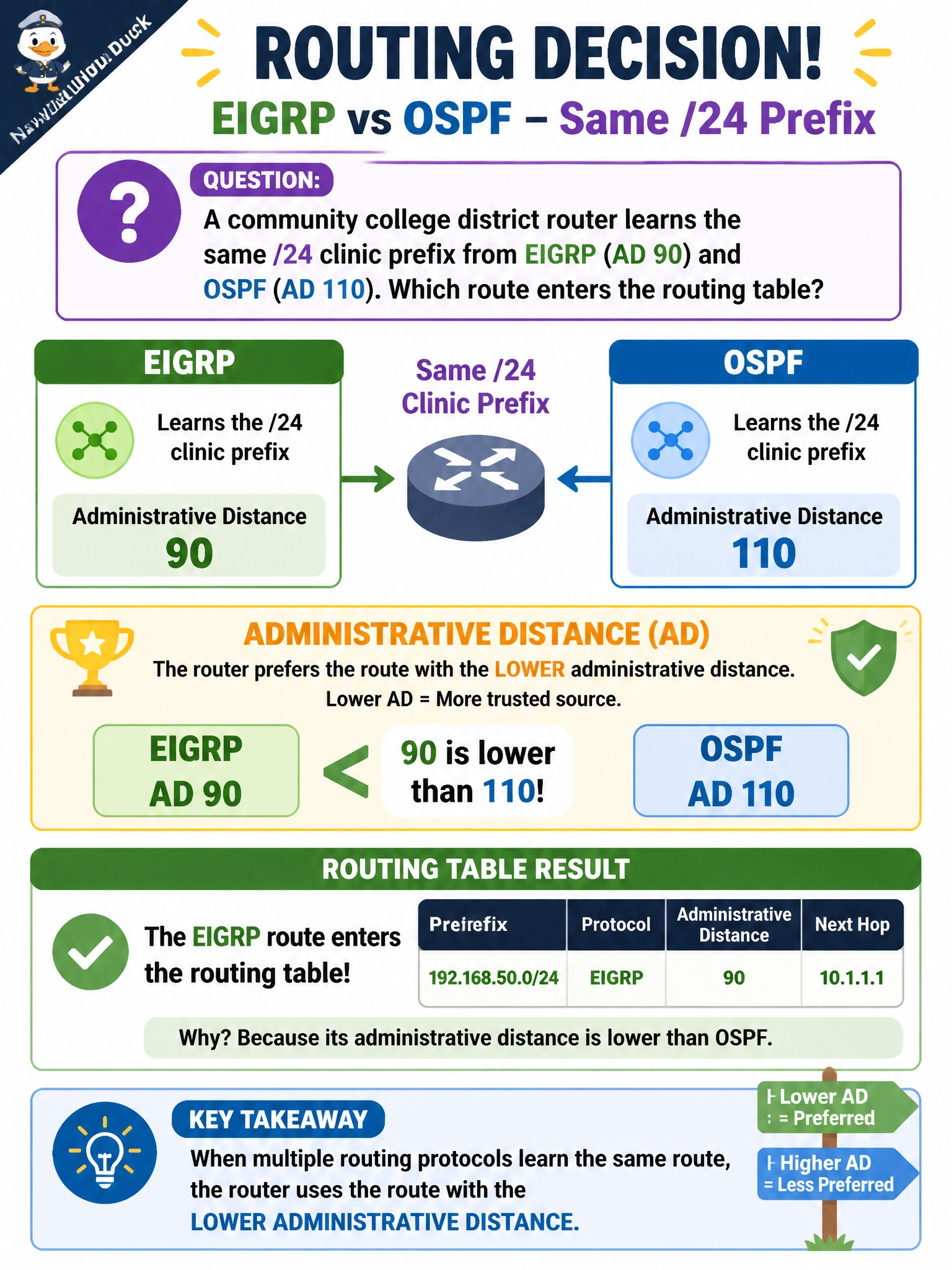
Same prefix, two protocols—lower AD wins, so EIGRP 90 beats OSPF 110. Matching prefixes alone do not create ECMP across different sources.
Full Explanation
A community college district router that learns the same /24 clinic prefix from EIGRP (AD 90) and OSPF (AD 110) installs the EIGRP route because lower administrative distance wins for equal-length prefixes from different protocols. Default Cisco AD values prefer EIGRP internal routes over OSPF, which matters when district boundaries, redistribution, or dual-IGP designs accidentally advertise the same campus clinic block from both protocols.
Choosing the OSPF route because OSPF is preferred over EIGRP by default fails; default AD favors EIGRP (90) over OSPF (110). Installing both as equal-cost multipath because the prefixes match fails because cross-protocol competition for the same prefix is resolved by AD, not automatic ECMP. Claiming neither installs until a floating static with AD 1 is added fails; the lower-AD dynamic route installs without requiring that static.
Exam caveat: EIGRP external routes use a different default AD than internal; always read the actual AD in show ip route rather than assuming every EIGRP entry is 90. Operational check: show ip route for the clinic /24, confirm EIGRP is installed with AD 90, note whether OSPF remains a candidate in the topology, traceroute a clinic host, and correct dual-origin advertisements if both IGPs should not own that district prefix.