
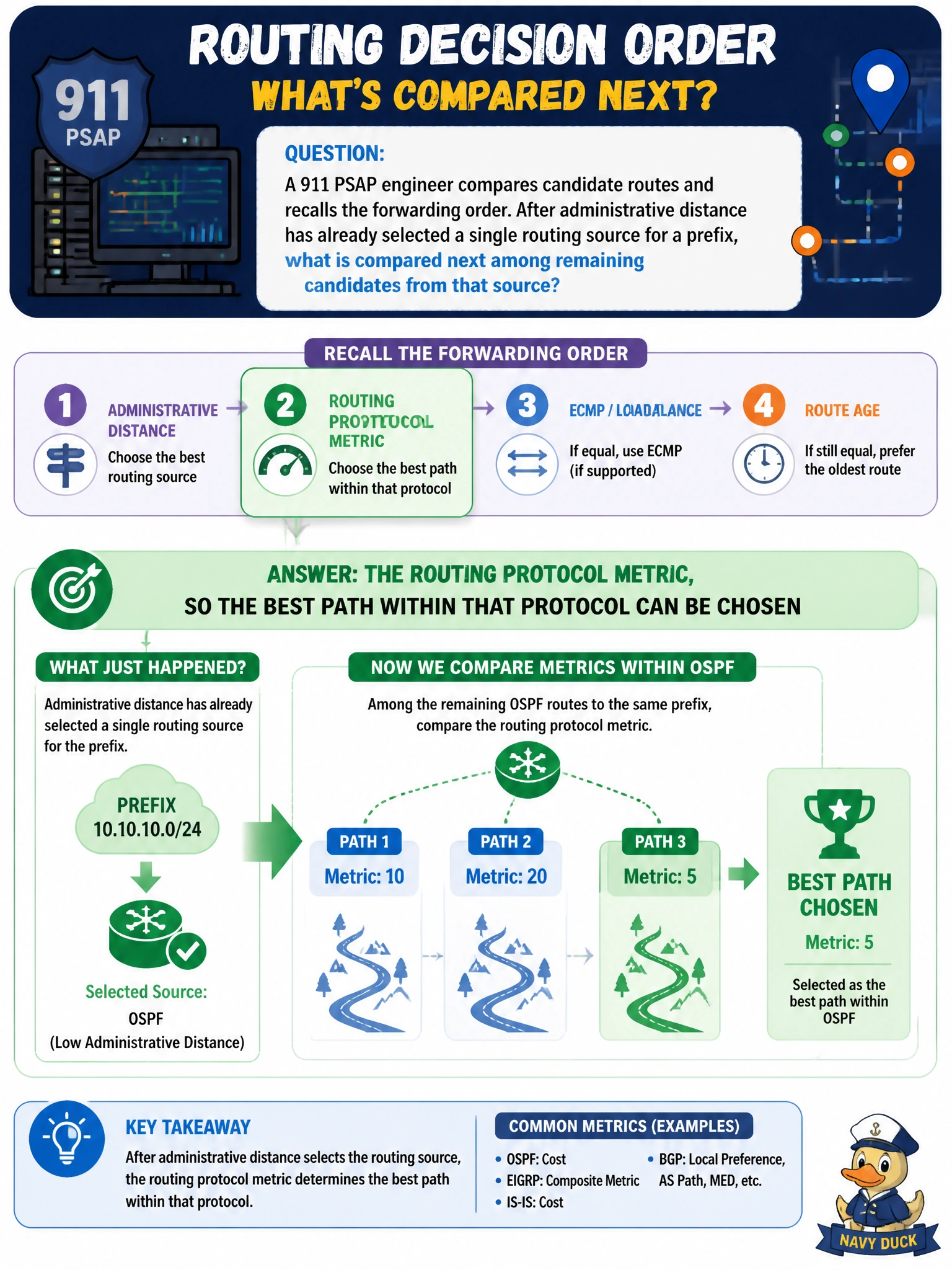
A 911 PSAP engineer compares candidate routes and recalls the forwarding order. After administrative distance has already selected a single routing source for a prefix, what is compared next among remaining candidates from that source?
Select an answer to reveal the explanation.
Short Explanation
First you pick which map vendor you trust (AD), then you pick the best road on that map (metric). RSSI, CDP name length, and syslog severity are not step two in IP forwarding.
Full Explanation
A 911 PSAP engineer recalling forwarding order should know that after administrative distance has selected a single routing source for a prefix, the routing protocol metric is compared next so the best path within that protocol can be chosen. Conceptually: longest match among covering prefixes, then AD among sources for that match context, then metric inside the winning source. Metric is therefore the intra-protocol step that finishes path selection for public-safety traffic.
Wireless RSSI of nearby APs fails because RF signal strength is not step two of IP RIB selection. CDP device-ID string length fails because CDP naming is unrelated to route metric comparison. Syslog severity of the last interface flap fails because logging severity does not choose among routing candidates.
Exam caveat: exact platform details (for example CEF load-sharing among equal metrics) can add behavior after metric ties, but the conceptual order remains longest match → AD → metric. Operational check: for competing PSAP routes, identify installed prefix length, confirm AD selected the intended source, then compare metrics within that source and verify the preferred next hop with show ip route and traceroute.