
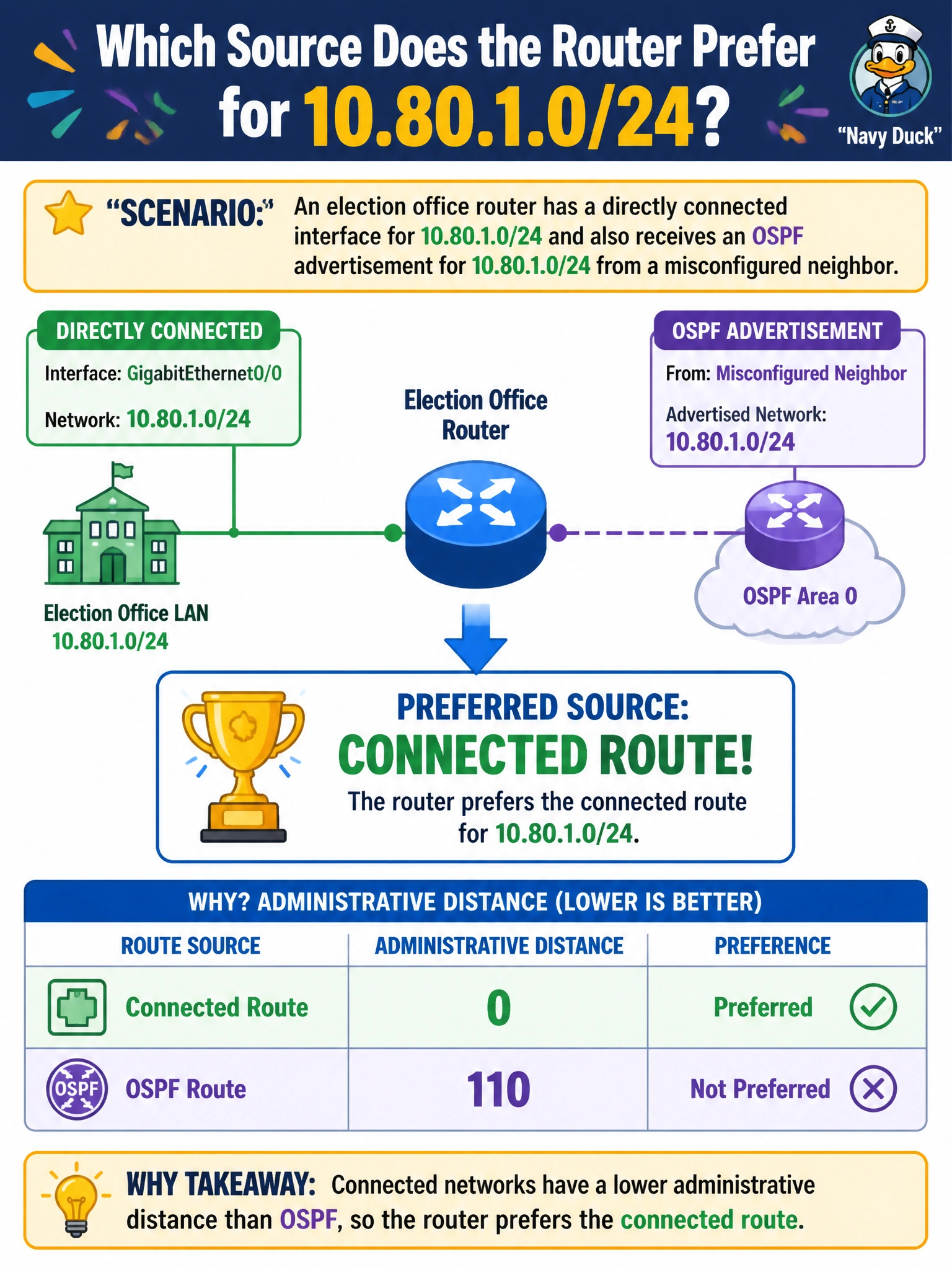
An election office router has a directly connected interface for 10.80.1.0/24 and also receives an OSPF advertisement for 10.80.1.0/24 from a misconfigured neighbor. Which source does the router prefer for that prefix?
Select an answer to reveal the explanation.
Short Explanation
If the subnet is plugged into your own interface, that is as trusted as it gets—connected AD beats OSPF. A neighbor’s advertisement does not kick out your own connected network.
Full Explanation
An election office router with a directly connected interface for 10.80.1.0/24 prefers that connected route over an OSPF advertisement for the same prefix from a misconfigured neighbor because connected networks have a lower administrative distance than OSPF. Local connectivity is trusted more than a dynamic claim for the same municipal block, which protects the office from a neighbor trying to override an attached subnet.
Preferring OSPF because dynamic updates always replace connected fails; connected AD is better (lower) than OSPF. Waiting for a static with AD 255 fails because AD 255 is not usable/installable in the usual sense and is not required to prefer connected. Installing both as ECMP regardless of AD fails because different AD sources do not form equal-cost multipath that way for the active entry selection.
Exam caveat: if the connected interface goes down, the connected route is withdrawn and a remaining OSPF path might install—dangerous if the OSPF advertisement was a misconfiguration claiming the office’s own space. Operational check: show ip route 10.80.1.0, confirm connected is installed, investigate why a neighbor advertises the same prefix, and filter or correct that OSPF advertisement to protect the election-office subnet.