
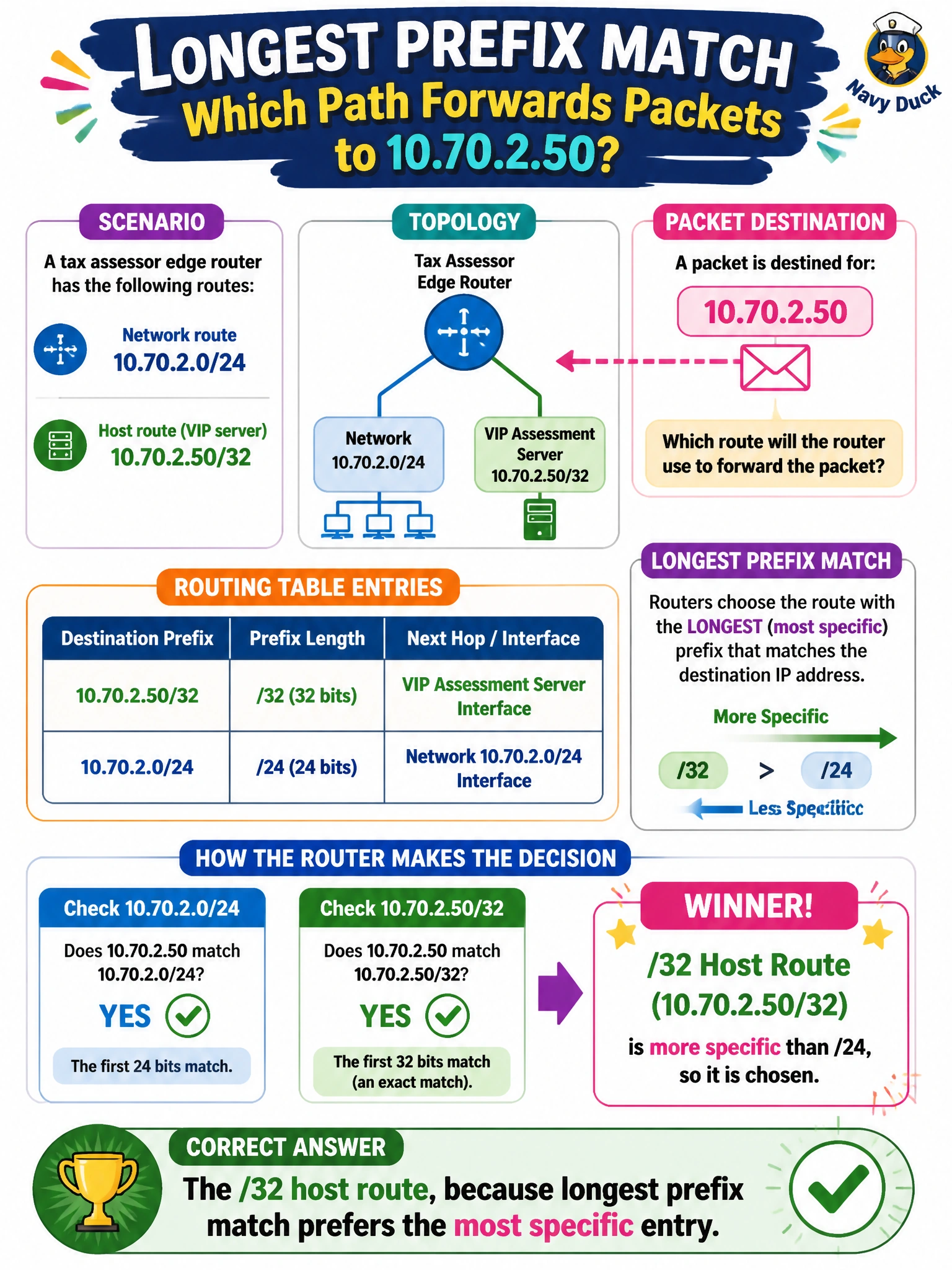
A tax assessor edge router has a network route 10.70.2.0/24 and a host route 10.70.2.50/32 for a VIP assessment server. Which path forwards packets destined to 10.70.2.50?
Select an answer to reveal the explanation.
Short Explanation
A /32 is a nameplate on one door—more specific than the whole hallway /24. IPv4 loves host routes; they are not an IPv6-only trick.
Full Explanation
A tax assessor edge router that has network route 10.70.2.0/24 and host route 10.70.2.50/32 for a VIP assessment server forwards packets destined to 10.70.2.50 via the /32 because longest prefix match prefers the most specific entry. Host routes are a standard IPv4 mechanism for steering one civic server differently from the rest of its subnet—useful for VIP firewall pinning, alternate WAN exit, or maintenance diversion.
Using the /24 only because host routes are never used when a network route exists fails; a more-specific /32 overrides the covering /24 for that single address. Claiming /32 routes are valid only in IPv6 fails because IPv4 host routes are /32 and are widely deployed. Forwarding via a default route only fails because both the /32 and /24 are longer matches than 0.0.0.0/0, so the default is not selected for the VIP.
Exam caveat: an orphaned or unreachable /32 next hop can black-hole only the VIP while the rest of the /24 still works—a common municipal troubleshooting trap. Operational check: show ip route 10.70.2.50 and confirm the host route is selected; show ip route 10.70.2.51 and confirm it follows the /24; traceroute both; verify the VIP next hop after any static or redistribution change on the assessor edge.