
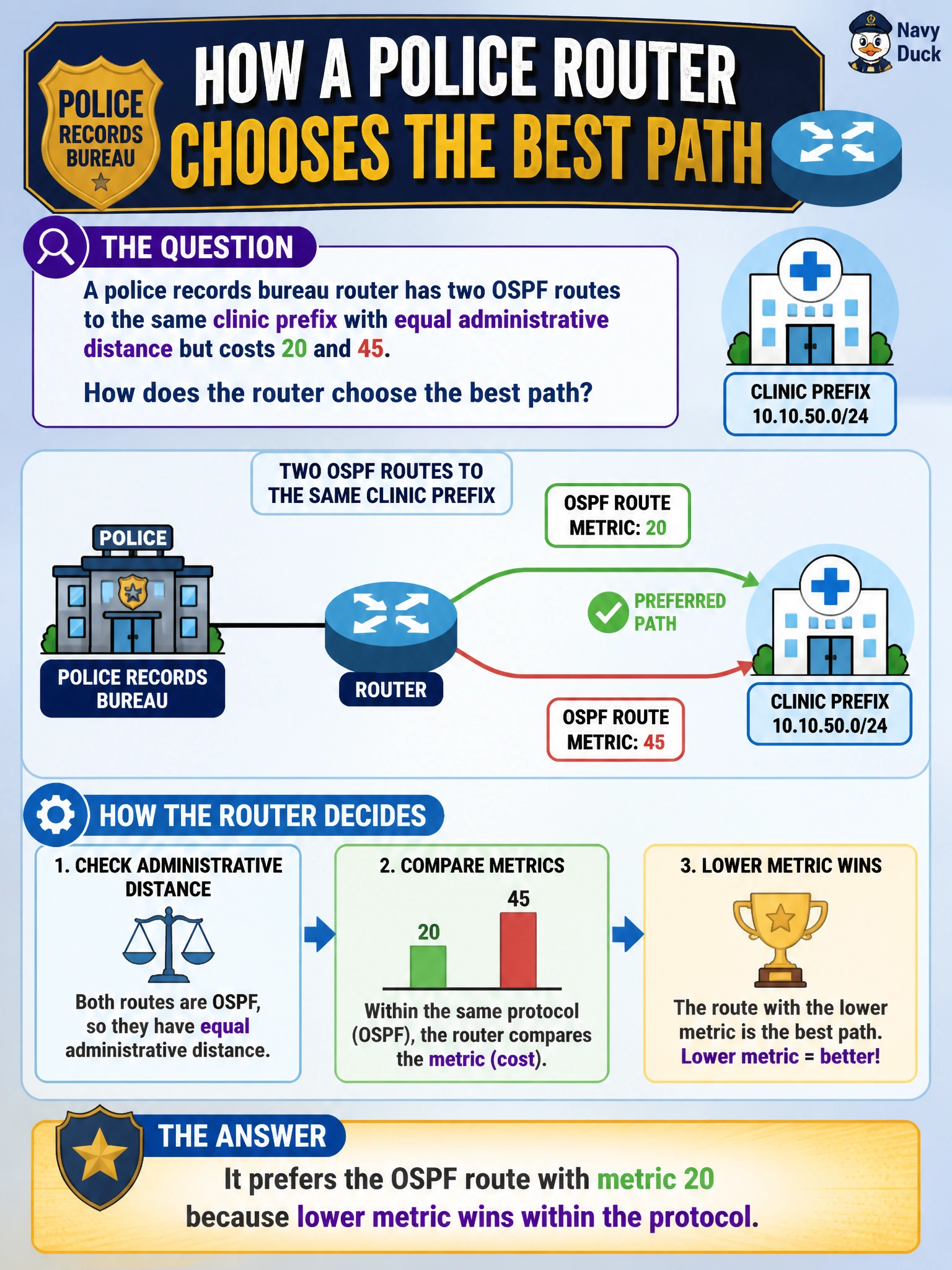
A police records bureau router has two OSPF routes to the same clinic prefix with equal administrative distance but costs 20 and 45. How does the router choose the best path?
Select an answer to reveal the explanation.
Short Explanation
Inside one protocol, metric is the scoreboard—lower OSPF cost is better. Bigger is not better here, and you do not wait around for EIGRP to break an OSPF tie.
Full Explanation
A police records bureau router with two OSPF routes to the same clinic prefix, equal administrative distance, and costs 20 and 45 prefers the OSPF route with metric 20 because after AD selects the OSPF source, lower metric wins within the protocol. OSPF cost is a relative path preference derived from interface bandwidth (or explicit cost); municipal operators use it to understand why one next hop is installed when multiple OSPF advertisements cover the clinic subnet.
Preferring metric 45 because “higher cost means more reliable” fails because OSPF treats higher cost as a worse path, not a better one. Ignoring metric and hashing packets by source MAC only fails because MAC-based hashing is not the primary OSPF best-path decision for installing the preferred route in the RIB. Installing neither until an EIGRP route appears fails because an OSPF-versus-OSPF metric comparison does not require another protocol to resolve.
Exam caveat: if both OSPF costs are equal, the router may install multiple equal-cost next hops (ECMP) rather than a single winner; unequal costs such as 20 vs 45 produce a clear preference. Operational check: show ip route for the clinic prefix, compare the OSPF costs 20 and 45 in the candidate or installed entries, confirm forwarding via the cost-20 next hop, and re-check after interface bandwidth or ip ospf cost changes on bureau uplinks.