
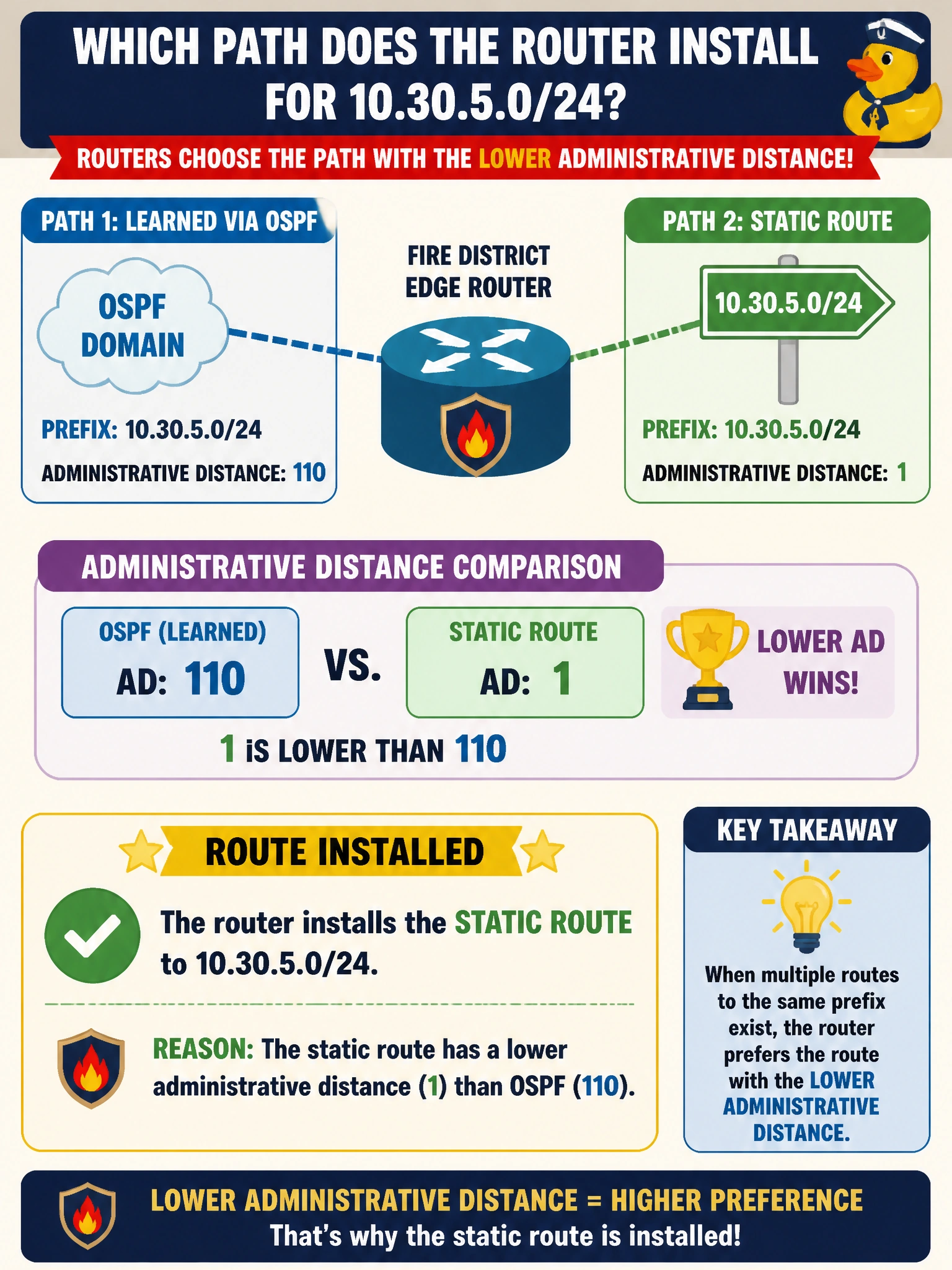
A fire district edge router learns 10.30.5.0/24 from OSPF (AD 110) and also has a static route to the same prefix with AD 1. Which path does the router install for that prefix?
Select an answer to reveal the explanation.
Short Explanation
Same street listed by two sources—pick the more trusted vendor. Static AD 1 beats OSPF 110, so the static installs. Dynamics do not automatically outrank statics.
Full Explanation
A fire district edge router that learns 10.30.5.0/24 from OSPF (AD 110) and also has a static route to the same prefix with AD 1 installs the static path because lower administrative distance wins among equal-length sources. Default Cisco AD values prefer a normal static over OSPF, which is why a manually preferred district path can override a dynamically learned station or clinic subnet when both offer the identical prefix.
Choosing the OSPF route because “dynamic protocols always beat static” fails by concept: with default distances, static AD 1 beats OSPF AD 110. Claiming neither route installs because identical prefixes cancel each other fails because the router prefers one source rather than deleting both. Claiming both install equally because AD is ignored when prefixes match fails; AD is exactly the mechanism that selects among different sources for the same prefix length.
Exam caveat: administrators can raise static AD (floating static) so OSPF remains primary until failure; always read the configured AD rather than assuming every static is AD 1. Operational check: show ip route 10.30.5.0 on the fire-district edge, confirm the installed entry shows static with AD 1, verify whether OSPF still holds a candidate elsewhere in the topology, traceroute a host in that subnet, and document the district’s static-versus-OSPF preference policy for that prefix.