
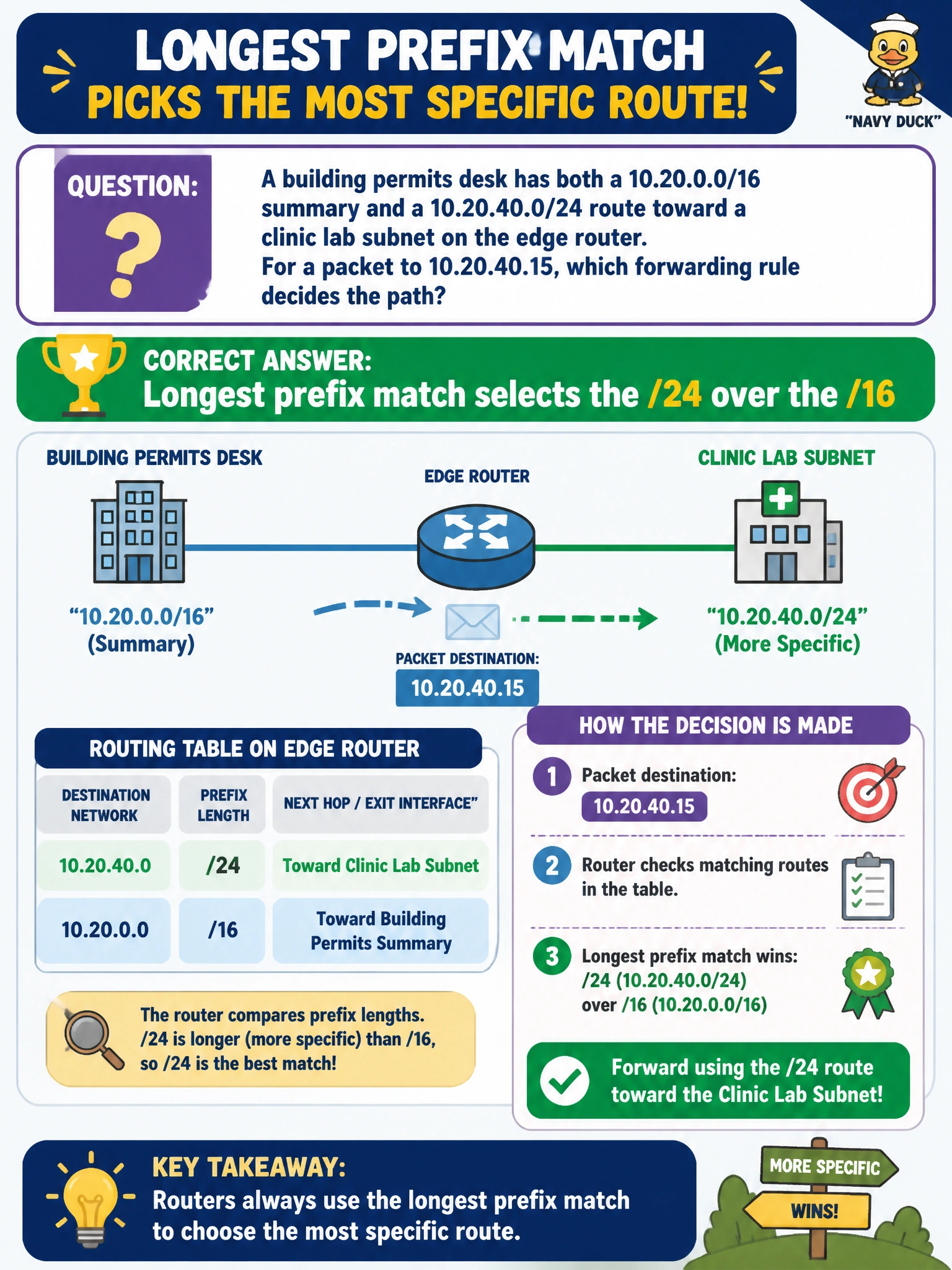
A building permits desk has both a 10.20.0.0/16 summary and a 10.20.40.0/24 route toward a clinic lab subnet on the edge router. For a packet to 10.20.40.15, which forwarding rule decides the path?
Select an answer to reveal the explanation.
Short Explanation
More house numbers matching wins—/24 is a tighter fit than /16 for 10.20.40.15. AD comes later among sources; STP does not referee IPv4 longest-match.
Full Explanation
A building permits desk edge router that has both 10.20.0.0/16 and 10.20.40.0/24 toward a clinic lab subnet forwards a packet to 10.20.40.15 using longest prefix match, selecting the /24 over the /16. Among routes that cover the destination, the most specific (longest) matching prefix wins. That rule is fundamental for municipal traffic steering when summaries and more-specific clinic routes coexist.
Claiming administrative distance always ignores prefix length fails because AD is not a substitute for longest-match; different-length matches are resolved by specificity first. Claiming the router randomly load-shares between /16 and /24 for every packet fails because unequal prefix lengths do not create that ECMP behavior. Claiming Spanning Tree root priority overrides IP prefix matching fails because STP does not replace Layer 3 longest-match forwarding.
Exam caveat: if two routes have the same prefix length, then source (AD) and metric matter; longest-match is about different lengths covering the same destination. Operational check: show ip route 10.20.40.15 (or the clinic host), confirm the /24 is selected, and traceroute from the permits edge to verify packets toward the lab follow the more-specific next hop rather than the /16 summary.