
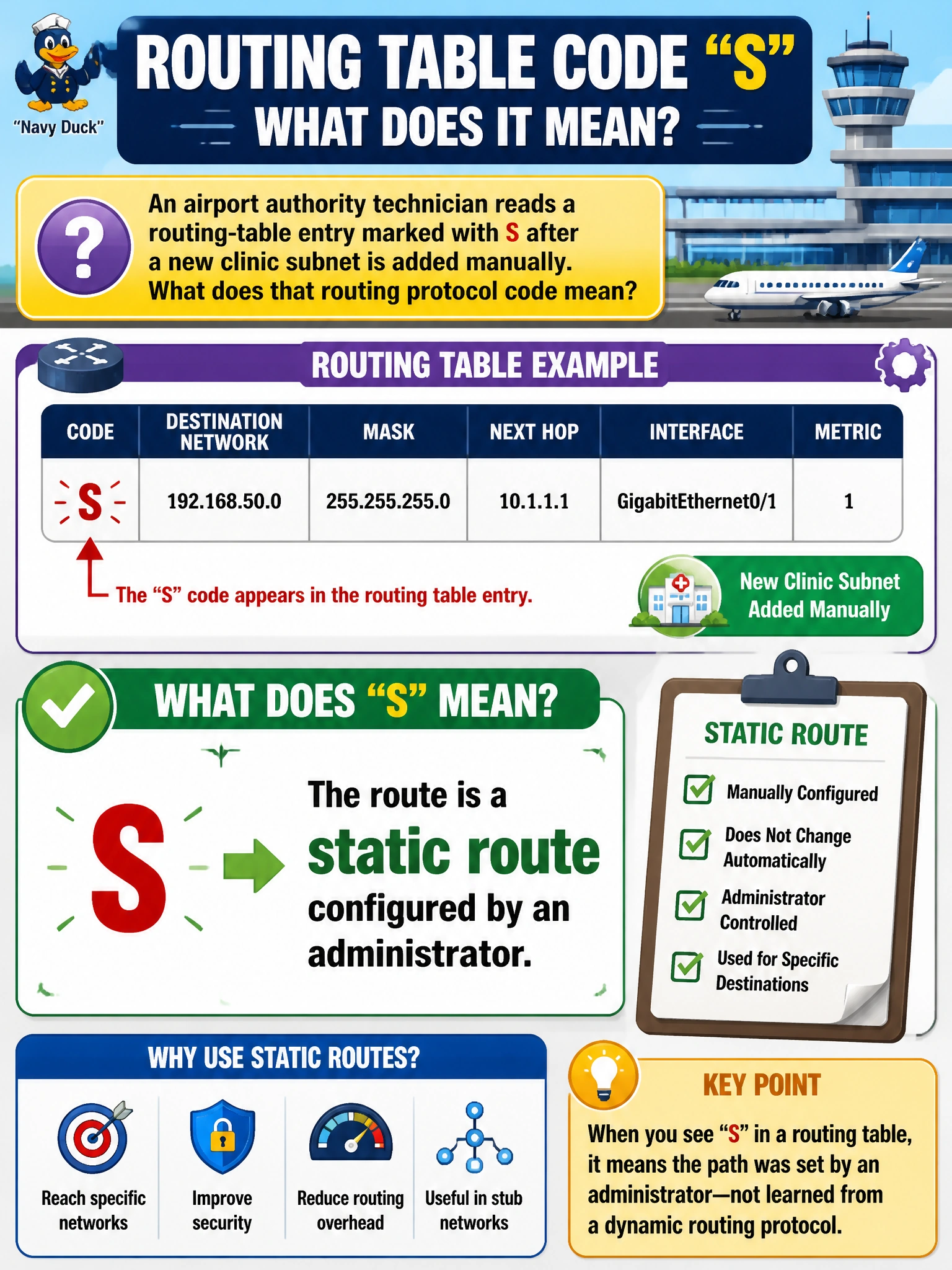
An airport authority technician reads a routing-table entry marked with S after a new clinic subnet is added manually. What does that routing protocol code mean?
Select an answer to reveal the explanation.
Short Explanation
S is the static badge—someone typed that route in on purpose. OSPF wears O, connected routes wear C, and EIGRP is not what S means here.
Full Explanation
When an airport authority technician reads a routing-table entry marked with S after a new clinic subnet is added manually, that protocol code means the route is a static route configured by an administrator. Cisco IOS labels each RIB entry with a source code so operators can audit whether a civic prefix was typed in, learned dynamically, or derived from a connected interface. Seeing S confirms the clinic path exists because someone configured an ip route (or equivalent), not because OSPF or EIGRP advertised it.
Interpreting S as an OSPF-learned route fails because OSPF uses O (with possible IA/E1/E2 suffixes). Interpreting S as a connected network discovered from an up interface fails because connected routes use C and appear when an interface has an address and is up/up. Interpreting S as an EIGRP path fails because EIGRP uses D; S is specifically the static badge on standard CCNA-level tables.
Exam caveat: floating statics still show S even when AD is raised above the default; a configured static may also exist in the configuration without installing while a better-AD source owns the prefix. Operational check: show ip route for the clinic prefix and confirm code S, match the entry to the running-config ip route statement (prefix, mask, next hop, optional AD), and document that the airport edge path was manually added rather than learned via OSPF or EIGRP after the change window.