
A community college district admin verifies the edge router after a topology change and needs traffic for unknown destinations to leave toward the ISP. Which routing-table concept confirms that fallback?
Select an answer to reveal the explanation.
Short Explanation
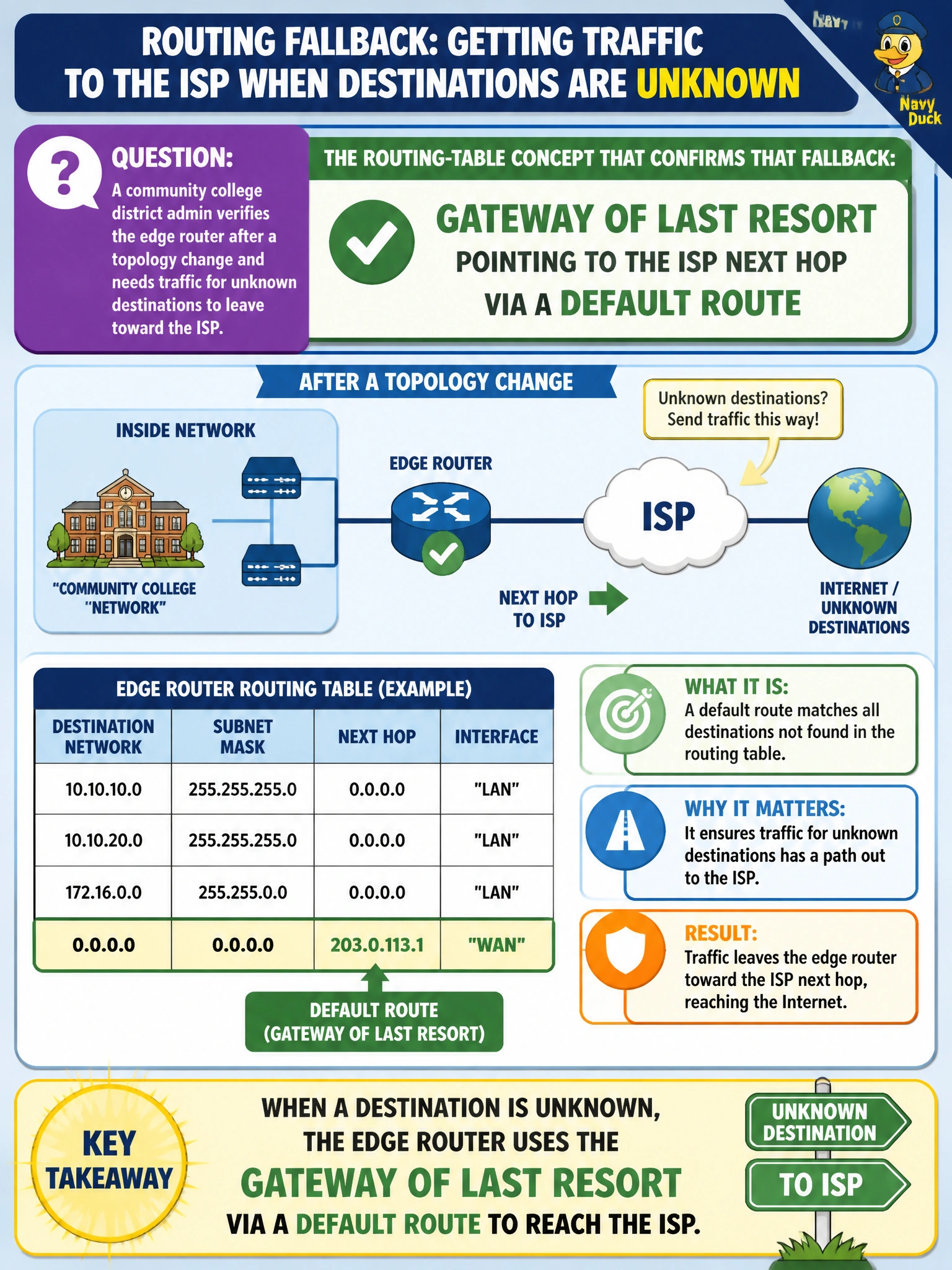
Unknown destinations need a labeled “everything else” exit—that is the gateway of last resort. A single host route, an access port, or an LACP priority will not cover the rest of the Internet.
Full Explanation
After a community college district topology change, confirming that unknown destinations leave toward the ISP means verifying the gateway of last resort pointing to the ISP next hop via a default route. That routing-table concept is the catch-all exit for destinations that match no longer prefix. District edge routers rely on it so Internet-bound student and staff traffic still has a defined path when only local and summary routes are otherwise present.
A host /32 for the district DNS server fails because it covers one address only and cannot serve as a general Internet fallback. VLAN access-port assignment on a closet switch fails because it only places a port in a Layer 2 VLAN; it does not create an IP default exit. EtherChannel LACP system priority fails because it influences LACP actor selection for bundling, not default routing toward an ISP.
Exam caveat: gateway of last resort may be static or dynamically injected; also ensure the default is not accidentally more preferred than intended internal routes for overlapping space. Operational check: show ip route | include Gateway|0.0.0.0, confirm next hop is the ISP, test an unmatched destination (policy permitting), and re-verify after the topology change that the college edge still has a working default.