
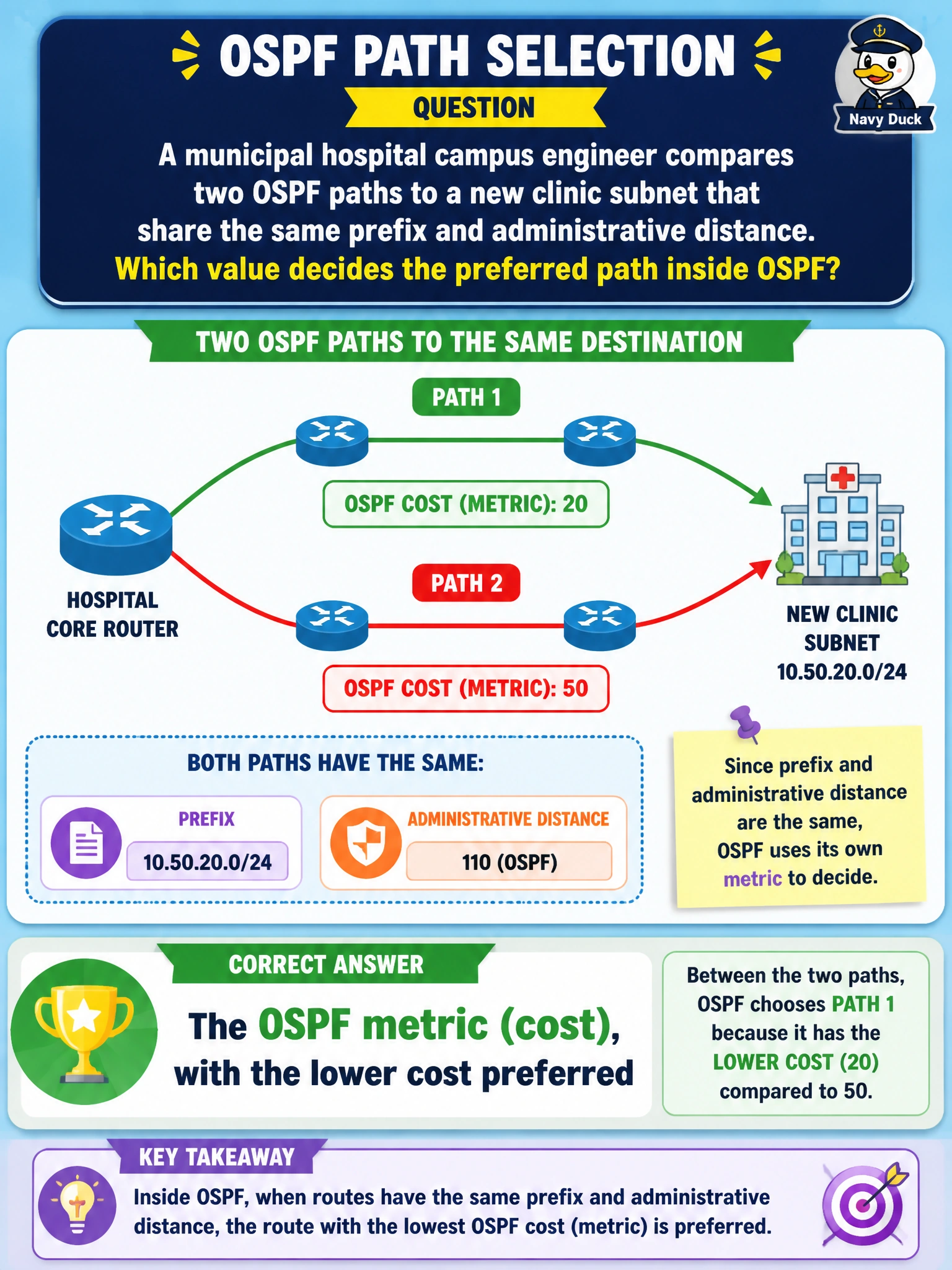
A municipal hospital campus engineer compares two OSPF paths to a new clinic subnet that share the same prefix and administrative distance. Which value decides the preferred path inside OSPF?
Select an answer to reveal the explanation.
Short Explanation
Same protocol, same destination—now you pick the cheaper toll road. That toll is the OSPF cost/metric. DHCP timers, Wi-Fi channels, and STP priority are not OSPF path pickers.
Full Explanation
A municipal hospital campus engineer comparing two OSPF paths to the same clinic prefix that already share administrative distance must decide with OSPF metric (cost): the lower cost is preferred. After AD has established OSPF as the selected source, cost is the intra-protocol path selector that steers campus traffic onto the better SPF path toward the clinic subnet. Cost usually reflects interface bandwidth relative to the OSPF reference bandwidth unless manually set with ip ospf cost.
DHCP lease time on clinic PCs fails because lease timers only control client address renewal and expiry; they do not participate in OSPF path selection. Wireless channel numbers used by clinic APs fail because RF channel planning is unrelated to link-state metrics in the routing domain. Spanning-tree bridge priority on the access switch fails because STP shapes Layer 2 forwarding topology and blocked ports; it does not replace OSPF cost when choosing among IP paths to a prefix.
Exam caveat: equal OSPF costs may install multiple next hops (ECMP) depending on platform configuration; unequal costs yield a single preferred path. Changing reference-bandwidth inconsistently across routers can skew costs unexpectedly. Operational check: compare show ip ospf interface / show ip route costs for both hospital paths to the clinic prefix, confirm the lower-cost next hop is installed, and re-validate after any bandwidth statement or explicit cost change on campus WAN or LAN OSPF links.