
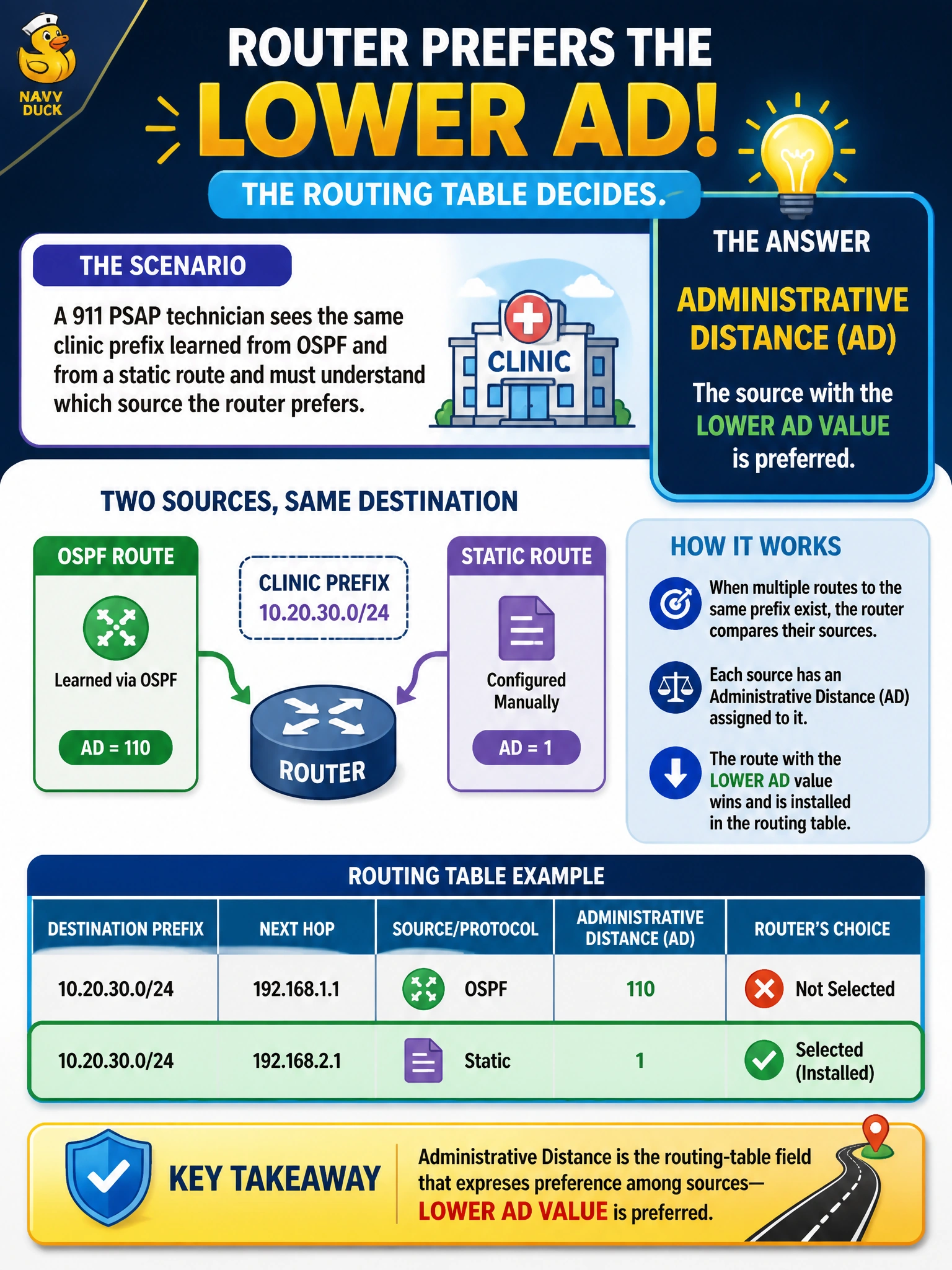
A 911 PSAP technician sees the same clinic prefix learned from OSPF and from a static route and must understand which source the router prefers. Which routing-table field expresses that preference among sources?
Select an answer to reveal the explanation.
Short Explanation
When two map vendors list the same street, AD is the trust ranking—lower number wins. Window size, native VLAN, and PoE class are not how routers pick a route source.
Full Explanation
When a 911 PSAP technician sees the same clinic prefix learned from OSPF and from a static route, administrative distance expresses preference among those sources: the lower AD value is preferred and typically becomes the installed routing-table entry. On Cisco routers, a default static route (AD 1) outranks OSPF (AD 110), so understanding AD explains which path public-safety traffic takes when both sources advertise one municipal clinic prefix. AD is not a bandwidth measurement; it is a trust ranking among route origins.
TCP window size fails by concept because it only affects transport-layer throughput and flow control between endpoints; it never ranks route sources in the RIB. Native VLAN assignment fails because it only classifies untagged frames on a trunk at Layer 2 and does not choose between static and OSPF for an IP prefix. PoE power class fails because it only governs power delivery to powered devices; it has no role in administrative-distance comparison.
Exam caveat: AD decides among equal-length candidates from different sources; a longer prefix still wins via longest-match before AD is the headline comparison. Floating statics intentionally use higher AD so OSPF can win until failure. Operational check: on the PSAP edge, show ip route for the clinic prefix, read the bracketed [AD/metric] values, confirm which source is installed, compare against the intended static-versus-OSPF policy, and traceroute to a clinic host to verify the preferred next hop after both sources are present.