
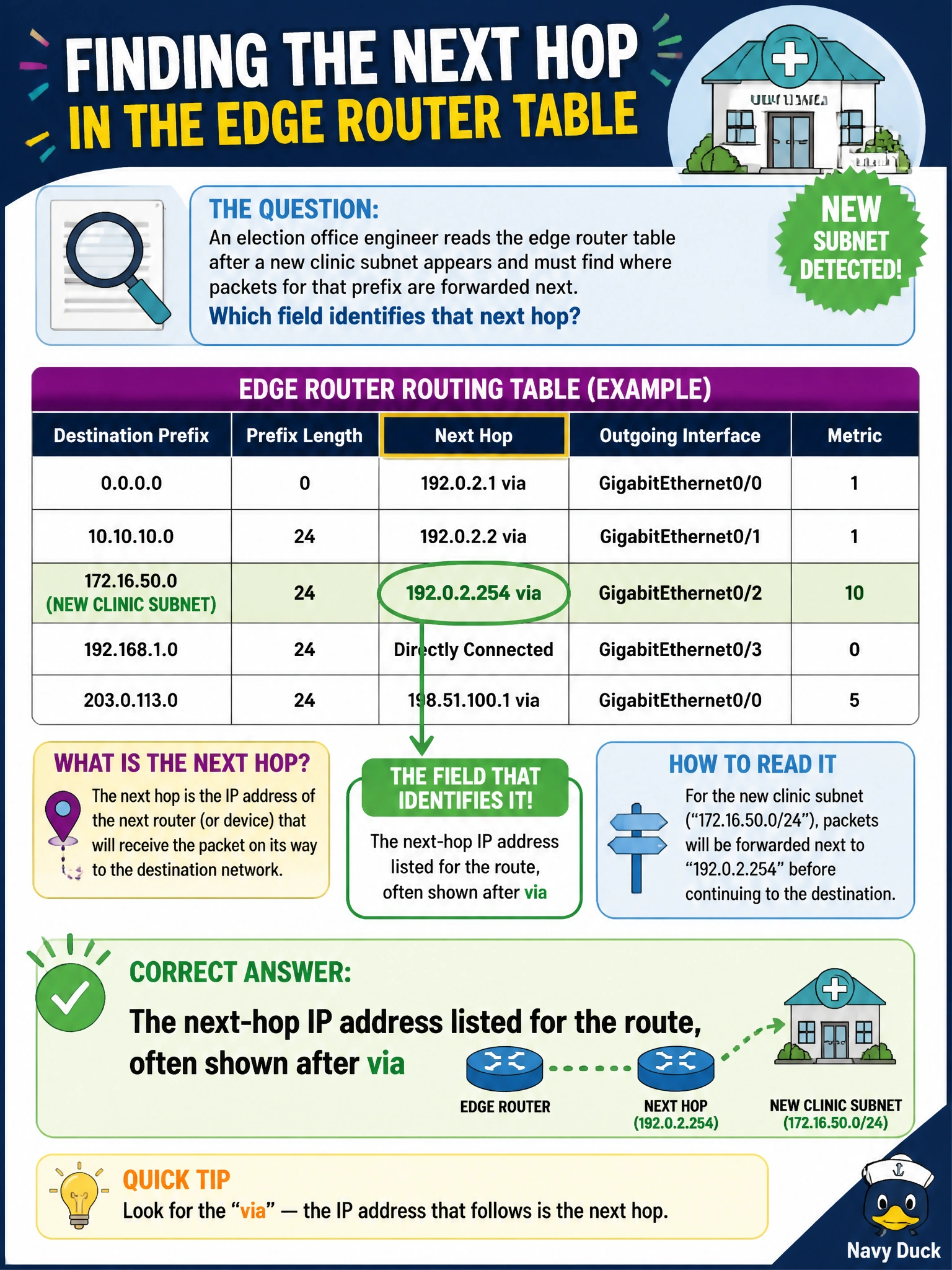
An election office engineer reads the edge router table after a new clinic subnet appears and must find where packets for that prefix are forwarded next. Which field identifies that next hop?
Select an answer to reveal the explanation.
Short Explanation
Next hop is the neighbor IP you hand the packet to—like the next depot on a courier run. Area numbers, syslog codes, and SSIDs do not tell the router the Layer 3 next hop.
Full Explanation
An election office engineer locating where packets for a new clinic prefix go next must read the next-hop IP address listed for the route, commonly shown after via. That field is the neighboring Layer 3 device that should receive matching packets. For civic edge routers, confirming next hop is the operational way to prove traffic toward a clinic leaves toward the intended neighbor rather than a stale or wrong exit.
OSPF area number alone fails because areas scope link-state databases and flooding domains; they are not the forwarding next hop printed in the routing table. Syslog facility codes fail because they only classify log messages for filtering and severity handling. Clinic guest WLAN SSIDs fail because they name wireless networks for client association; they do not identify the IP next hop for a routed prefix on the edge router.
Exam caveat: some routes are connected or interface-static and may show an exit interface without a via IP; when via is present, that IP is the next hop, and recursive resolution may still apply. Operational check: show ip route for the clinic prefix, record the via address and outbound interface, ping/traceroute the next hop, and confirm CEF/adjacency is valid so election-office traffic to the clinic is forwarded correctly.