
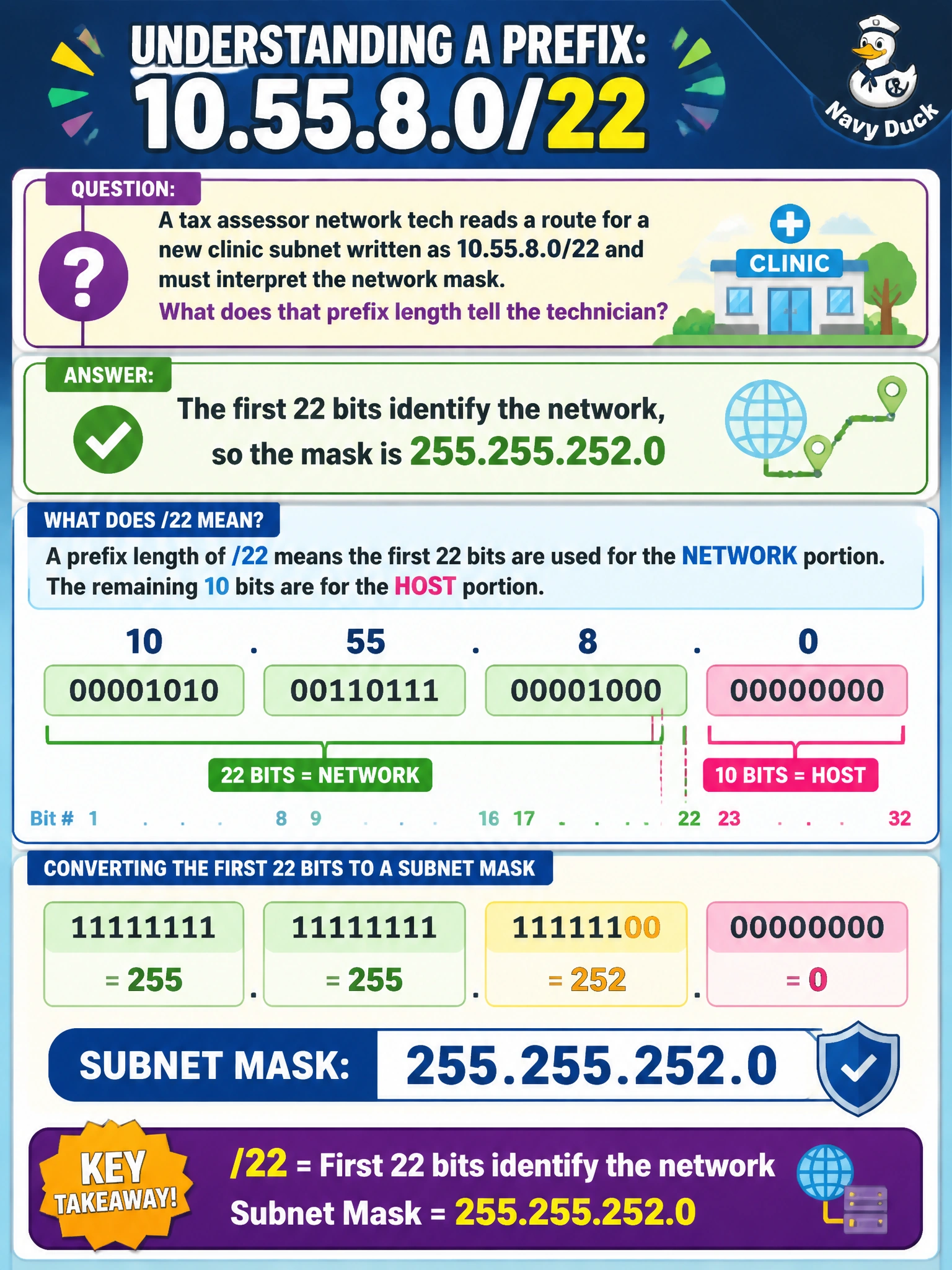
A tax assessor network tech reads a route for a new clinic subnet written as 10.55.8.0/22 and must interpret the network mask. What does that prefix length tell the technician?
Select an answer to reveal the explanation.
Short Explanation
/22 is just a shorthand for how wide the network fence is—255.255.252.0. Those 22 bits mark the network side, not the host side, and /22 is perfectly normal IPv4.
Full Explanation
When a tax assessor network technician sees 10.55.8.0/22 for a new clinic subnet, the prefix length means the first 22 bits identify the network portion. That corresponds to subnet mask 255.255.252.0. Understanding slash notation lets municipal staff size and verify larger clinic or campus blocks without mistaking prefix length for host count or assuming IPv4 cannot use /22.
Saying the first 22 bits identify only the host portion fails by concept: leading bits are network/subnet bits; remaining bits are host bits. Claiming exactly 22 usable hosts exists fails because /22 yields far more addresses (10 host bits → 1022 usable hosts in classic IPv4 subnetting, ignoring special cases). Claiming /22 is IPv6-only fails because /22 is a valid, common IPv4 prefix length for larger municipal aggregates.
Exam caveat: usable-host formulas and whether network/broadcast are reserved depend on context (legacy subnetting vs some point-to-point or /31 usage); the exam point here is mask equivalence of /22 to 255.255.252.0, not a host-count trick. Operational check: convert /22 to dotted mask, confirm the clinic addressing plan uses 255.255.252.0, and verify the routing-table prefix matches the allocated block before advertising or static-routing that clinic subnet.