
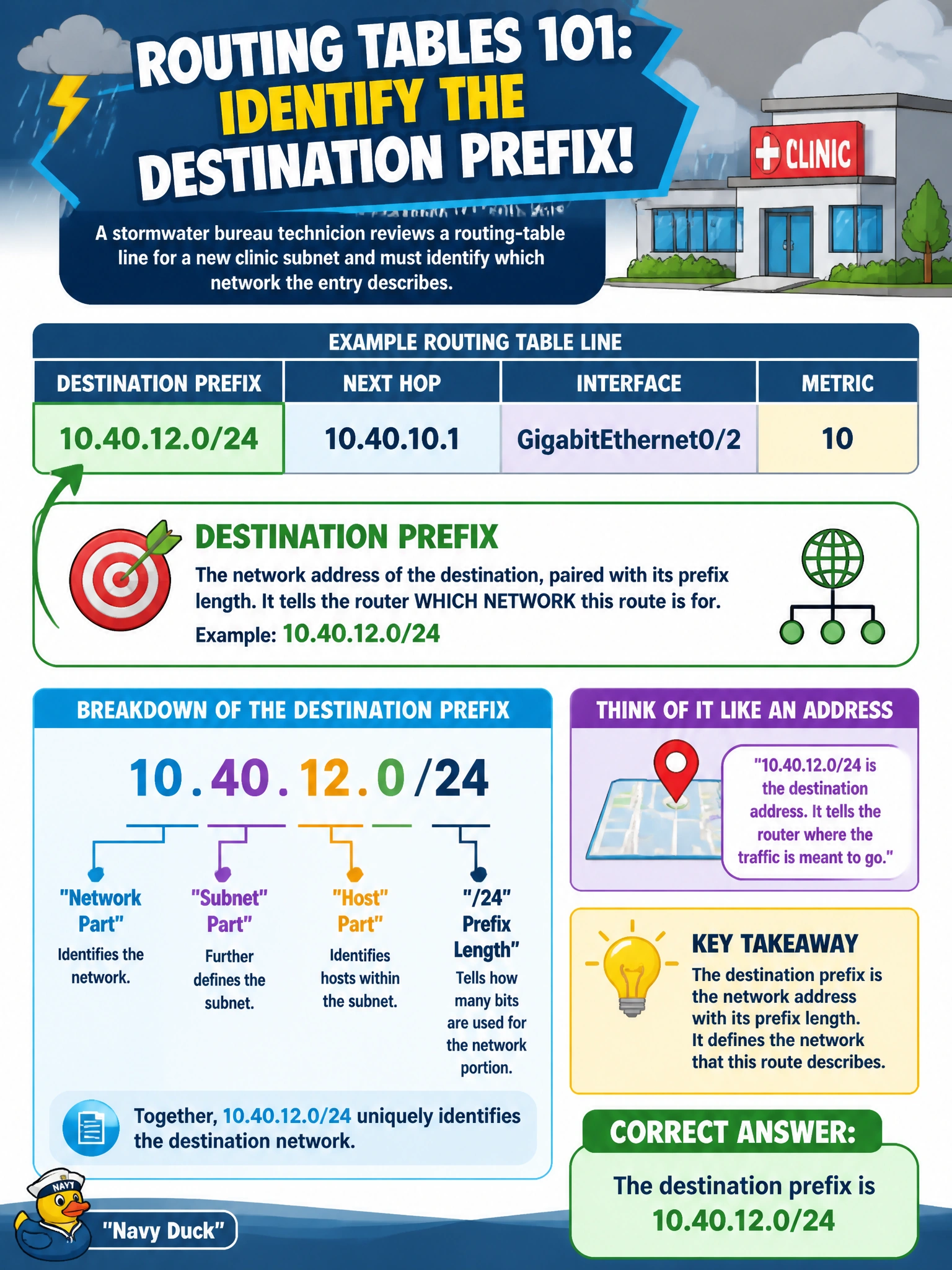
A stormwater bureau technician reviews a routing-table line for a new clinic subnet and must identify which network the entry describes. Which component is the destination prefix?
Select an answer to reveal the explanation.
Short Explanation
The prefix is the street address block the map entry is about—like 10.40.12.0/24. Next hop and interface say how you leave; AD is a trust score, not the destination itself.
Full Explanation
A stormwater bureau technician reading a routing-table line must identify the destination prefix as the network address shown with its prefix length—for example 10.40.12.0/24. That field answers which destinations the entry covers. In municipal edge tables, separating “what is this route about?” from “how do we leave?” prevents misreading next hops or interfaces as the destination itself when troubleshooting a new clinic subnet.
Treating only the next-hop IP after via as the destination fails because via names the neighboring router used for forwarding, not the covered network. Treating only the outbound interface name as the destination fails because the interface is an egress mechanism (especially for connected or interface-static styles), not the prefix being described. Treating only the administrative distance in brackets as the destination fails because AD is a preference/trust value among sources, not a network identity.
Exam caveat: some displays show mask in dotted decimal instead of slash notation; both forms identify the same prefix length, and host routes appear as /32. Operational check: for the clinic entry, read the leftmost network/mask (or prefix length), confirm it matches the intended clinic block, then separately note via and exit interface; do not confuse those forwarding fields with the destination prefix when validating the stormwater edge table.