
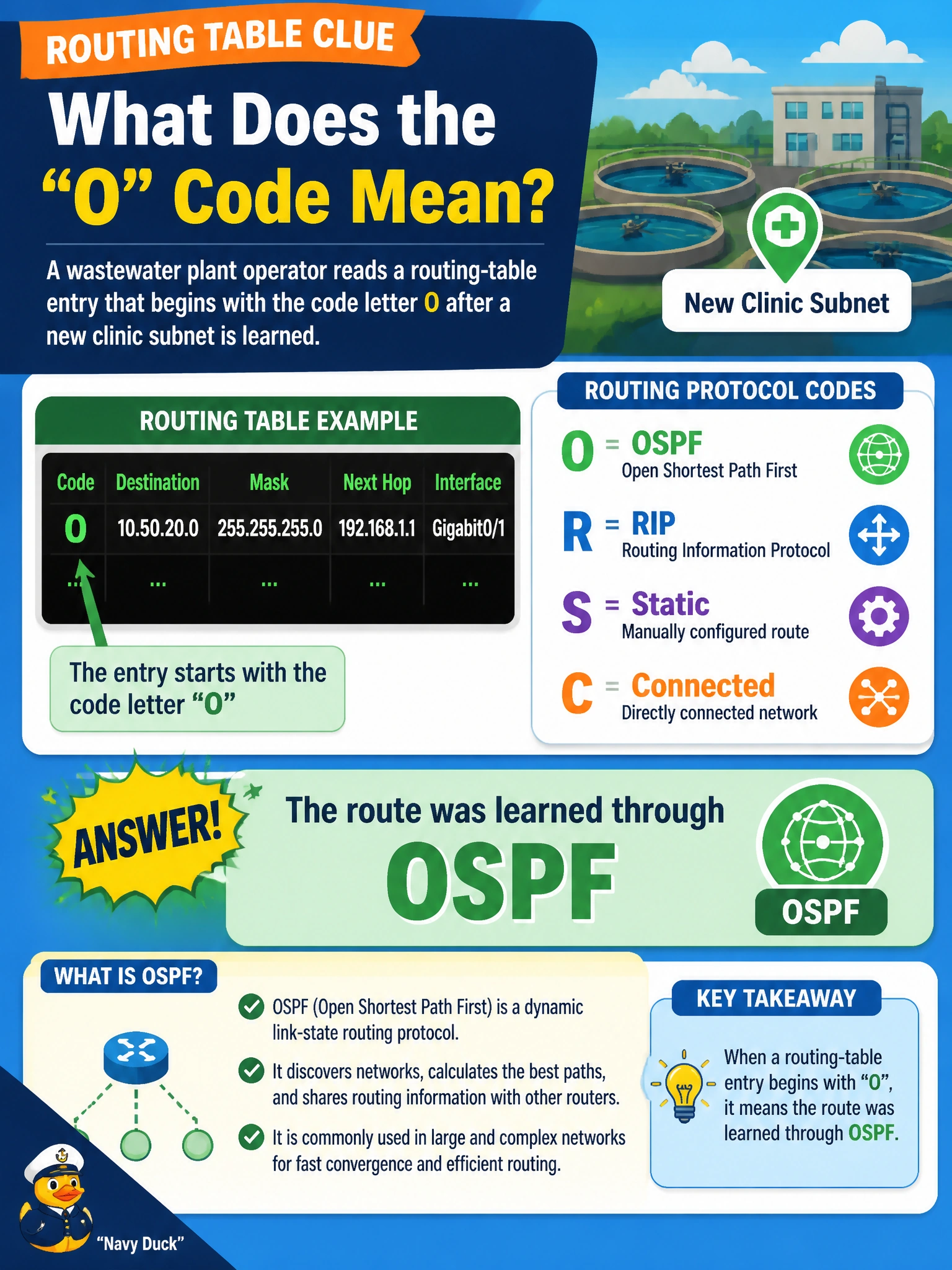
A wastewater plant operator reads a routing-table entry that begins with the code letter O after a new clinic subnet is learned. What does that routing protocol code indicate?
Select an answer to reveal the explanation.
Short Explanation
Those little letters at the front of each route are like badges on a delivery jacket. O means OSPF brought that route in. Connected, static, and BGP wear different badges.
Full Explanation
When a wastewater plant operator sees a routing-table entry whose code letter is O for a newly learned clinic subnet, that code indicates the route was learned through OSPF. Cisco IOS marks each RIB entry with a source code so operators can tell at a glance whether a municipal prefix arrived via a dynamic IGP, a static configuration, a connected interface, or another protocol. Recognizing O correctly ties the clinic subnet to OSPF advertisement and SPF installation rather than to manual or connected sources.
Interpreting O as “directly connected only” fails because connected networks use code C (and often appear with the interface as next hop without via). Treating O as a static route fails because statics use S. Treating O as BGP fails because BGP uses B (or other BGP-related codes depending on path type); BGP is not what O means on a typical CCNA edge table.
Exam caveat: OSPF may show additional detail such as O IA (inter-area) or O E1/E2 (external); the leading O still identifies OSPF as the source family, while the suffix describes OSPF route type. Operational check: show ip route for the clinic prefix, confirm the leading code is O (or O IA/E1/E2 as appropriate), verify an OSPF neighbor and LSA exist for that subnet, and document that the plant edge learned the clinic path via OSPF rather than a static.