
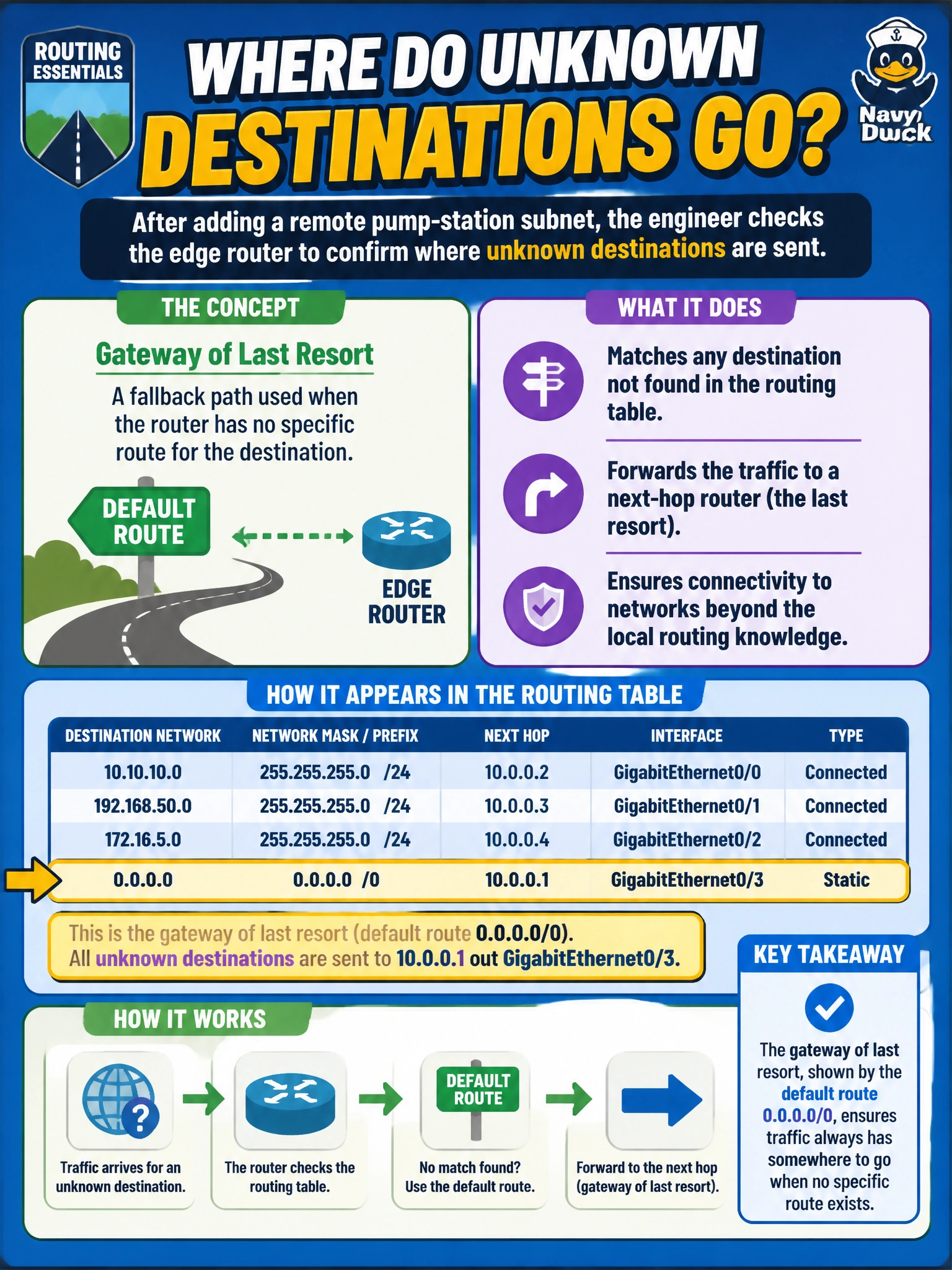
A sanitation department engineer checks the edge router after adding a remote pump-station subnet and needs to confirm where unknown destinations are sent. Which routing-table concept identifies that fallback path?
Select an answer to reveal the explanation.
Short Explanation
When the truck does not have a street listed, it still needs a default exit ramp. That exit ramp in the routing table is the gateway of last resort—usually 0.0.0.0/0. Process IDs, native VLANs, and EtherChannel hashes are different jobs.
Full Explanation
After a sanitation department engineer adds a remote pump-station subnet, confirming where unknown destinations go requires identifying the gateway of last resort. That concept is the routing-table fallback next hop used when no more-specific route matches—typically installed by a default route such as 0.0.0.0/0 toward an upstream ISP or core. For municipal edge routers, verifying the gateway of last resort is how operators prove Internet-bound or otherwise unmatched traffic still has an exit path.
The OSPF process ID fails as an answer because it only names the local OSPF instance and does not define a default forwarding target. Native VLAN on a trunk fails conceptually because it only affects how untagged Layer 2 frames are classified on a trunk; it is not an IP routing fallback. EtherChannel hash algorithms fail because they only distribute frames across bundled member links; they do not create a Layer 3 default route or gateway of last resort.
Exam caveat: a gateway of last resort can be learned dynamically (for example OSPF external default) or configured statically; presence of “Gateway of last resort is …” in show ip route confirms the active fallback regardless of how it was installed. Operational check: display the routing table, locate the gateway of last resort line and the matching 0.0.0.0/0 entry, ping an unused public address from the router (policy permitting), and confirm the next hop matches the intended ISP or core path after the pump-station change.