
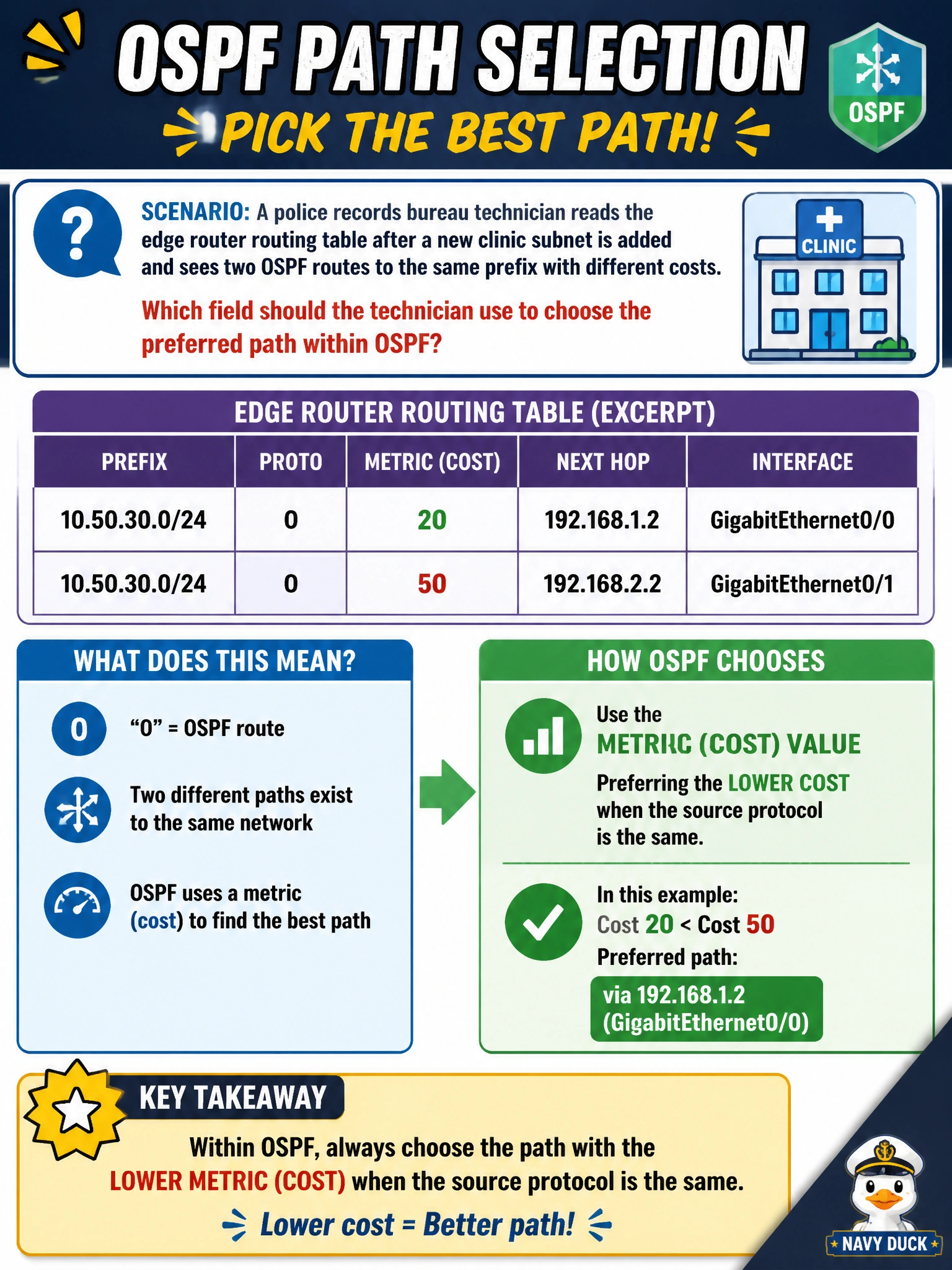
A police records bureau technician reads the edge router routing table after a new clinic subnet is added and sees two OSPF routes to the same prefix with different costs. Which field should the technician use to choose the preferred path within OSPF?
Select an answer to reveal the explanation.
Short Explanation
Think of two roads to the same clinic that both use the same map app—metric is the travel-time score. Inside OSPF, the lower cost wins. AD picks among different sources; it does not break a same-protocol tie.
Full Explanation
When a police records bureau edge router shows two OSPF routes to the same clinic prefix, path preference inside OSPF is decided by metric (cost), not by administrative distance. After the router has already accepted OSPF as the source for that prefix, it compares OSPF costs and installs the lower-cost path as preferred. That is the correct intra-protocol tie-break: same source protocol, same prefix, lower cost wins for forwarding toward the new clinic subnet.
Choosing administrative distance alone fails by concept because AD ranks different route sources (static vs OSPF vs EIGRP); it does not select among equal-source OSPF candidates. Preferring the MAC address of the next-hop interface fails because Layer 2 addressing does not decide Layer 3 route preference inside the IP routing table. Using VLAN ID on a LAN switch fails because VLAN tagging scopes Layer 2 broadcast domains; it does not choose which OSPF route the edge router installs for an IP prefix.
Exam caveat: equal OSPF costs can produce ECMP (multiple equal-cost paths) depending on platform configuration; “lower cost preferred” still governs unequal costs, while equal costs may load-share rather than pick a single winner. Operational check: on the edge router, show the routing table entry for the clinic prefix, confirm both candidates are OSPF (code O), compare the metric/cost values in brackets, and verify traffic uses the lower-cost next hop with a traceroute or show ip route detail after the clinic subnet is advertised.