
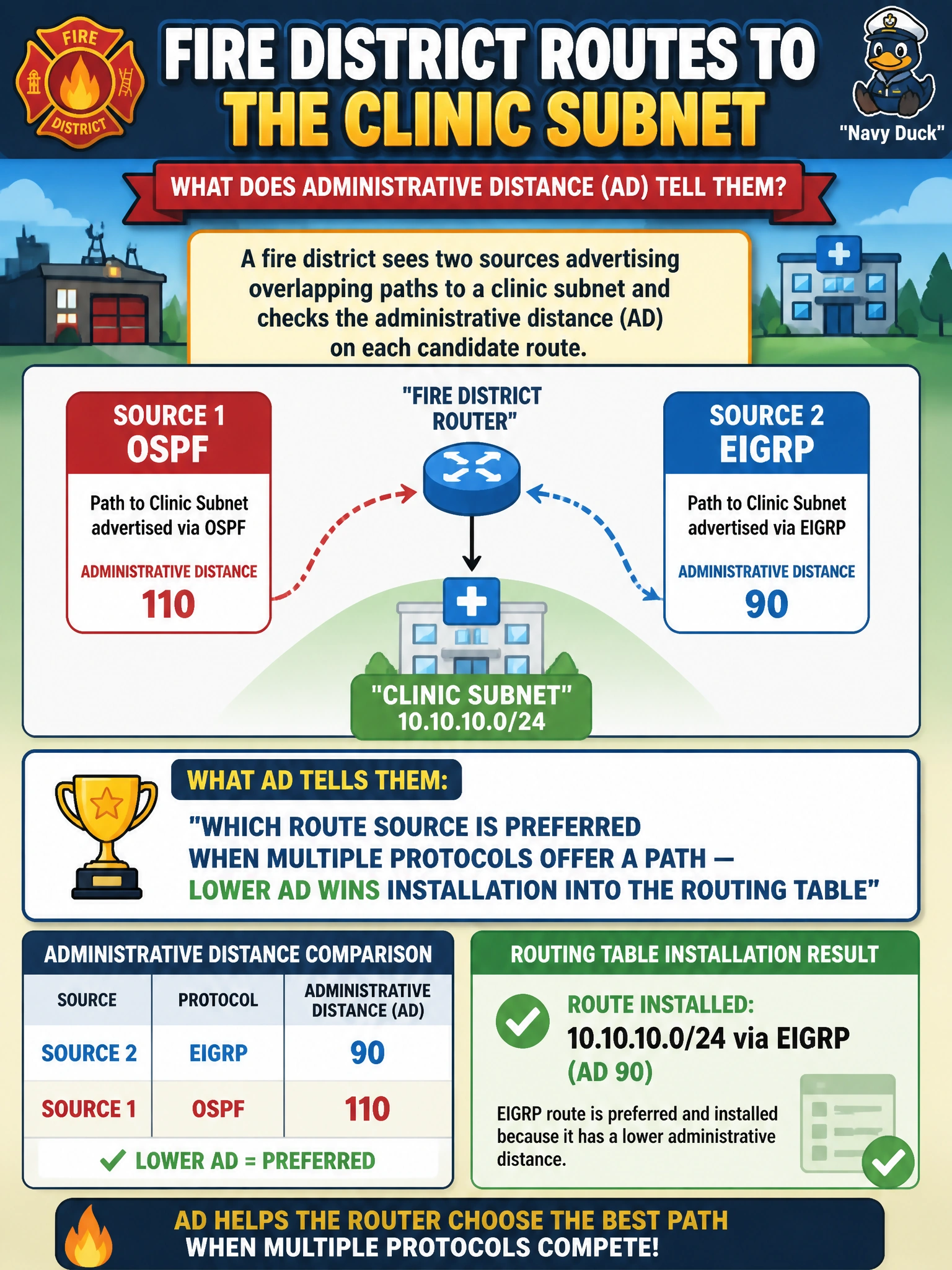
A fire district sees two sources advertising overlapping paths to a clinic subnet and checks the administrative distance on each candidate route. What does AD tell them?
Select an answer to reveal the explanation.
Short Explanation
Administrative distance is the trust score between route sources — static versus OSPF versus others. Lower AD gets the chair in the routing table when prefixes compete. It is not a power budget or a fiber light-meter reading.
Full Explanation
Administrative distance is the router’s trust ranking for route sources when multiple protocols (or static versus dynamic) offer a path to the same prefix. The fire district comparing overlapping advertisements uses AD to see which source is preferred for installation into the routing table—lower AD wins, all else equal for that selection step. Understanding AD prevents confusion when OSPF, static, or other sources compete for a clinic subnet.
AD is not fiber loss in dB on an uplink. It is not PoE watt reservation for atrium APs. It is not the native VLAN ID on trunks. Those are physical or Layer 2 concerns unrelated to preferring one routing source over another.
Exam caveat: AD selects among sources; metric selects among routes from the same source or protocol. A floating static route uses a deliberately higher AD so it installs only if the primary dynamic route disappears. Default ADs (for example connected, static, eBGP, EIGRP, OSPF, RIP) are exam favorites—know the relative order even if exact tables vary by platform documentation version.
Operational check: show ip route for the clinic prefix and identify the installed source; compare candidate AD values with show ip route detail or protocol databases; raise or lower a lab floating static AD and confirm which route installs when both are present.