
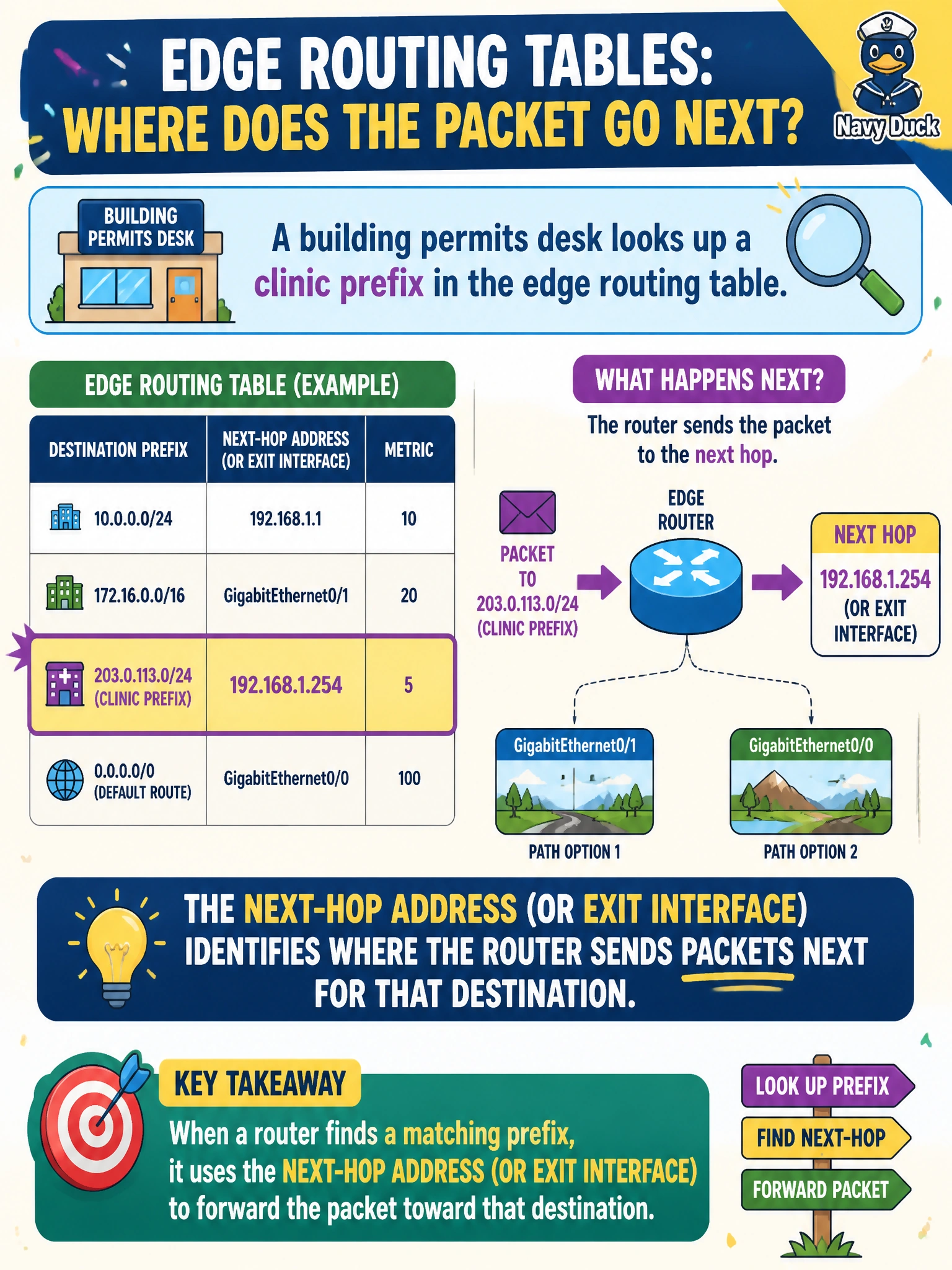
A building permits desk looks up a clinic prefix in the edge routing table. Which field identifies where the router sends packets next for that destination?
Select an answer to reveal the explanation.
Short Explanation
Next hop is the next mailbox in the relay — the IP (or exit interface) where this router hands off packets for that clinic prefix. DNS TTL and SSIDs live in other worlds; the routing entry's next hop is the forwarding handoff.
Full Explanation
A routing table entry’s next-hop field (next-hop IP address and/or outgoing interface) identifies where the router sends packets next for that destination prefix. When the building permits desk looks up a clinic prefix, that next hop is the forwarding instruction: hand the packet to this neighbor or out this interface toward the clinic path. Without a usable next hop or exit interface, the destination alone cannot forward traffic.
DNS TTL on the municipal website homepage is a name-resolution caching timer, not a route next hop. A wireless SSID on a nearby AP names a WLAN, not an IP forwarding adjacency. NTP stratum describes time-server hierarchy and does not forward clinic packets.
Exam caveat: recursive lookup may resolve a next-hop IP to an exit interface; directly connected routes may show only an exit interface. A next hop can be reachable yet still wrong if it points to an unintended firewall or VRF. Always validate both the next hop and that it is reachable in the correct table.
Operational check: show ip route for the clinic prefix, note next-hop or exit interface, confirm the next hop is reachable with ping or CEF adjacency, and traceroute to a clinic host to ensure the first hop matches the table.