
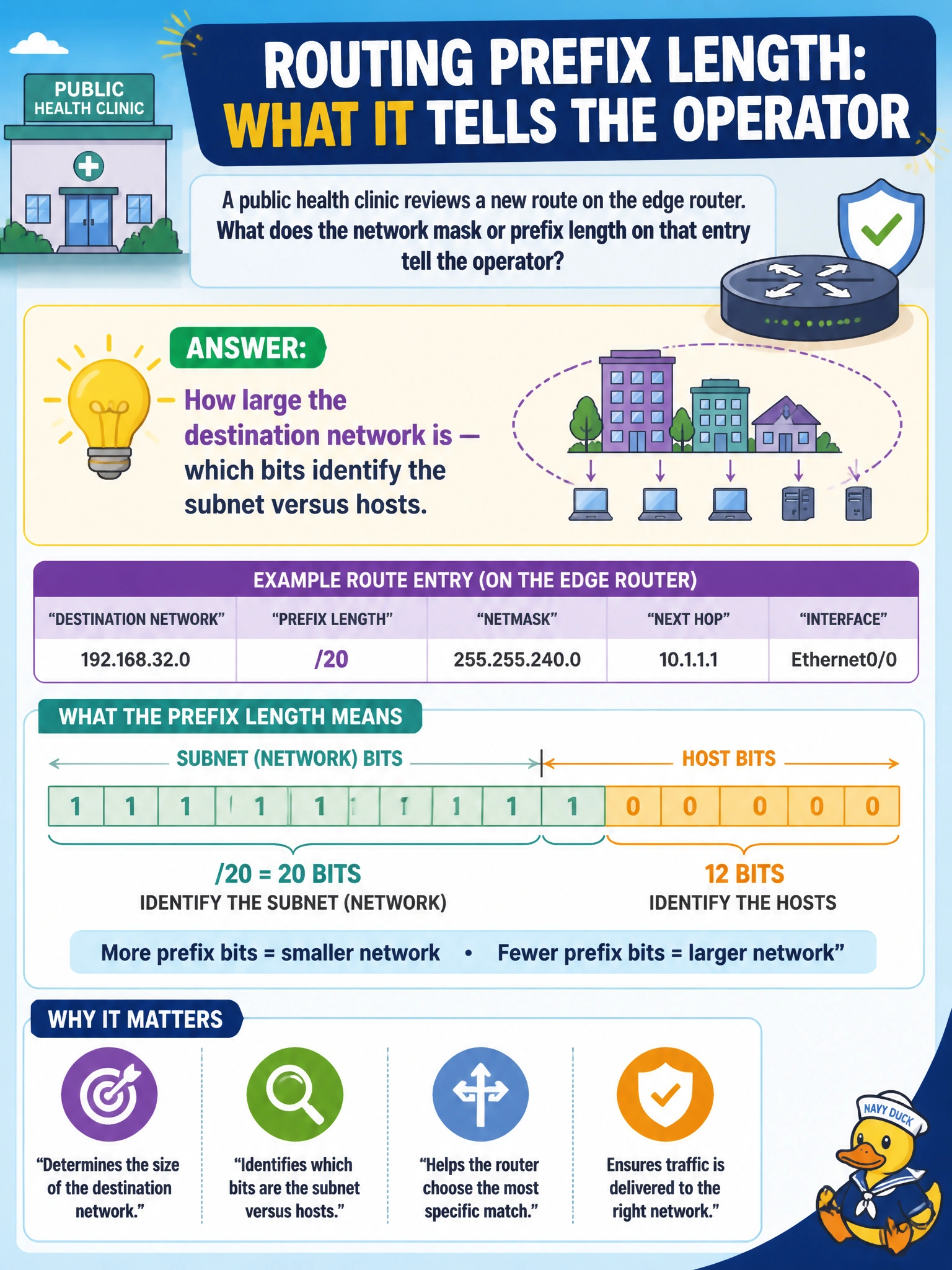
A public health clinic reviews a new route on the edge router. What does the network mask or prefix length on that entry tell the operator?
Select an answer to reveal the explanation.
Short Explanation
The mask is the fence line around the subnet — /24 is a bigger yard than /30. It tells public health how wide that destination network is, not how chatty syslog will be.
Full Explanation
The network mask or prefix length on a routing table entry tells the operator how large the destination network is—specifically which bits identify the subnet versus host portion. For a public health clinic reviewing a new edge route, /24 versus /30 (for example) changes how broadly packets match that destination and whether the route covers the entire clinic block or only a tiny link subnet.
Prefix length is not a syslog storage quota. It is not an OSPF process ID that must match every switch in the closet. It is not a WLC LAG member count required for the route to install. Those ideas borrow unrelated operational numbers and attach them to the wrong field.
Exam caveat: longest-prefix match means a more specific mask wins over a shorter one when multiple destinations overlap. Misreading /16 as /24 (or vice versa) causes wrong conclusions about coverage and blackholes. Connected routes inherit the interface mask; static and dynamic routes carry the mask as advertised or configured.
Operational check: compare the clinic design document’s subnet size to the mask on show ip route; if the installed prefix is broader or narrower than intended, correct the static statement or OSPF advertisement before cutting over traffic.