
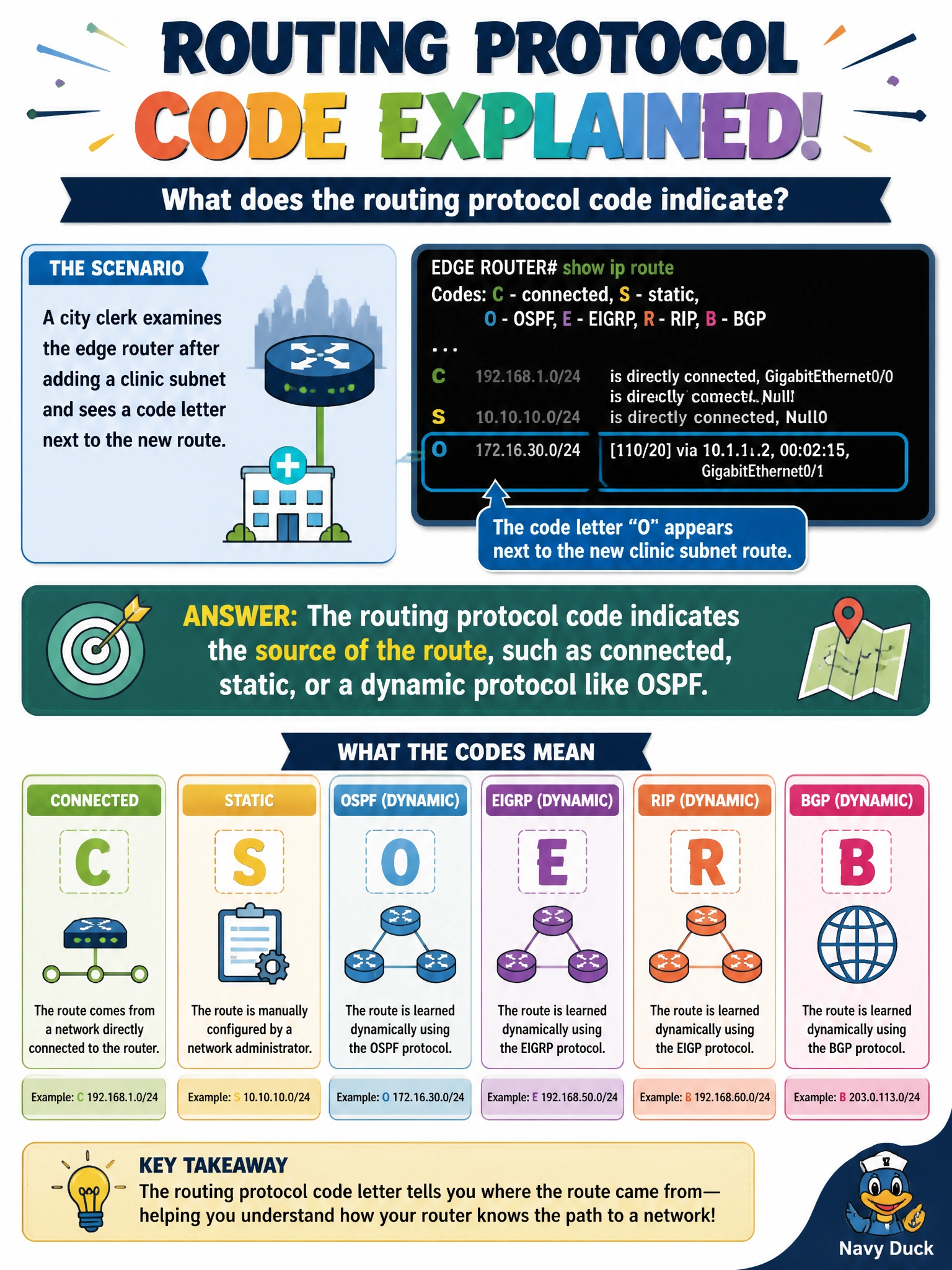
A city clerk examines the edge router after adding a clinic subnet and sees a code letter next to the new route. What does that routing protocol code indicate?
Select an answer to reveal the explanation.
Short Explanation
That little letter beside a route is the route's birth certificate — C for connected, S for static, O for OSPF, and so on. It tells the clerk where the route learned its manners, not how long the cable is.
Full Explanation
In a Cisco routing table, the code letter beside a prefix identifies how the route was learned—the route source. Examples include connected, static, and dynamic protocols such as OSPF. When a city clerk adds a clinic subnet and sees that code, the letter answers “where did this route come from?” which is essential before trusting or troubleshooting the path.
The code is not cable length from a desk to the MDF. It is not CPU temperature of the route processor. It is not a Layer 2 EtherChannel identifier used for wireless LAG. Those distractors mix physical, hardware-health, and switching concepts into a Layer 3 table field that encodes protocol origin.
Exam caveat: memorize common codes (C, S, O, D, R, B, and others as taught) and remember that the code is about source, while administrative distance and metric are separate selection criteria. A route can be present from one source even when another source exists with a worse AD.
Operational check: run show ip route for the clinic prefix, read the code letter, and correlate it with the expected origin (for example S after a static add, O after OSPF advertisement); if the code is unexpected, investigate redistribution or competing sources next.