
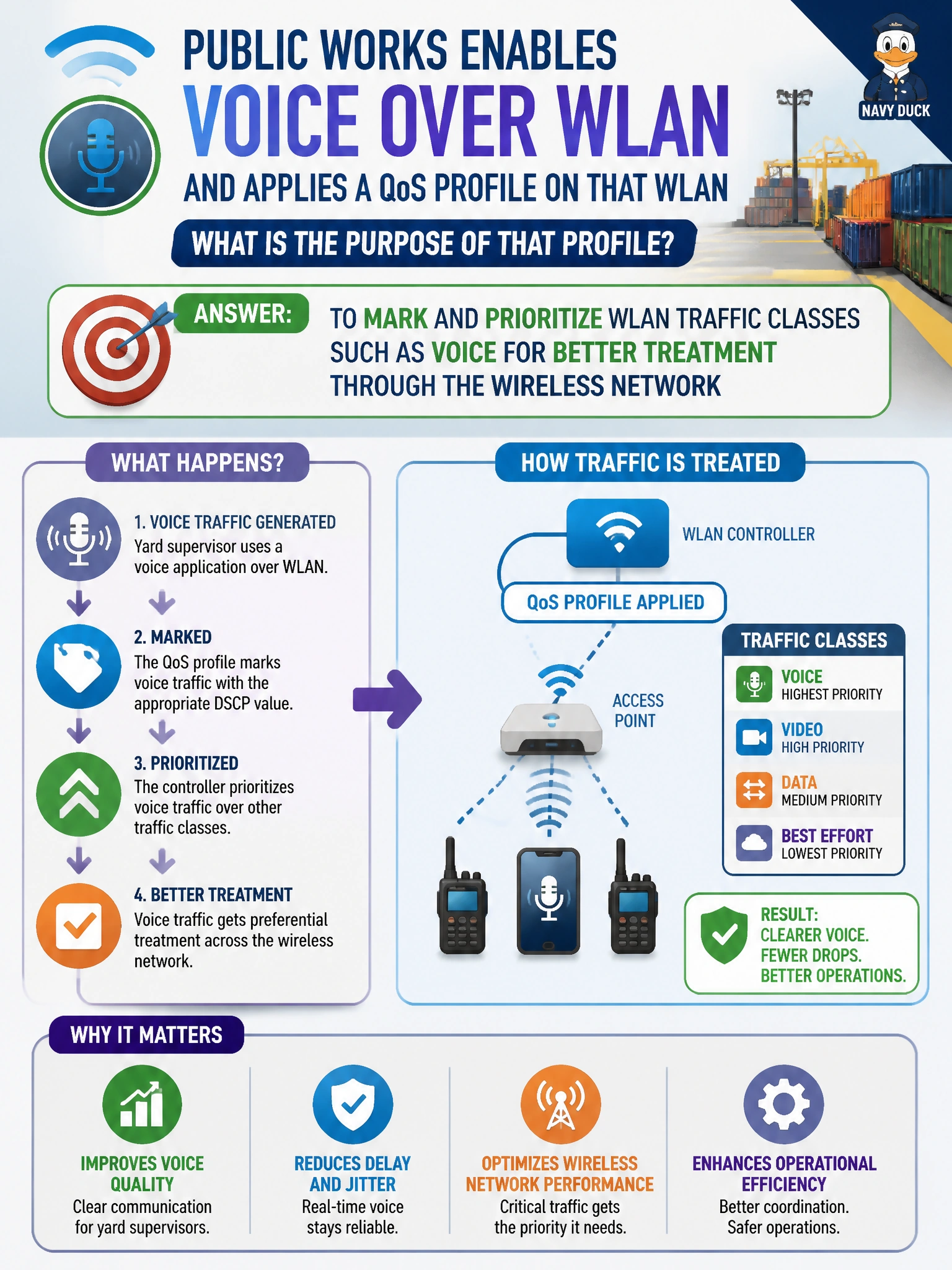
Public works enables voice over WLAN for yard supervisors and applies a QoS profile on that WLAN in the controller GUI. What is the purpose of that profile?
Select an answer to reveal the explanation.
Short Explanation
Voice over Wi-Fi hates sitting behind bulk file downloads. A QoS profile on the WLAN is the express lane sticker — it marks and prioritizes voice so supervisor calls stay clearer. It does not unplug PoE or erase the SSID at sunset.
Full Explanation
A QoS profile applied to a voice-capable WLAN on the controller GUI exists to classify, mark, and prioritize latency-sensitive traffic such as voice so it receives better treatment across the wireless network relative to bulk data. For public-works yard supervisors using voice over WLAN, that profile aligns wireless queuing and marking behavior with the voice application’s needs instead of treating all SSIDs as equal best-effort traffic.
QoS profiles do not delete SSIDs on an evening schedule. They do not replace RADIUS with CDP for voice signaling—CDP is a neighbor discovery protocol, not a voice AAA substitute. They also do not convert an AP from PoE to AC power based on DSCP bits; power sourcing is independent of QoS marking.
Exam caveat: wireless QoS must be consistent with wired QoS trust and queuing downstream; marking at the WLAN without campus QoS support yields limited benefit. Also remember admission control and compatible handset/WLAN features matter for voice quality beyond a single GUI dropdown.
Operational check: place a voice call on the supervisors’ WLAN, confirm the WLAN QoS profile is applied, and verify markings/queues (controller/AP and upstream switch) show voice treated preferentially versus a bulk file transfer on the same airtime.