
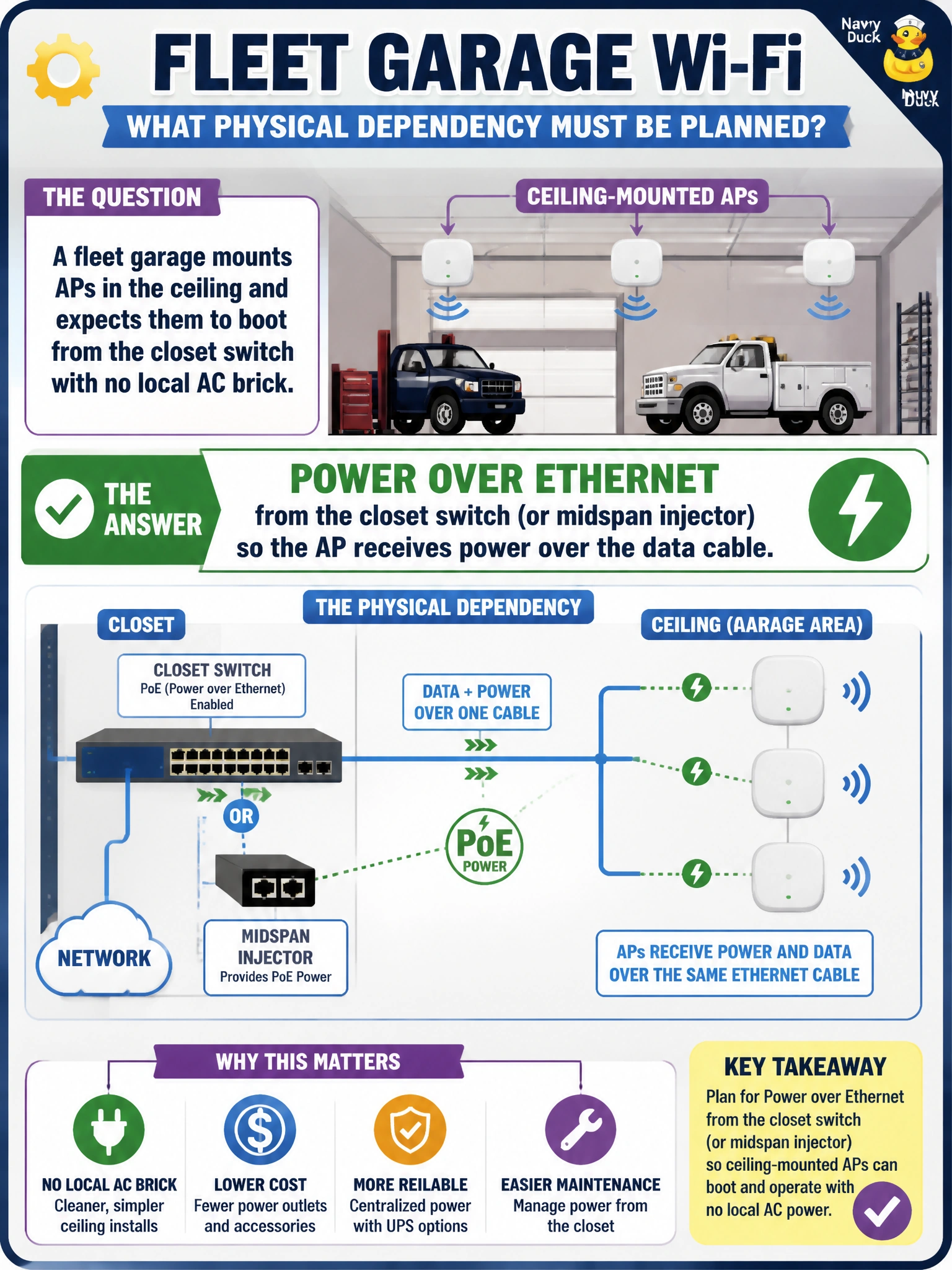
A fleet garage mounts APs in the ceiling and expects them to boot from the closet switch with no local AC brick. What physical dependency must be planned?
Select an answer to reveal the explanation.
Short Explanation
Ceiling APs are like holiday lights on a long extension — they need power delivered over the Ethernet run. Plan PoE (or a midspan injector) from the closet switch so the AP boots without a wall wart in the rafters.
Full Explanation
Ceiling-mounted fleet-garage APs that boot from the closet switch without a local AC adapter depend on Power over Ethernet. The access switch (or a midspan PoE injector) must supply power over the same copper drop that carries data so the AP can power radios, boot, and join the network. Planning PoE budget, cable length, and port PoE enablement is therefore a physical prerequisite, not an optional extra.
Leaving a USB console cable permanently attached does not power the AP for normal operation; console is for out-of-band CLI. A TFTP server moves files—it does not supply voltage to the AP. Disabling PoE so the AP supposedly draws power from the wireless radio is physically nonsensical; radios consume power, they do not feed the AP’s power input.
Exam caveat: different APs need different PoE classes (including higher draws for Wi-Fi 6/6E radios and USB accessories). Undersized PoE can cause boots, radio disablement, or flapping that looks like a CAPWAP or switchbug problem. Also distinguish PoE from PoE+ / UPOE capability on the switch.
Operational check: before mounting, confirm the closet switch port shows PoE delivered and sufficient wattage for the AP model; after mount, verify the AP boots, obtains an address, and joins the WLC without any local power brick.